
Installation And Wiring Methods For JL-411 Photocell Used With Solar Panels
Introduce
Solar lighting systems look simple from the outside. But inside, the wiring must be set up the right way. That is why the JL-411 matters. It is a low-voltage photocell sensor for automatic DC lighting control. Long-Join rates it for 12V and 24V DC lighting.
When used with a solar panel system, this device does not replace the solar charge controller. It acts as the light switch on the load side.

What The JL-411 Photocell Is And Why It Fits Solar Lighting
The JL-411 is a low-voltage photocell for DC lighting systems. Long-Join describes the JL-411 series as applicable for controlling DC-rated lighting automatically according to the ambient light level, and its related comparison pages say the series is built for 12VDC and 24VDC systems.
It needs a reliable photocell switch. The switch senses daylight. It keeps the load off during the day. This helps because a solar street light does not need a complex switch to tell when day becomes night. Long-Join’s overview of low-voltage photocells also says the JL-411 and JL-411R are aimed at basic jobs that need something reliable.
Where To Install The JL-411 In A Solar Lighting Setup
The sensor should be installed where it can clearly “see” the real outdoor light. If the photosensitive part is blocked by a panel frame, pole arm, housing edge, tree branch, or wall, it may read the light level badly and switch the lamp at the wrong time. Long-Join’s installation guidance for photocontrol sensors says proper exposure to ambient light is important for stable dusk-to-dawn operation.
In easy terms, do not hide the sensor. Put it in an open spot where daylight reaches it naturally, but avoid places where the lamp’s own light shines directly back into the sensor. That kind of self-light can confuse the unit and cause cycling.
For solar fixtures with compact housings, this often means placing the JL-411 on the outer body or in a small exposed section away from glare and shadow. Long-Join’s JL-411R listing also notes that the R version provides a separated sensor assembly, which is helpful when the best sensing position is different from the main body position.
Best Installation Position For JL-411
Installation Point | Good Practice | Why It Matters |
Light exposure | Place in open natural light | Helps the sensor detect day and night correctly |
Obstructions | Keep away from shade by panel, pole, or housing | Prevents false switching |
Lamp glare | Do not let the fixture shine back into the sensor | Reduces cycling or unstable control |
Service access | Mount where technicians can inspect it easily | Makes maintenance simpler |
How To Wire The JL-411 In A Solar Panel System
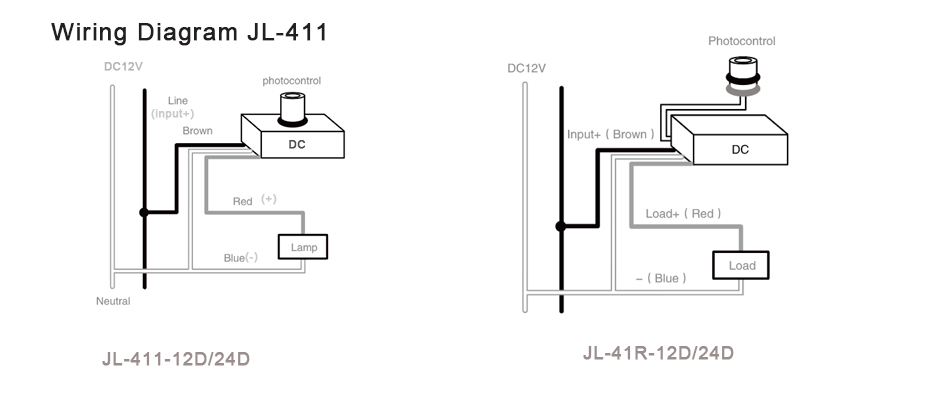
What matters most is this: the JL-411 should go on the load side, not between the solar panel and the controller. In a basic DC solar system, the solar panel sends power to the controller. The controller then charges the battery. The battery powers the light.
The JL-411 is wired into the lamp circuit. This lets it switch the lamp on or off based on the ambient light. That matches the product’s purpose as a DC lighting control device, rather than a charging regulator.
A simple system path looks like this: solar panel to controller, controller to battery, battery to JL-411, then JL-411 to the lamp load. In that position, the photocell switch acts like an automatic gate. During the day, it keeps the lamp circuit open. At night, it closes the circuit so the battery can feed the light. This is the easiest way to understand its job in a solar street lighting system.

Simple Connection Path
System Part | Main Job |
Solar Panel | Produces DC power from sunlight |
MPPT / Charge Controller | Manages charging and protects battery |
Battery | Stores energy for night use |
JL-411 Photocell | Switches lamp load by light level |
Lamp Load | Uses stored power at night |
How The JL-411 Works With An MPPT Controller
These two parts work together. But they do different jobs. An MPPT controller controls the power from the solar panel. It helps the battery charge better and waste less energy. The U.S. Department of Energy says a controller directs power from the source to the battery and the load. NREL also says a charge controller manages the flow of electricity from solar panels to the battery and the load.
The JL-411 does not control panel voltage, current tracking, or charging strategy. Its role is much simpler. It watches the outdoor light and switches the lamp load on or off. So the MPPT controller protects charging performance, while the JL-411 handles lighting control. That division of work is useful because it reduces unnecessary daytime load use and helps protect the battery from wasteful discharge.
Problems Caused By Wrong JL-411 Installation Or Wiring
The first common problem is wrong placement. If the sensor stays in shade all day, it may think evening has come. At night, it may catch light from the lamp itself. When that happens, it can switch the load on and off again and again.
These are small mistakes, but they create big headaches in field use. Long-Join’s installation advice for photocontrols stresses proper sensor orientation and stable ambient light exposure for reliable performance.
The second common problem is wrong wiring position. If someone tries to use the JL-411 as if it were the charging controller, the system will not behave correctly. This device is for controlling the load circuit, not for replacing the solar charging function. In plain language, it is a photo control switch, not the brain of the solar charging path.
Common Problems And Easy Fixes
Problem | Likely Cause | Easy Fix |
Lamp stays on in daytime | Sensor blocked or mounted in shade | Move sensor to open light |
Lamp flickers at night | Lamp light hits sensor | Reposition sensor away from glare |
Battery drains too fast | Load not switching correctly | Check load-side wiring |
Charging acts strangely | JL-411 placed in wrong circuit role | Keep controller in charge path, JL-411 in load path |
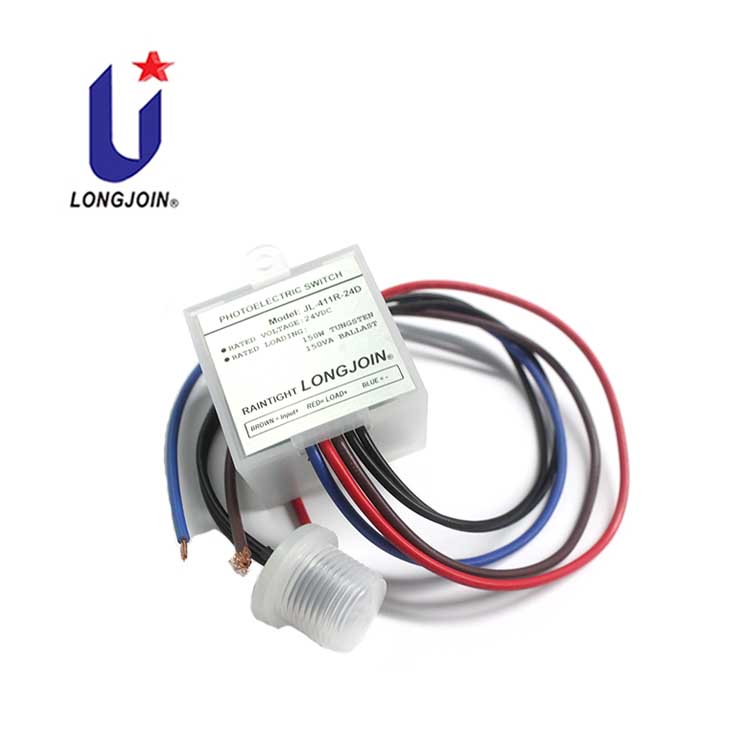
The Best Way To Explain The Full JL-411 Solar Wiring Method
A clear way to say it is this: the solar panel sends power to the controller. The controller then charges the battery. The JL-411 sits between the battery output and the streetlight load. It works as an automatic photocell switch for the streetlight. Its sensor head must stay open to natural light. This helps it tell day from night and turn the lamp on only when needed.
Conclusion
The JL-411 is best understood as a low-voltage load switch for solar lighting systems. Install it where it can read natural light clearly, and wire it on the load side after the battery and controller path. Let the MPPT controller handle charging. Let the JL-411 switch the lamp on and off.
This simple split makes the system easier to understand. It is also easier to wire and trust.
External Links:
- https://www.energy.gov/energysaver/balance-system-equipment-required-renewable-energy-systems
- https://unboundsolar.com/solar-information/mppt-article?srsltid=AfmBOoqNHwgYf_462r8Op5YlbHRTr4XYk7mOMok_VZfwxQ3_dq9V62-p
- https://www.morningstarcorp.com/faq/how-does-solar-charge-controller-work/
 English
  Russian
  Spanish
  Portuguese
  Arabic
  Japanese
  Italian