
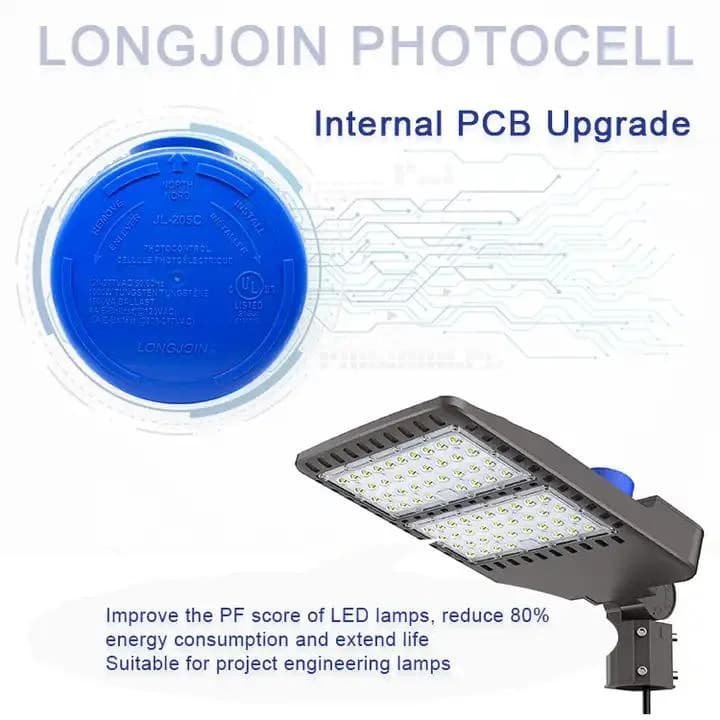
Does CDS Photocell Experience Setpoint Drift Due To Temperature Changes?
Introduce
A CDS photocell switches a lamp perfectly in one season. Then in another it seems early.
CDS means cadmium sulfide. A light-dependent resistor. Light changes its resistance, and so does temperature.
The circuit reads that resistance to decide when to switch, so temperature can shift the effective setpoint. Long-Join says the same: CdS cells simple and useful, but temperature affects their resistance.
What Does Setpoint Drift Mean?
Two similar street lights come on a few minutes apart under the same sky. Odd. Setpoint drift is one reason.
The setpoint is the light level where the photocell changes state.
Temperature | Possible CDS Effect | Lamp Behavior |
Rises | Resistance may drop in some designs | Later turn-on or earlier turn-off |
Falls | Resistance may rise | Earlier turn-on or later turn-off |
Near test temperature | Smaller change | More stable switching |
Common patterns. Not a rule for every CdS part. Direction and size of drift depend on the element and the control circuit.
Why Does Temperature Touch A CDS Element At All?
More light, lower resistance. Darkness, higher resistance. That’s what makes CdS handy for automatic outdoor lighting.
Temperature adds a second influence. The material inside doesn’t behave the same at every temperature. Resistance moves while the light level barely changes, and a basic circuit reads that movement as part of the light signal. It can’t tell the difference.
Long-Join’s JL-401C is a good CdS example. Published specs: CdS sensor, 10–20 lux turn-on, 25–35 lux turn-off, ambient range from -40°C to +70°C. Full details sit on the JL-401C/JL-401CR product page.
What Does Drift Look Like On A Real Street?
Usually a timing problem. Not a total failure. Lamp still works, but its switching time doesn’t match the lights next to it.
Problem | What You Notice | Likely Cause |
Delayed morning turn-off | Lamp stays on after sunrise | Cold sensor near OFF threshold |
Early lighting on cloudy days | Comes on before it looks dark | Low light and temperature act together |
Seasonal difference | Summer and winter timing changes | Sensor temperature shifts by season |
Hot-area instability | More trouble in hot periods | Fixture heat affects sensing point |
On/off cycling | Lamp switches several times | Light sits close to setpoint |
Mornings show it best. Daylight rising, but the sensor’s still cold from the night. Its reading has drifted toward the “dark” side, so the lamp hangs on a bit longer before daylight pushes it past the OFF point.
Cloudy weather does something similar. Photocell’s already near its switching point. A cloud drops the light, temperature nudges it a little more, and the lamp crosses the line.
Temperature isn’t the only cause of shaky switching though. Long-Join’s R-Filtered vs IR Sensors guide explains that unwanted light, LED spectral behavior, and sensor response can also trigger false switching and repeated cycling. Check that before blaming heat for everything.
Why Are Hot Areas Worse?
A street-light sensor can sit in direct sun for hours on top of a hot fixture. The temperature right there runs higher than the air temperature in any weather report.
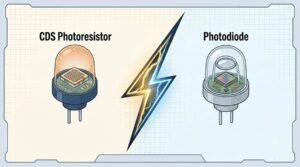
Hot parts of Africa, the Middle East, Southeast Asia. Strong sun, hot days, cooler nights, dust, haze, reflected light. All of it makes stable sensing harder. Long-Join points out that temperature shifts CdS resistance, which is one reason photodiode designs get considered for hotter environments.
Buyers, the rule’s simple. Check the full operating-temperature range and the sensing technology. Don’t pick a street light photocell on voltage or price alone.
Long-Join digs deeper into this in “Why Do High-Temperature Countries Choose Photodiode Photocells Instead Of CDS Photocells?“
How Do You Reduce Drift?
Can’t stop outdoor temperatures from changing. Can make the control less sensitive to them.
Fix | How It Helps | Best Use |
Temperature-rated sensing element | Better stability in heat and cold | Harsh outdoor sites |
Compensation circuit | Offsets part of the temperature change | Tighter switching needs |
Wider ON/OFF gap | Cuts repeated switching | Dusk and dawn control |
Time delay | Ignores clouds or headlights | Roads, parking areas |
Photodiode sensing | More precise electronic control | Hot climates |
Time delay helps too. A short shadow, a passing car’s lights, a brief cloud shouldn’t flip a street lamp instantly. Long-Join builds time-delay functions into several outdoor controls for exactly this.
Long-Join’s electronic controller range offers both CdS and photodiode options, so the sensing method can match the site. See the Direct Electronic Wire-In Controllers range.
FAQs
A change in the light level where the controller turns the lamp on or off. Temperature, component tolerance, aging, and circuit design can all cause it.
Changes CdS resistance. The controller reaches its ON or OFF point earlier or later.
Direct sun and fixture heat push the sensor away from its normal test condition. Dust, reflections, and shifting light pile on.
Light level's already close to the setpoint. Small shifts in light or temperature push the reading across the line more than once.
Temperature-rated parts, compensation, a wider ON/OFF gap, time delay, or a more stable sensing method when needed.
Conclusion
Does drift make CDS a bad choice? No. CDS photocells work well in plenty of outdoor lighting jobs. The trick is knowing their limits.
Temperature can change CdS resistance and shift the switching point. Good calibration, hysteresis, time delay, compensation, and the right sensor choice cut the problem down. In very hot or demanding projects, another sensing method may fit better.
For engineers and buyers, the better question isn’t “does this photocell work?” It’s “will it switch consistently in this site’s real temperature, light, and weather?”c
External Link:
●https://www.adafruit.com/product/161?srsltid=AU7gw4WCCm7VSD19ZNLhGmUBpeAonfGnTBA6BmNtswSN3IABZjosx-J3
●https://en.wikipedia.org/wiki/Cadmium_sulfide
●https://en.wikipedia.org/wiki/Photoresistor
 English
  Russian
  Spanish
  Portuguese
  Arabic
  Japanese
  Italian