
Can IP Ratings Truly Reflect Salt Spray Environment Performance?
Introduce
IP ratings are the first thing most buyers check when specifying outdoor photocontrols for coastal and port installations. They are easy to compare, widely understood, and appear on every product datasheet.
The problem is that IP ratings were not designed to measure salt spray performance. They measure dust and water ingress.
In a coastal salt spray environment, corrosion is the primary threat, and IP testing says nothing about it.
What Is an IP Rating?
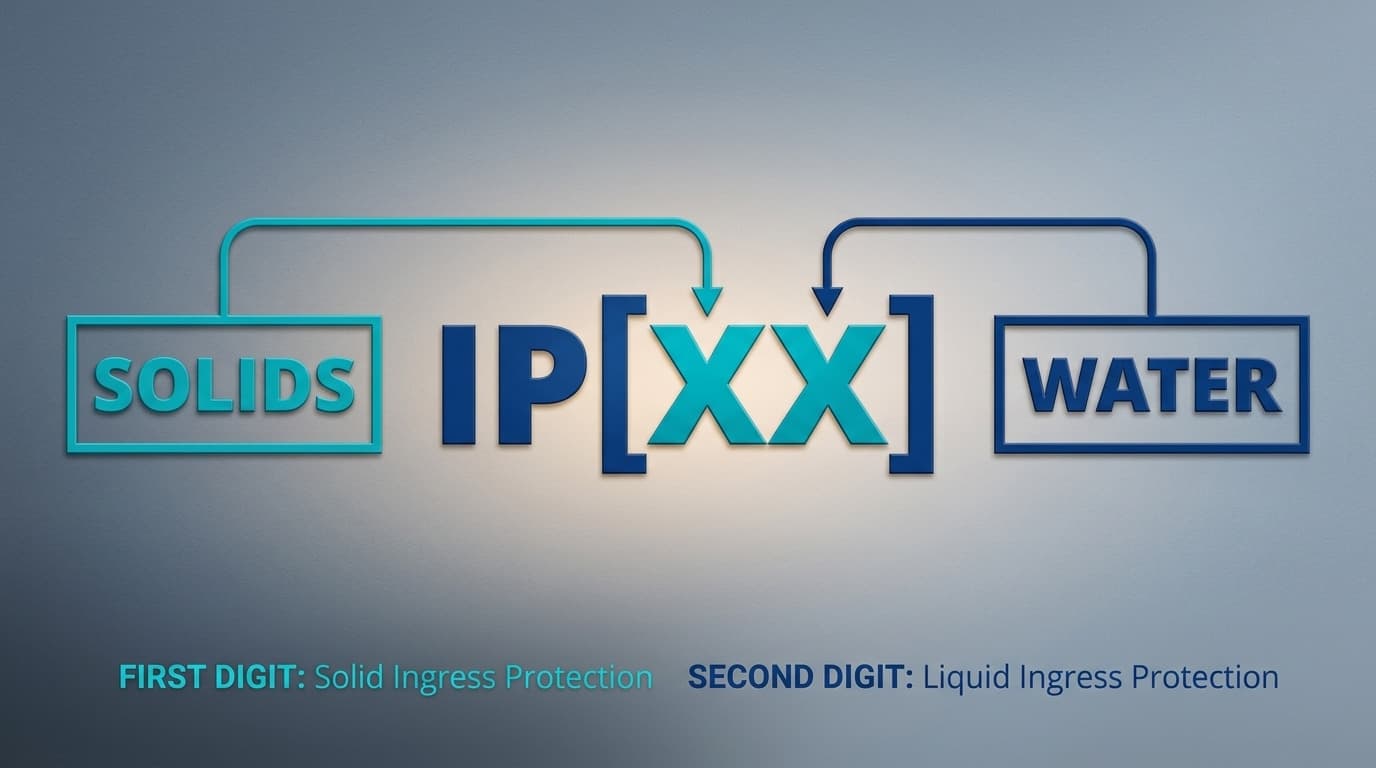
IP (Ingress Protection) ratings defined by IEC standards indicate a product’s resistance to dust and water ingress.
The two digits in an IP rating each cover a specific test:
IP Rating | Tested Item | Description |
IPX5/IPX6 | Water spray test | Tests against varying intensities of sprayed water |
IPX7/IPX8 | Immersion test | Tests resistance to water immersion at a certain depth |
IP5X/IP6X | Dust test | Prevents full or partial dust ingress |
IP tests do not assess for saltwater corrosion, chemical corrosion, sea breeze impact, or the humid conditions commonly found in port areas.
What Does Salt Spray Entail?
Unlike water ingress, salt spray corrosion is chemical corrosion. Chemical corrosion is assessed through entirely separate testing standards that IP ratings do not cover.
Salt spray corrosion testing is governed by ASTM B117 and IEC 60068-2-11. UL1598 specifies salt spray requirements with 500 to 1000-hour test cycles for North American street lighting components. These standards assess how materials degrade under sustained exposure to salt-laden mist, a process of electrochemical corrosion that is fundamentally different from the physical water sealing that IP testing evaluates.
An IP65 or IP67 product looks to guarantee that water cannot physically enter the housing under specific test conditions. This guarantee does not include the accumulation of salt deposits on the surfaces of housing material, gaskets, metal fasteners, and circuit boards over months and years.
Why Can IP66 or IP67 Products Still Fail in Salt Spray Environments?

IP66 demonstrates protection against powerful water jets. It does not guarantee salt-related protection such as spray corrosion resistance, condensation ingress prevention, or resistance to embrittlement from salt exposure.
A product can pass IP66 testing and still fail rapidly in a coastal environment because salt deposits left by evaporated sea spray are hygroscopic, which means that they absorb moisture from the air and concentrate it at the surface of housing materials, gaskets, and metal components. This creates a sustained corrosive environment that exists even when the product is not directly exposed to moisture.
IP water spray tests apply clean water for a defined duration and then stop. The coastal salt environment applies corrosive loading continuously.
Gasket materials that pass IP water ingress testing can still be attacked by salt chemistry. An EPDM or silicone gasket that holds a perfect seal against clean water may degrade faster in sustained salt spray exposure depending on the material formulation and the absence of UV stabilisers.
Metal fasteners that hold the housing together, connect the twist-lock pins, and secure the receptacle base are all vulnerable to galvanic and electrochemical corrosion in salt environments. IP testing does not assess fastener corrosion.
What Actually Protects Against Salt Spray?
Salt spray resistance is determined by materials, gasket quality, coating selection, and circuit board protection.
Salt Spray Resistant Materials and Components | Description |
Glass fibre reinforced base (GF) | High-temperature resistant and superior to common plastic in salt spray corrosion resistance |
EPDM/Silicone gaskets | Stable, UV-resistant, tightly sealed to prevent salt intrusion |
UV-stabilised PC or PBT | Maintains long-lasting durability under UV exposure |
Stainless steel metal parts (304/316) | Corrosion-resistant steel naturally resists salt corrosion |
PCB conformal coating | Protects printed circuit boards from moisture and salt corrosion |
Corrosion-resistant fasteners | Prevents loosening or breakage due to corrosion |
Salt spray resistant coatings | Surface protection prolongs overall product lifespanc |
IP ratings cannot substitute for the comprehensive protection conferred by proper materials, design, and salt spray testing.
Why Is Condensation More Critical Than Ingress in Salt Spray Environments?
In coastal areas, condensation forms overnight as temperatures drop, and evaporates during the day, leaving concentrated salt deposits that accelerate corrosion at vulnerable regions.
IP testing applies water from outside. Condensation forms inside sealed enclosures when warm humid air cools against the cold walls of a sealed housing. The salt it carries comes from the coastal atmosphere that entered during the day through any gap too small to register as an IP failure. IP tests do not include condensation cycle evaluations and cannot capture this real-world failure mechanism.
The combination of salt deposit accumulation, thermal cycling, and condensation cycling is what ages coastal photocell housings. It is not a single water jet event.c

What Are the Procurement Recommendations?
Here are some procurement tips for coastal areas:
- Request salt spray resistance test reports such as ASTM B117 alongside IP rating documentation.
- Prioritise products using glass-fibre reinforced bases, stainless steel or corrosion-resistant metal parts, EPDM or silicone gaskets, UV-stabilised housing materials, and PCB conformal coating.
- Look for comprehensive test data on condensation cycling, UV protection, and mechanical durability.
- Discuss maintenance and replacement cycles with suppliers to understand the real total cost of ownership in coastal installations.
Long-Join’s photocontrol product range includes all these material specifications and more for those interested in procurement
Frequently Asked Questions on IP Ratings and Salt Spray Performance
IP ratings cover physical ingress of dust and water only. The first digit rates dust protection and the second rates water resistance at defined test intensities.
IP testing uses clean water applied for defined durations. Salt spray testing applies salt-laden mist continuously over 500 to 1000 hours to assess the electrochemical corrosion of materials rather than physical water ingress.
IP66 confirms protection against powerful water jets. It does not test salt corrosion resistance, condensation cycle performance, gasket material stability under sustained salt exposure, or fastener corrosion resistance.
For resistance to salt spray corrosion, here are some recommended design materials:
- Glass-fibre reinforced PBT bases
- EPDM or silicone gaskets
- UV-stabilised housing materials
- Stainless steel (304/316) metal components
- PCB conformal coating
- Corrosion-resistant fasteners
A combination of these elements assists in determining actual salt spray performance.
Condensation forms inside sealed enclosures from humid coastal air, deposits concentrated salt as it evaporates, and creates sustained corrosive loading at gasket interfaces and PCB surfaces, a failure mechanism that IP testing does not evaluate.
Conclusion
IP ratings measure dust and water ingress. Salt spray corrosion is a chemical process that IP testing was never designed to assess.
Coastal and port installations require products specified to ASTM B117 and IEC 60068-2-11 salt spray standards, with housing materials, gaskets, metal components, and PCB protection selected specifically for sustained electrochemical corrosion resistance.
An IP66 or IP67 rating is a necessary but insufficient specification for any photocontrol operating in a salt spray environment.
External Links
●https://en.wikipedia.org/wiki/IP_code
●https://en.wikipedia.org/wiki/Salt_spray_test
●https://store.astm.org/b0117-26.html
●https://webstore.iec.ch/en/publication/64484


 English
  Russian
  Spanish
  Portuguese
  Arabic
  Japanese
  Italian