
What Are the Key Differences Between the CB Scheme and Other International Certification Systems?
Introduce
Every market has its own rules. A photocell product that clears one country’s certification process doesn’t automatically gain entry elsewhere.
The CB Scheme was created specifically to reduce duplicated testing across borders, but it works alongside other certifications rather than replacing them.
UL, ENEC, and CE each serve different purposes, and understanding how they relate to each other is what allows manufacturers to plan an efficient global certification strategy rather than starting from scratch in every market.
Long-Join has navigated all four systems across our product range. This article explains what each one does, where the key differences lie, and how they work together.
What Is the CB Scheme?
The CB Scheme is a global mutual recognition system for electrical product safety test results, administered by the International Electrotechnical Commission (IEC) through its IECEE network.
The core principle is straightforward: if a product passes an IEC safety test at an accredited CB testing laboratory, that test report can be used to apply for national certification in any participating member country without repeating the same underlying tests.
This saves significant time and cost for manufacturers entering multiple markets simultaneously.
The critical limitation is equally straightforward: a CB test report is not, in itself, a market authorisation. It is evidence that reduces testing burden when applying for local certification.
Each country still requires its own national certification process. The CB certificate starts the conversation; it doesn’t end it.
What Are the Four Main International Certification Systems?
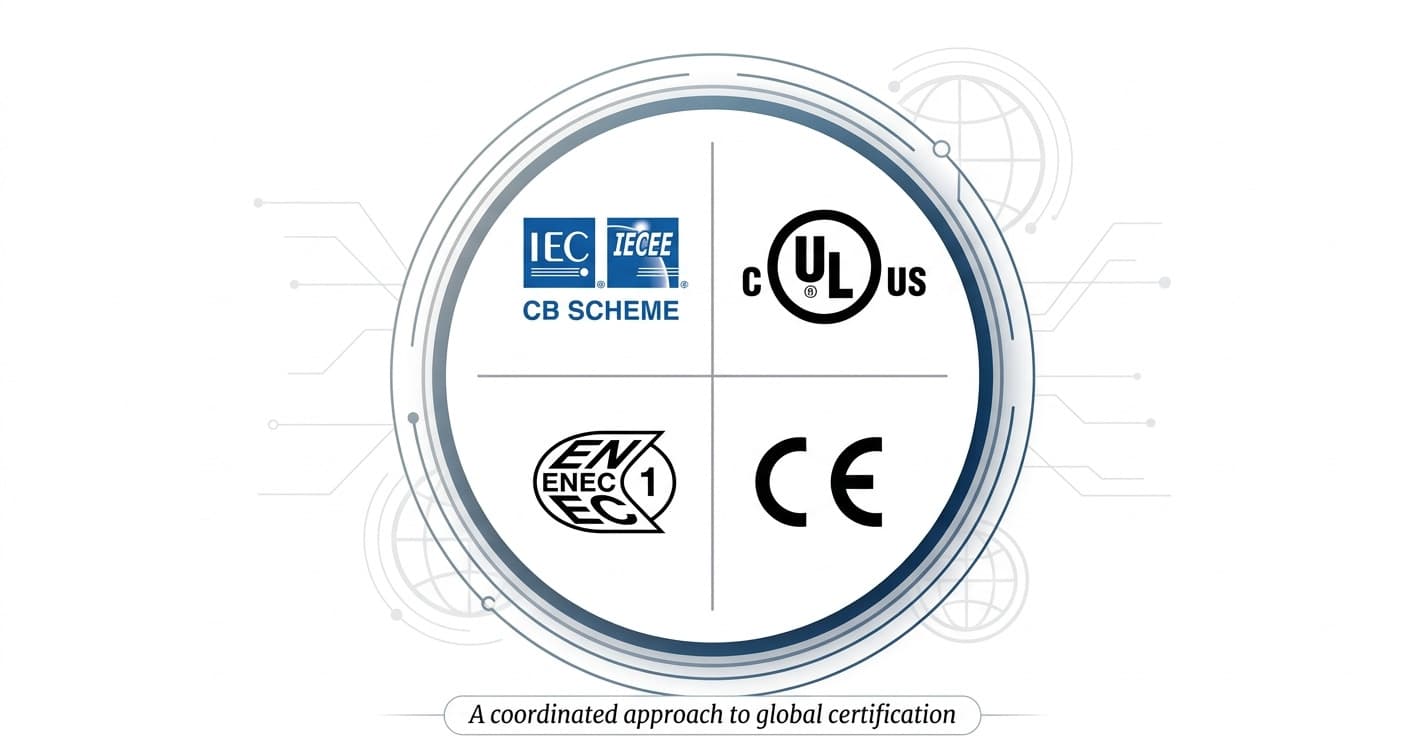
CB Scheme, UL, ENEC, and CE each represent a different type of certification authority with different scopes, different testing requirements, and different levels of manufacturer involvement.
Certification System | Body/Source | Nature of Certification | Scope of Application | Certification Focus | Remarks |
CB Scheme | IEC (IECEE) | Mutual recognition of test reports, not a final certificate | Multiple countries, especially industrial electrical products | Product safety testing and conformity verification | Fast mutual recognition of test results, but local certification needed |
UL | Underwriters Laboratories (USA) | Third-party safety certification | USA and some international markets | Rigorous product safety standards, factory audits | Highly authoritative in the USA, symbolises strict safety |
ENEC | European lighting industry-specific mark | Mandatory third-party certification and periodic factory audits | European lighting market | Product quality and durability certification | Industry-specific accepted high-quality mark |
CE | European Union regulatory mark | Manufacturer declaration of compliance | All relevant products in EU market | Compliance with safety, health, and environmental directives | Statutory mark, not a product quality assurance |
What Are the Main Differences Between the CB Scheme and the Others?
Let’s look at seven comparison points that separate the CB Scheme from UL, ENEC, and CE. These points cover sectors such as authority, longevity, certification type, and geographic coverage.
Comparison Point | CB Scheme | UL | ENEC | CE |
Certifying Authority | Managed by the IEC international organisation | US third-party certification body | European industry associations and accreditors | EU legal regulatory body |
Type of Certification | Test report mutual recognition, not an absolute certificate | Mandatory third-party product safety certification | Industry-specific mandatory third-party quality certification | Manufacturer self-declaration and regulatory compliance |
Factory Auditing Required | Not necessarily, mainly test-report based | Includes strict factory audits | Mandatory annual factory audits and ongoing supervision | Generally no factory audit |
Geographic Coverage | Multiple contracting member countries | Primarily the US market and some overseas | European lighting industry’s main markets | EU and applicable product scope |
Applicable Product Range | Widely covers electrical and electronic products | Mainly electrical safety and some electronics | Lighting products and key components | Entire product range covering safety, environment, etc. |
Application Advantages | Saves redundant testing in multiple countries | High authority, brand added value | Industry recognition, high-quality mark | Legal mandatory compliance mark |
Certification Longevity | Depends on local re-certification and standards usage | One certificate valid nationwide | Continuous audits ensure certificate validity | Compliance by declaration only |
The factory audit difference is one of the most practically significant. CE requires no factory audit. The CB Scheme does not mandate one. UL includes strict factory inspection as part of its certification and surveillance process. ENEC requires annual factory audits to maintain the certification.
For buyers who need assurance that a manufacturer’s production quality matches what was tested, UL and ENEC provide that assurance through the audit requirement. CB and CE do not.
How Does Long-Join Approach Global Certification?
Long-Join’s product certification strategy follows a four-step structure that covers the main global markets through coordinated use of all four systems.
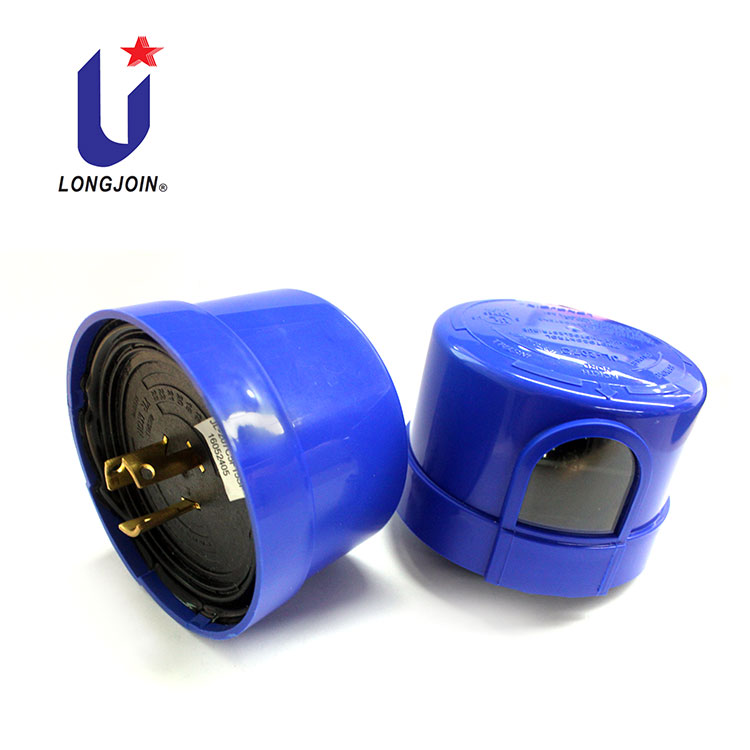
The CB test report is the first step. Completing IEC-standard safety testing through a CB-accredited laboratory gives Long-Join test evidence that can be presented to national certification authorities across participating member countries, reducing duplicated laboratory work.
UL certification covers the North American market. Long-Join’s core photocell models, including the JL-205C, JL-207C, and JL-103A, carry UL or UL773A listings that satisfy the certification requirements of US and Canadian distributors, municipal tenders, and inspection authorities.
ENEC system certification covers European quality requirements. For Long-Join products entering professional European lighting procurement, ENEC provides the independently audited quality mark that major lighting brands and infrastructure tenders require beyond the CE baseline.
CE compliance ensures legal market access across the EU. Long-Join maintains CE marking across the product range as the legal foundation for European market entry, working in conjunction with ENEC for quality-sensitive applications.
All information can be found in Long-Join’s full certification documentation for customers’ perusal.
Frequently Asked Questions on the CB Scheme
The CB report provides mutual recognition of test results to reduce duplicated testing, but each country still requires its own national certification. The CB report is an input to those processes, not a replacement for them.
CE is the legal entry requirement — without it, a product cannot be sold in the EU. ENEC is the quality standard, providing third-party audited assurance of product performance and production consistency that CE self-declaration does not require.
CB provides the test foundation for multi-country entry. UL covers North America. ENEC meets European quality requirements. CE satisfies EU legal compliance. Together, they cover the main markets Long-Join serves without unnecessary duplication of underlying testing.
No. CE can be achieved through manufacturer self-declaration without third-party testing. Both CB and UL require independent laboratory testing. ENEC requires the most rigorous testing plus mandatory factory audits. CE indicates legal compliance, not quality superiority.
The CB Scheme covers over 50 IECEE member countries across North America, Europe, Asia, Africa, and South America. Key markets include the US, Germany, Japan, China, Australia, and most of the EU. Specific coverage depends on the product category and participating national certification bodies.
Conclusion
The CB Scheme, UL, ENEC, and CE each have a specific role in the global certification landscape.
CB reduces testing duplication across multiple markets. UL provides the safety authority and brand credibility needed for North American procurement. ENEC delivers the independently audited quality assurance that professional European lighting markets demand. CE provides the legal compliance baseline for EU market access.
Long-Join’s certification portfolio covers all four, giving buyers in every major market the documentation they need without compromise.
External Links
●https://en.wikipedia.org/wiki/CB_Scheme
●https://www.iec.ch/homepage
●https://en.wikipedia.org/wiki/CE_marking


 English
  Russian
  Spanish
  Portuguese
  Arabic
  Japanese
  Italian