
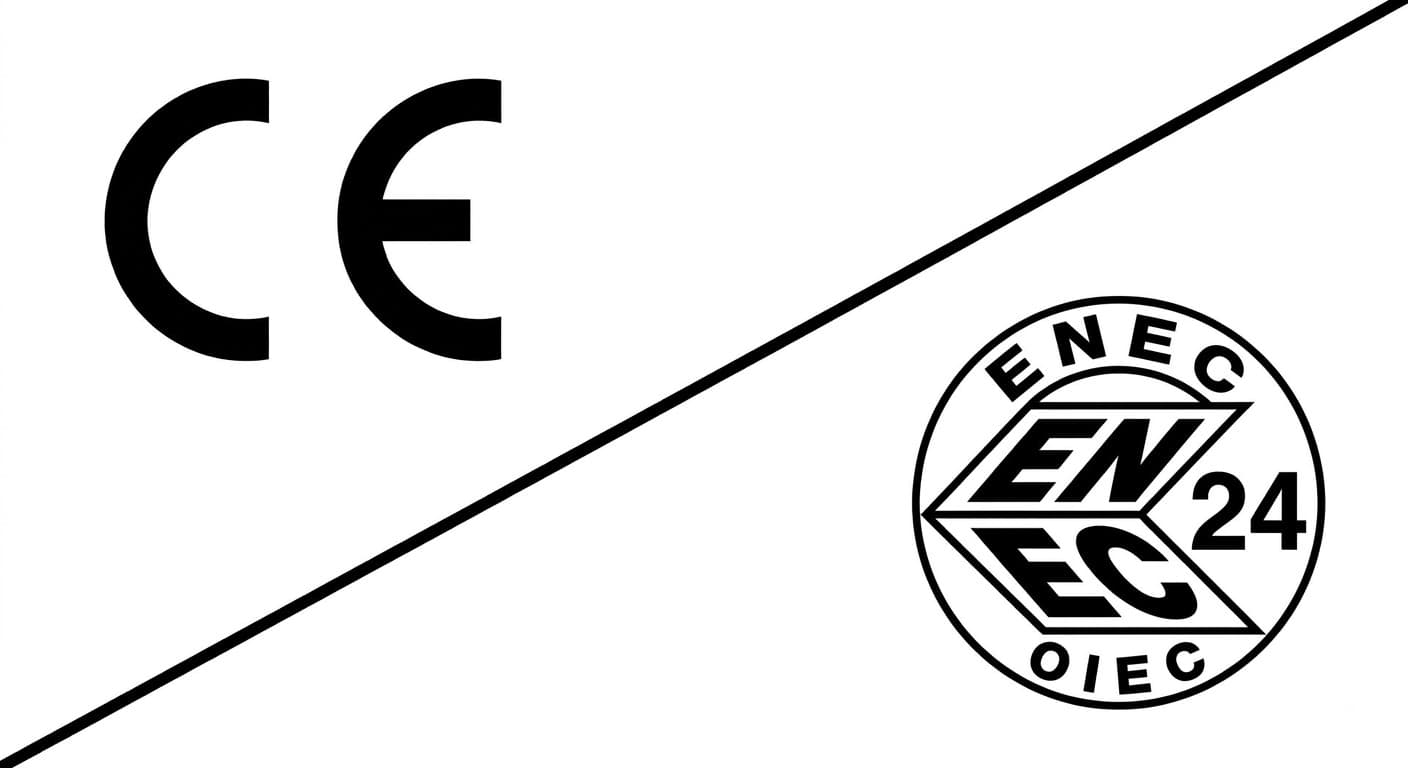
Comparison Between ENEC and CE: What Are the Differences?
Introduzir
Both ENEC and CE appear on lighting products sold in Europe. Both matter for market access.
But they are not the same kind of mark, they don’t represent the same level of assurance, and they are not interchangeable in tender specifications that require one or the other.
CE is a legal compliance mark. ENEC is a quality certification. The distinction has real consequences for product selection in road lighting, smart city infrastructure, and any outdoor lighting project where long-term reliability is the priority.
What Is ENEC?
European Norm Electrical Certification (ENEC) is a unified European certification mark specifically designed for lighting products such as luminaires, photocells, LED drivers, and lighting accessories that requires mandatory third-party testing, factory audits, and continuous surveillance.
CE marking can be achieved through manufacturer self-declaration for many product categories. ENEC cannot. Every ENEC-certified product has been independently tested by an accredited body, and the manufacturing facility is audited annually to confirm production quality remains consistent with the tested samples.

This makes ENEC meaningfully harder to obtain and meaningfully more difficult to counterfeit than CE. It is recognised across major European lighting markets as the quality benchmark for professional outdoor lighting procurement.
How Do ENEC and CE Compare Across Key Dimensions?
Twelve factors separate the two marks, and across every dimension, ENEC represents stricter requirements and stronger assurance.
No. | Aspecto | ENEC | CE | Explicação |
2.1 | Nature of Certification | Mandatory third-party certification with accredited testing, factory audits, and continuous supervision | Manufacturer’s self-declaration; third-party testing optional and not legally required | ENEC entails stricter third-party oversight and quality assurance |
2.2 | Certification Specificity | Dedicated to the lighting industry (luminaires, photocells, LED drivers, etc.) | General compliance standard applicable to various product categories | ENEC focuses on high-end lighting products with industry-specific quality standards |
2.3 | Proof Object | Product quality and performance | Legal sales permission | ENEC emphasises quality guarantee, CE underscores regulatory compliance |
2.4 | Testing Rigour | Includes long-term aging, thermal cycling, insulation durability, component consistency tests | Generally meets basic safety testing | ENEC mandates stricter durability and specialised tests |
2.5 | Factory Audit | Annual audits and factory inspections | No mandatory factory audits | ENEC ensures continuous production quality stability |
2.6 | Special Requirements for Photocells | Strict checks on heat resistance, humidity, aging of photosensitive windows, insulation distances, waterproof and dustproof structures | Relatively lenient technical requirements | ENEC guarantees long-term outdoor reliability of photocells |
2.7 | Mark Usage Regulation | Strict authorisation and difficult to counterfeit | Marks may be misused; lacks effective supervision | ENEC is more transparent and trustworthy |
2.8 | Industry Integration and Recognition | Mandatory for major European lighting brands | Use permitted by legal compliance | ENEC is a quality ticket required for high-end market access |
2.9 | Applicable Product Environment | Suitable for long-term outdoor use, emphasising water resistance, dustproofing, salt spray, and UV aging resistance | Does not focus on environmental durability | ENEC better accommodates outdoor lighting requirements |
2.10 | LED Driver Specific Requirements | Strict tests for ripple, flicker, EMC, thermal protection, insulation distances | Only meets minimum compliance levels | ENEC ensures high-quality and high-performance LED drivers |
2.11 | Confiança de Mercado | Known as a “trust mark” in the European market with good reputation | Merely a legal compliance mark | ENEC reflects corporate professionalism and product strength |
2.12 | Cost and Value | Higher testing, audit, and ongoing supervision costs but reduces after-sales and maintenance risks | Lower costs, focusing mainly on compliance | ENEC investment yields longer-term stability benefits |
Why Does ENEC Matter Specifically for Photocells?
Photocells sit at the top of street light poles, exposed to full outdoor conditions for years.
Heat resistance, humidity tolerance, photosensitive window aging, insulation distances, and waterproof and dustproof structure integrity all determine whether the unit is still working correctly in year five and year ten. CE testing does not specifically evaluate these dimensions. ENEC does.
For any fotocélula being specified into road lighting infrastructure, ENEC certification provides the documented assurance that the product has been tested specifically for the conditions outdoor photocells actually face, and not just the general electrical safety requirements that CE covers.
Long-join also provides full certification documentation for their photocell ranges for general perusal.
Frequently Asked Questions
CE is primarily a legal compliance declaration that allows a product to be sold in the EU market. ENEC is a third-party quality certification requiring accredited testing, annual factory audits, and continuous production surveillance. CE can be self-declared; ENEC cannot.
Factory audits verify that production quality remains consistent with the samples that were tested for certification. Without ongoing audits, a manufacturer could pass initial testing and then reduce quality in production. Annual ENEC audits close that gap and ensure every unit shipped reflects the certified specification.
Because major European lighting brands and infrastructure procurement tenders require it as a condition of supply. CE confirms legal compliance. ENEC confirms quality, durability, and production consistency — the factors that determine whether a product performs reliably over years of outdoor service, not just on the test bench.
Outdoor photocells face heat, humidity, UV exposure, salt spray, and thermal cycling across their service lives. ENEC specifically tests for these conditions including photosensitive window aging, waterproof and dustproof structure integrity, and insulation distance stability. CE testing does not cover these dimensions to the same depth.
Through UV-resistant housing materials, industrial-grade sealing design, high-temperature rated internal components, and the -40°C to +70°C working temperature range that covers the full outdoor thermal environment. Long-Join's testing and manufacturing processes under ISO 9001:2015 ensure production consistency that supports the ongoing surveillance requirements of ENEC certification.
Conclusão
CE is the legal baseline for selling in Europe. ENEC is the quality standard for being taken seriously in European professional lighting procurement.
Choosing ENEC-certified photocell products means the testing rigour, factory audit trail, and ongoing surveillance are all behind the mark, not just a manufacturer’s self-declaration.
For road lighting, smart city infrastructure, and any outdoor lighting project where long-term reliability is a specification requirement, ENEC is the certification that matters most.
Links externos
●https://www.enec.com/
●https://en.wikipedia.org/wiki/CE_marking



 Portuguese
  English
  Russian
  Spanish
  Arabic
  Japanese
  Italian