

Are Long-Join Twist-Lock Photocells Compatible with Vibration Environments of High Mast Lights?
Introduzir
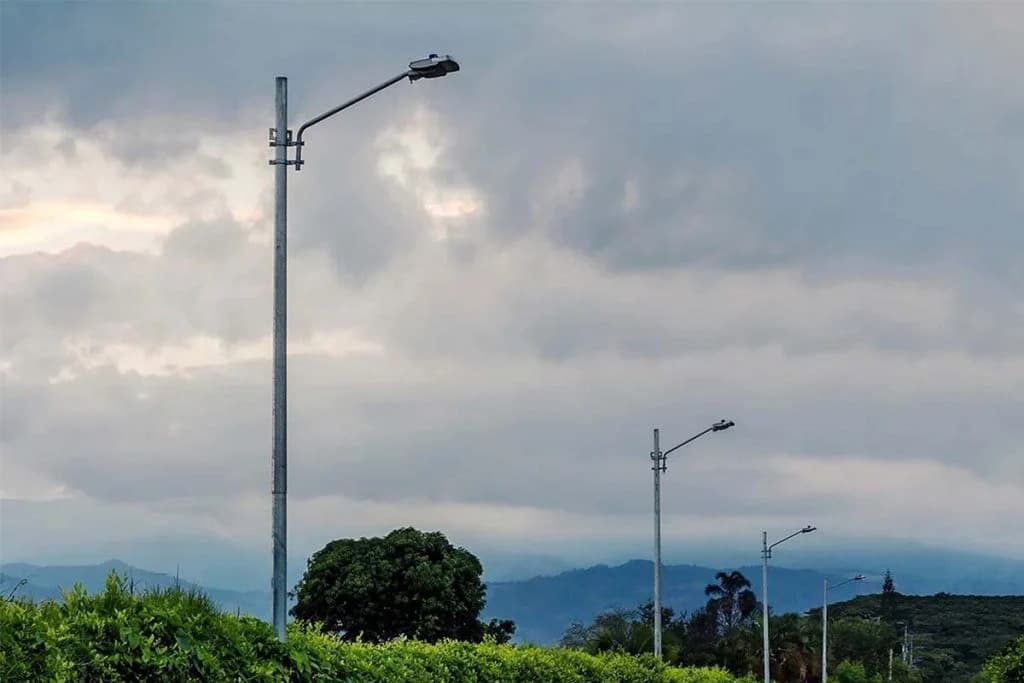
High mast lights operate in one of the most mechanically demanding environments that outdoor lighting components encounter. At 15 to 25 metres in height, the pole acts as a long lever that amplifies ground-level vibrations and wind-induced oscillations.
The photocell at the top of this lever is the component most exposed to mechanical stress, thermal cycling, and environmental loading. Standard photocells designed for moderate outdoor conditions do not reliably survive high mast vibration environments.
Long-Join’s photocell design addresses this through specific material, structural, and component choices across eight impact dimensions.
What Is the Vibration Environment of High Mast Lights?
High mast light vibration comes from three sources:
- Vento
- Traffic
- Thermal cycling
These sources combine to create continuous mechanical stress on the photocell at the mast top.
Vibration Source | Descrição |
Wind Vibration | Frequent wind speed changes cause continuous stress vibrations on the light and photocell |
Traffic Vibration | Heavy vehicles create ground resonance transmitted through the pole to the mast-top photocell |
Thermal Expansion and Contraction | Daytime high temperature (~85°C) versus nighttime low temperature (~25°C) causes material expansion and contraction inducing structural vibration |
Wind is the dominant vibration source for most high mast installations. It produces not just the large-amplitude swaying visible during storms but the constant low-amplitude high-frequency oscillation that occurs even in moderate wind conditions. This continuous cycling is more damaging to solder joints and mechanical connections than occasional large events because it accumulates fatigue damage steadily across years of service.
Traffic vibration from heavy vehicles on roads adjacent to high mast poles transmits through the ground and up the pole structure. The resonant frequency of the pole and luminaire assembly can amplify this vibration significantly at the top of the structure.
Thermal cycling adds a different kind of mechanical stress. A 60°C daily temperature swing from daytime luminaire heat to cool nights produces expansion and contraction in the pole, the luminaire, and the photocell components. Over years of cycling, this repeated dimensional change fatigues joints and connections that were sized for static loads.
What Are the Eight Major Impacts of Vibration on Photocells and How Does Long-Join Address Each?
Eight specific failure mechanisms result from high mast vibration, each requiring a targeted design response that Long-Join twist lock photocells were designed to address.
PC Base Cracking
PC material loses impact resistance under sustained vibration and thermal cycling combined with UV degradation. A PC base that tests adequately in static conditions may crack in service at a high mast installation where vibration, UV, and high temperature combine continuously.
Long-Join uses 30 to 40% glass-fibre reinforced GF+PBT base material, which maintains mechanical strength and crack resistance under the combined loading of vibration and thermal cycling that PC cannot sustain.
Relay Contact Vibration Sticking
Standard relays can experience contact welding or sticking when exposed to continuous vibration at the moment of switching. The mechanical impulse at contact closure, combined with ambient vibration, can cause the contact surfaces to adhere.
Long-Join uses industrial-grade relay specifications selected for their vibration resistance, preventing the abnormal continuous lighting that results from contacts stuck in the closed position.
PCB Solder Joint Fatigue Failures
PCB solder joints are vulnerable to fatigue cracking under repeated low-amplitude vibration. The joint flexes by a microscopic amount on each vibration cycle, and over millions of cycles this accumulates cracks that eventually produce open circuits.
Long-Join uses wave soldering processes that produce larger, more consistent solder fillets at each joint, increasing the fatigue life of the connections under sustained vibration conditions.
Loose Socket Connection from Insertion and Extraction Forces
The twist-lock connection between the photocell and the Soquete NEMA must remain secure under the continuous vibration that high mast installation produces. A standard-quality socket with lower spring contact force may allow the photocell to work loose over time, producing intermittent contact.
Long-Join’s high-strength GF base and reinforced structural design maintain socket connection integrity under the sustained vibration and thermal cycling forces that high mast positions experience.
Vibration Causing Sealing Ring Looseness and Water Ingress
Vibration fatigues the compression set of sealing rings over time. A ring that maintains adequate compression in a static installation may lose compression in a high-vibration environment as the housing components repeatedly flex and the ring’s elasticity is progressively reduced.
Long-Join uses EPDM sealing rings with a pressure-tight design calibrated to maintain sealing integrity under vibration loading, preventing the condensation and water ingress that loosened seals allow.
Microscale Displacement of Photosensitive Window Causing False Triggers
If the photosensitive window shifts position relative to the sensing element under vibration, the effective field of view changes. This can cause the sensor to read different areas of the sky at different vibration amplitudes, producing an unstable lux reading that triggers false switching.
Long-Join’s integrated structural design fixes the photosensitive window position relative to the sensor element so that vibration-induced displacement cannot occur at the amplitudes that high mast installation produces.
Vibration Worsening LED Driver EMI Interference
Mechanical vibration in the luminaire assembly increases the variability of cable routing and connector positions relative to each other, which affects the electromagnetic coupling between the LED driver’s switching circuit and the photocell’s control circuit. Vibration-induced EMI interference can cause relay chatter and MCU instability.
Long-Join installs RC filter circuits, TVS diodes, and MOV surge protection to maintain EMC performance under the variable conditions that vibration produces.
Vibration Accelerating Base UV and Salt Spray Aging
Vibration causes microscopic surface cracking that accelerates UV penetration and salt spray ingress into the base material. Once UV and salt chemistry reach the polymer below the surface, degradation accelerates significantly.
Long-Join’s UV stabiliser additives in the GF+PBT base material resist this accelerated degradation pathway, maintaining material integrity even when surface micro-cracking from vibration provides additional UV and chemical access routes.
Frequently Asked Questions on High Mast Vibration Compatibility
30 to 40% glass-fibre reinforced GF+PBT base material with UV stabiliser additives, EPDM sealing rings with pressure-tight design, and industrial-grade relay components rated for vibration resistance.
Continuous vibration at contact closure creates mechanical impulses that can cause contact surfaces to adhere — known as contact welding or sticking — producing permanent light-on failure. Industrial-grade relay specifications with vibration resistance ratings prevent this.
Through wave soldering processes that produce larger, more consistent solder fillets with higher fatigue resistance than hand soldering or minimal reflow processes. Larger fillets distribute the stress of each vibration cycle across a larger joint area.
EPDM sealing rings with pressure-tight compression geometry maintain sealing integrity under the cyclical loading that vibration applies to the housing joint. Unlike standard gasket designs, the pressure-tight configuration retains adequate compression even after the fatigue-induced compression set that sustained vibration produces.
Vibration changes cable routing and connector positions relative to each other, increasing EMI coupling variability between the LED driver and the photocell circuit. RC filter circuits, TVS diodes, and MOV protection maintain EMC performance under these variable conditions.
Conclusão
High mast light vibration environments expose photocells to mechanical stress levels that standard products are not designed to sustain, with eight specific failure mechanisms that each require targeted design responses.
Long-Join addresses all eight through GF+PBT base material with UV stabiliser, industrial-grade relay selection, wave soldering reinforcement, pressure-tight EPDM sealing, integrated window positioning, and RC plus TVS plus MOV EMC protection.
Lower-end products that address only some of these factors will show predictable failure patterns in high mast vibration environments.
Links externos
●https://en.wikipedia.org/wiki/High-mast_lighting

 Portuguese
  English
  Russian
  Spanish
  Arabic
  Japanese
  Italian