
Comparison Between Heat Shrink Cable JL-700L and JL-700L Cable Versions
Introduce
Choosing the right connector for a smart lighting system can be confusing. Different versions often look the same at first glance. Many customers ask which option protects them more outside. The standard JL-700L or the heat-shrink version.
This guide makes things clear. It explains each model’s structure and waterproof performance in simple words. It also covers the best uses and the design trade-offs behind them all.
What Makes the JL-700L Socket Important in Modern Outdoor Smart Lighting Systems?
When you handle outdoor street lighting systems, you already know that each connector is vital. A weak seal or loose cable lets in water and rust. That can cause failure. So what does the JL-700L actually do?
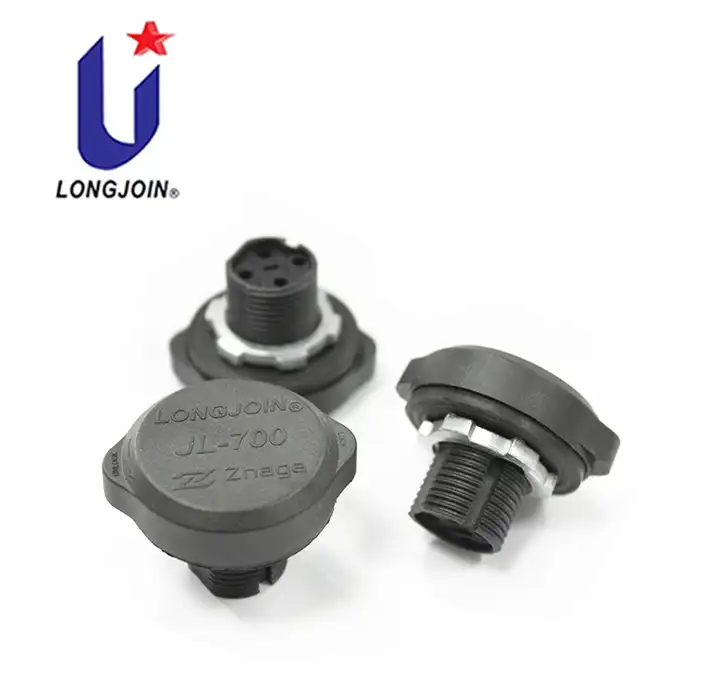
The JL-700L is a Zhaga Book 18–standardized connector, designed for smart lighting controllers, nodes, and photocontrol systems. It works as the interface between your lamp and the control device—much like the “charging port” of a street light.
The socket has a grooved body and a Zhaga cap. It also uses a silicone gasket and a zinc nut. These parts work together to form a tight IP66 seal. It stops water, dust, and insects from getting into the control port.
How Is the JL-700L Built, and Why Does Its Structure Matter?
People often ask this: “Why does structure even matter? To them, everything looks the same.” In reality, even small structural changes can affect safety.
The JL-700L includes:
- A grooved threaded body for easy locking
- A silicone gasket that presses tightly to stop leaks
- A zinc alloy nut for firm fastening
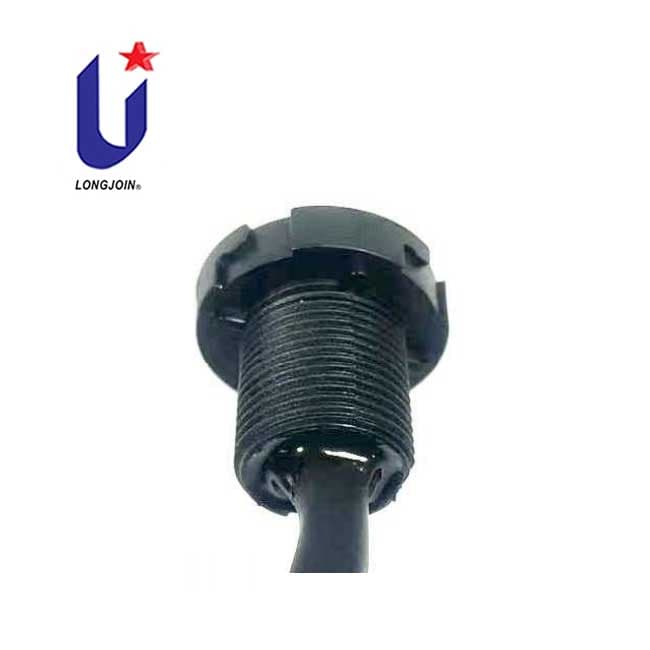
- A cable gland at the rear to seal the cable entry
This structure supports reliable installation, even when lamps vibrate in strong winds or heavy traffic. It also protects smart nodes, photoelectric sensor modules, and wireless controllers from early damage.
What Wire Gauge Options Does the JL-700L Support, and Why Does That Matter?
Many installers worry about wire size. The wrong gauge can make wires overheat or signals weak. So what does the JL-700L support?
The JL-700L uses AWM 1015 series wires, available in:
- 18 AWG
- 20 AWG
- 22 AWG
These wires handle up to 105°C and 600V. That makes them safe for most smart lights and common sensing devices. The insulation is thick enough to block heat from LEDs. It stays flexible for quick installation.
How Does Custom Cable Length Improve Installation?
Some projects require long cables for pole-top controllers, while others need short internal lengths for compact fixtures.
With the JL-700L, cable length is fully customizable. This avoids unnecessary cable clutter and improves safety by preventing bending fatigue.
Why Was the Heat Shrink Version of JL-700L Developed?
Manufacturers saw a clear problem. The JL-700L had IP66 protection, but some sites needed more. Places near the sea or in harsh factories are tough on gear. Salt, moisture, and fumes slowly creep into cable joints.
To solve this, Long-Join developed a reinforced version using heat-shrink tubing.
What Is Added in the Heat Shrink-Wrapped JL-700L Version?
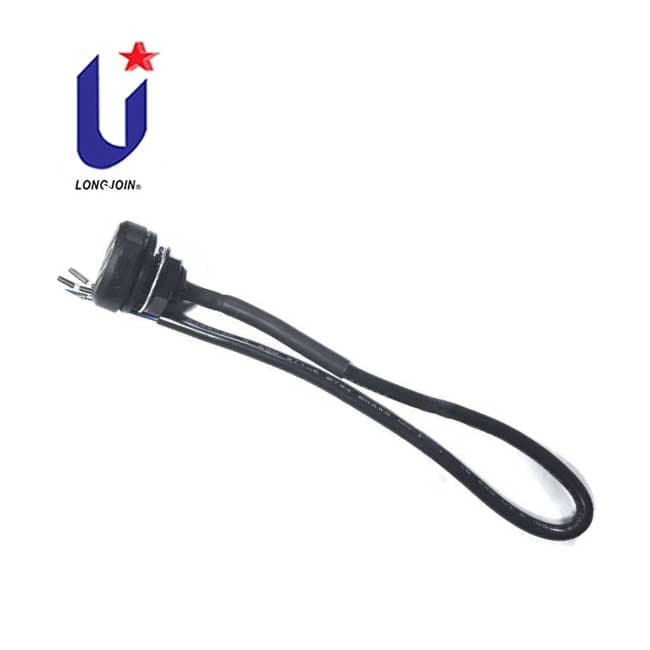
The enhanced model wraps the rear cable junction with a 10–20 cm heat shrink sleeve. When heated, the sleeve shrinks and forms a tight seal around the cable.
This simple upgrade protects the cable core from:
- Water droplets
- Humid air
- Acidic mist
- Corrosion
- Micro-cracks from constant bending
This makes it ideal for docks, bridges, coastal highways, and chemical plants.
How Does the Structure of the Heat Shrink JL-700L Improve Waterproofing?
The heat-shrink version keeps the same main Zhaga components:
- Grooved socket body
- Zhaga cap
- Silicone gasket
- Zinc or plastic nut
But it adds:
- A long shrink tube around the cable
- A securement ring for extra stability
This improves sealing at the most common failure point: the cable entry.
Why Do Both Models Recommend a Mounting Flatness of Less Than 1.5°?
A surprising number of failures come from uneven lamp surfaces. Even small tilts create micro-gaps in the gasket, allowing water to enter.
Both the standard and heat shrink models recommend:
- Installing the socket on a surface tilted less than 1.5°
- Using proper torque to flatten the gasket evenly
This ensures the sealing gasket works exactly as intended.
Do Both Versions Support the Same Voltage and Current Ratings?
Yes. Both sockets support:
- Rated Voltage:30V DC max
- Rated Current:5A max
This fits smart lighting nodes, photocell controllers, and low-voltage signal systems widely used in modern LED luminaires.
See related specifications on Long-Join’s controller page.
How Should the Heat Shrink JL-700L Be Installed for Best Waterproof Performance?
Many installers ask, “Is this harder to install?” The answer is no—it follows the same steps but simply adds a shrink layer.
What Steps Should You Follow During Installation?
- Place the waterproof silicone gasket on the threaded port.
- Align the gasket’s flat side with the socket screws.
- Fix the JL-700L onto the lamp surface.
- Insert the securement ring tightly.
- Fasten the zinc nut with a torque above 2.5 N·m.
- Apply heat evenly to activate the shrink tube.
This ensures the shrink tube locks properly around the cable.
Why Is the Securement Ring Important?
The securement ring keeps the nut from loosening. This reduces vibration damage and maintains sealing force along the gasket.
What Customization Options Does Long-Join Offer for Zhaga Sockets?
Customers often need different materials or structural changes based on their project. Long-Join offers a wide set of options for the JL-700 series.
What Threaded Connector Options Are Available?
If space is limited inside the lamp, installers can choose the JL-700S short version. It keeps the same Zhaga functionality but saves internal space.
What Bracket Options Can Improve Installation Stability?
Long-Join offers multiple bracket types:
- JL-700K4-210K
- JL-210K wall mount
Can Customers Order Wireless Variants of Zhaga Sockets?
Yes. Long-Join supplies JL-700W and JL-700W2 wireless variants compatible with different smart control systems.
These are often used in:
- Sensor nodes
- Photocell controlunits
- Wireless controller modules
- Zhaga Book 18–compatible interfaces
How Does Long-Join Continue Improving Its Zhaga and Photocontrol Product Line?
Technology in outdoor lighting changes every year. Smart cities demand more automation, better data, and more durable connectors.
How Does R&D Improve the JL-700 Series?
Long-Join’s R&D team redesigns components based on customer feedback. They test:
- Waterproof performance
- Cable durability
- Torque resistance
- Compatibility with new street lighting outdoorsystems
This allows customers to adopt new technologies without changing their existing lamp design.
What Advanced Sensors Does Long-Join Produce Alongside Zhaga Sockets?
Long-Join also produces:
- PIR motion sensors.
- Microwave sensors.
- 0–10V dimming modules.
- DALI dimming modules.
They work with Zhaga sockets to build a faster, safer, energy-saving system. This makes smart city lighting easy to upgrade.
How Do You Choose Between the Standard JL-700L and the Heat Shrink Version?
Here is a second table to help you decide based on your environment:
Which Model Should You Choose?
Environment | Recommended Model | Reason |
Regular streets, parks, and campuses | Standard JL-700L | Strong sealing with lower cost |
Coastal highways | Heat Shrink JL-700L | Extra protection from salty air |
Industrial zones | Heat Shrink JL-700L | Resistant to chemicals and acids |
High-vibration areas (bridges, tunnels) | Heat Shrink JL-700L | Adds strain relief and prevents cable cracking |
Budget-limited projects | Standard JL-700L | Reliable and economical |
Conclusion
Both JL-700L versions last long. They are safe and reliable too. The standard JL-700L has a strong IP66 seal. The heat-shrink version boosts protection by covering the cable end and blocking dust, water, and other harsh elements.
Whether you pick the standard model or the reinforced heat shrink type, both work with Zhaga controllers and photocell systems. They also suit smart street lighting.
Long-Join keeps improving, so lighting makers and city planners can build safe, modern lighting networks.
External Links:
●https://www.nemaenclosures.com/enclosure-ratings/ip-enclosures/ip66-enclosures.html
●https://www.zhagastandard.org/books/overview/smart-interface-between-outdoor-luminaires-and-sensing-communication-modules-18.html
●https://en.wikipedia.org/wiki/Heat-shrink_tubing


