
What Specific Technical Standards Must Photocontrols Meet to Obtain ENEC Certification?
Представлять
ENEC certification sets the quality benchmark for photocontrol products entering the European professional lighting market.
It is not a checkbox exercise. Every requirement in the ENEC framework exists because outdoor photocontrols face conditions that basic CE compliance testing does not adequately assess.
This includes testing sustained heat, UV exposure, moisture, thermal cycling, and electromagnetic interference across years of continuous outdoor service.
Understanding what the technical standards actually require helps manufacturers plan their product development and testing strategy correctly from the start, rather than discovering gaps during the certification audit.
What Technical Standards Must Photocontrols Meet for ENEC Certification?
ENEC is a dedicated European lighting industry certification mark that requires:
- Mandatory third-party testing
- Factory audits
- Ongoing surveillance
An accredited certification body must independently test the product against defined standards, audit the manufacturing facility, and conduct ongoing surveillance to verify that production quality remains consistent with the tested specification.

This is why ENEC carries more weight in professional European lighting procurement than СЕ alone. The mark cannot be self-applied. It requires demonstrated third-party verification at both the product and production level.
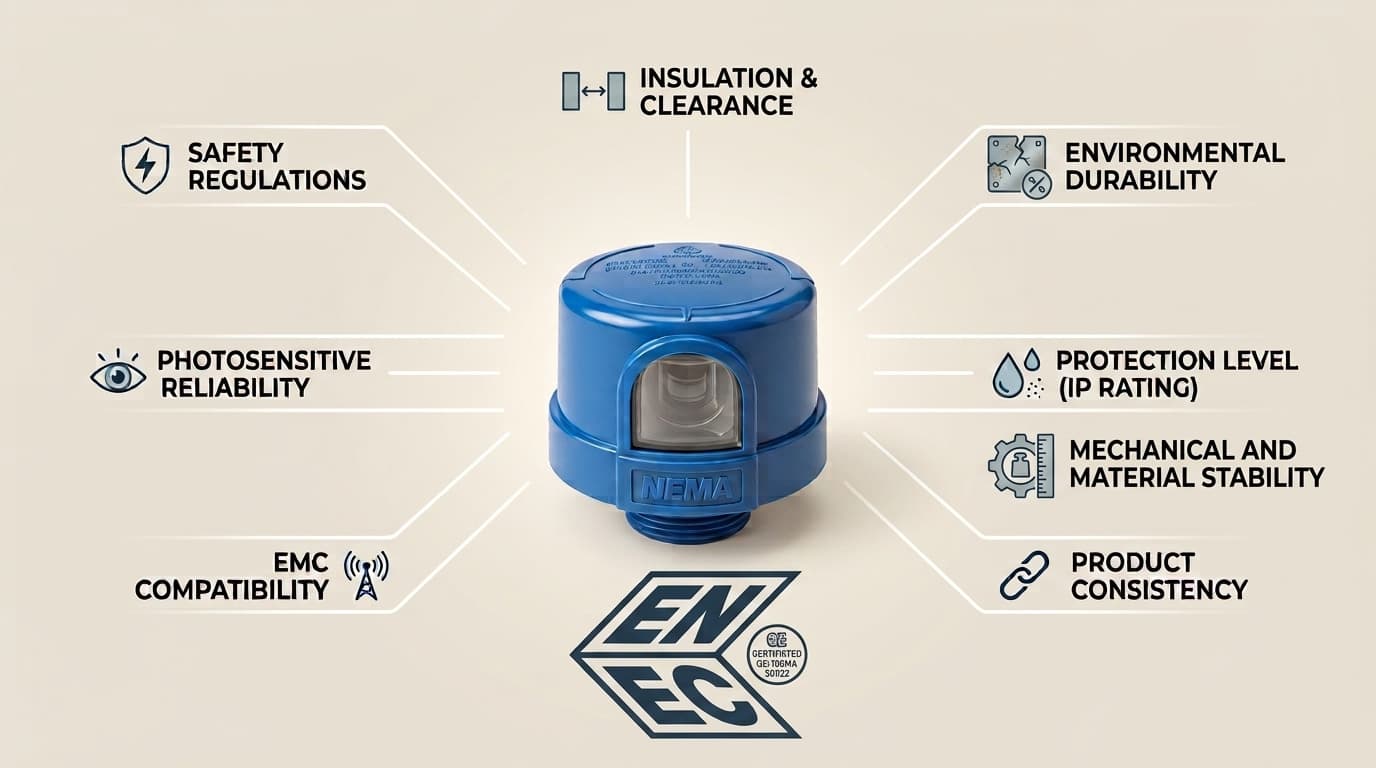
Eight standard categories define the technical requirements photocontrols must satisfy. The table below explains the specific requirements for each item.
Standard Category | Specific Requirements | Объяснение |
Safety Regulations | Comply with the European Low Voltage Directive (LVD), meeting basic electrical safety requirements | Products must fulfil criteria for electric shock protection, insulation, and safety |
Environmental Durability Tests | Long-term aging and thermal cycling tests | Product housings and internal components need to withstand temperature fluctuations for outdoor stability |
Insulation and Clearance | Internal insulation distances meet standards | Ensures adequate safety spacing between PCB and electronic parts to prevent short circuits and breakdowns |
Photosensitive Element Reliability | Heat resistance and aging tests on light-sensitive windows | Guarantees stable optical sensing performance, avoiding functional failures due to aging of the sensor element |
Protection Level (IP Rating) | Waterproof and dustproof testing | Compliance with required ingress protection (IP) levels for outdoor photocontrol use |
EMC and Electromagnetic Compatibility | Compliance with EMC directives to avoid electromagnetic interference | Ensures photocontrol functions properly in electromagnetic environments without disturbing nearby devices |
Mechanical and Material Stability | Use of high-durability materials like glass fibre reinforced PBT for housings | Ensures housings and bases possess heat resistance and mechanical strength suitable for long-term outdoor exposure |
Product Consistency and Batch Control | Batch products meet consistent performance criteria | Regular factory supervision reduces quality variation, enhancing customer experience |
The Low Voltage Directive safety requirements establish the electrical safety baseline. Electric shock protection, insulation integrity, and safe construction under fault conditions are all tested here. A product that fails these requirements cannot proceed further in the certification process.
Photosensitive element reliability testing specifically targets the outdoor lifespan of the sensor window and the sensing component itself. UV exposure causes optical materials to yellow and lose transmittance over time, shifting the effective lux threshold at which switching occurs.
Heat resistance testing of the sensing window confirms that the optical performance remains stable across the full operating temperature range. This is particularly important for photodiode-based sensors, which are inherently more stable than CDS components across temperature ranges but still require documented testing to meet ENEC requirements.
EMC compliance testing confirms that the photocontrol does not radiate electromagnetic interference that affects nearby devices — particularly relevant as LED drivers have become more sensitive to interference from the switching circuits in photocontrols operating on the same circuit. Immunity testing also confirms the photocontrol is not disrupted by external electromagnetic sources.
How Does Long-Join's Photocontrol Design Reflect ENEC Compliance?
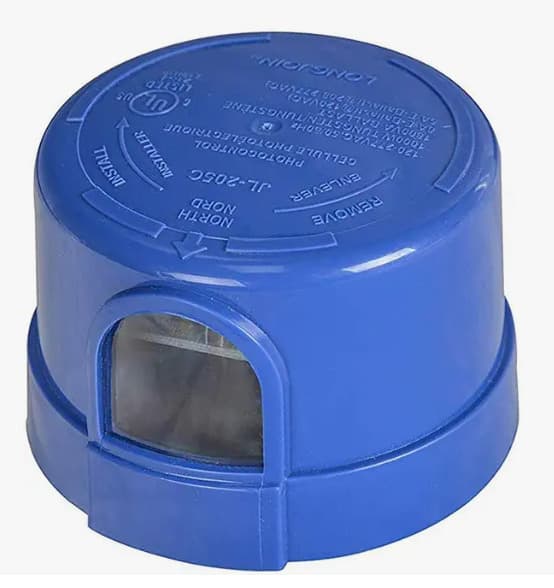
Four design principles in Long-Join’s photocontrol range directly address the ENEC technical requirements.
Robust electronic components
Robust electronic components with strong heat resistance are used throughout the product line. The JL-207C‘s industrial-grade MCU and high-temperature-rated relay contacts are specified to maintain performance across the full -40°C to +70°C rated operating range.
Intelligent algorithms
Intelligent algorithms combined with precise photosensitive elements reduce false switching actions that would otherwise produce unnecessary relay wear in the product’s assessed cycling life.
Cover Design
Housing and base design follow international standards. It involves glass fibre reinforced PBT with UV stabiliser, ultrasonic welded housing joints, and IP65 or IP67 sealing, providing the mechanical and environmental protection that ENEC’s durability requirements assess.
Third-Party Testing
Complete factory testing with third-party certification bodies provides the documented test record that ENEC auditors review. Available in the certification documentation in Long-Join’s quality certificate library.
Frequently Asked Questions on ENEC Technical Standards for Photocontrols
The European Low Voltage Directive provides the electrical safety baseline, covering electric shock protection, insulation integrity, and safe construction under fault conditions. Products must satisfy all LVD requirements before other ENEC category testing is assessed.
Through heat resistance testing and UV aging tests on the sensor window material. The tests verify that optical transmittance and switching threshold accuracy remain stable across the rated operating temperature range and after extended UV exposure.
IP rating testing under IEC 60529, covering both dust ingress testing under negative pressure with fine particulate and water jet testing at a defined flow rate from all angles. Both dust-tight and water-jet-resistant performance must be confirmed without ingress.
Minimum clearance and creepage distances between live conductors, PCB traces, and accessible surfaces are defined by the applicable IEC and LVD standards. These distances account for worst-case outdoor contamination and must be maintained under the temperature and humidity conditions the product is rated for.
Through product design using materials and components specified to meet ENEC requirements, complete internal testing before submission, and engagement with accredited third-party certification bodies for independent testing and factory audit review.
Заключение
ENEC certification for photocontrols is not a simplified version of CE with extra paperwork. It is a comprehensive technical assessment covering eight distinct requirement categories — electrical safety, environmental durability, insulation clearance, sensor reliability, IP protection, EMC compliance, material stability, and production consistency. Every requirement addresses a real outdoor failure mode. Long-Join designs its photocontrol products to meet these requirements through material selection, circuit design, and manufacturing process controls, providing European buyers with the documented quality assurance that ENEC certification represents.
Внешние ссылки
●https://www.enec.com/
●https://en.wikipedia.org/wiki/CE_marking

 Russian
  English
  Spanish
  Portuguese
  Arabic
  Japanese
  Italian