
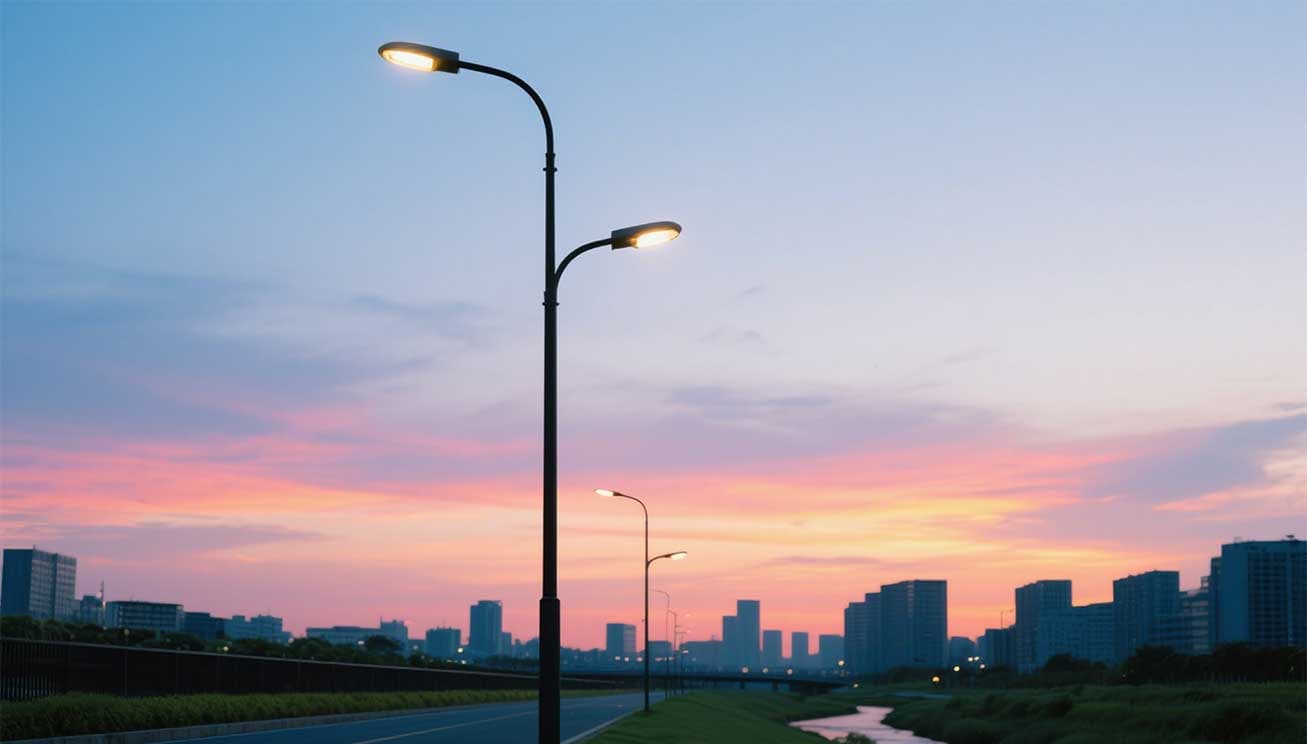
Should Twist-Lock Photocells Have A North Arrow?
Introdurre
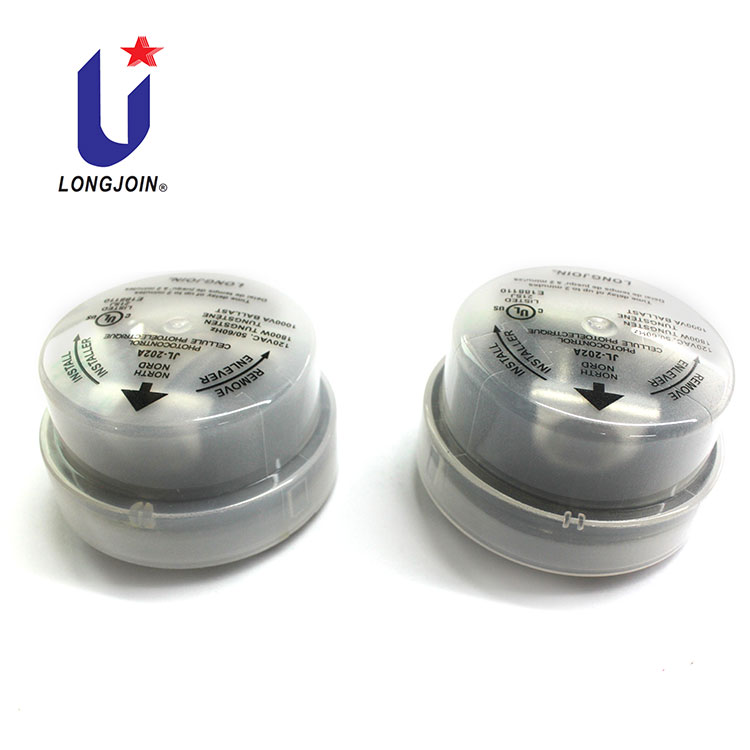
Look at a twist-lock photocell sometime, and you will notice a small arrow on the top marked “NORTH.” Most people see it and move on. But that arrow actually matters in outdoor lighting.
A twist-lock photocell reads natural daylight and switches the lamp based on that reading. It is the core control for street lights, garden lights, doorway lights, parking lot lights, and most other outdoor fixtures that need to turn themselves on at dusk and off at dawn. Long-Join’s JL-205C is one example, designed to do exactly that.
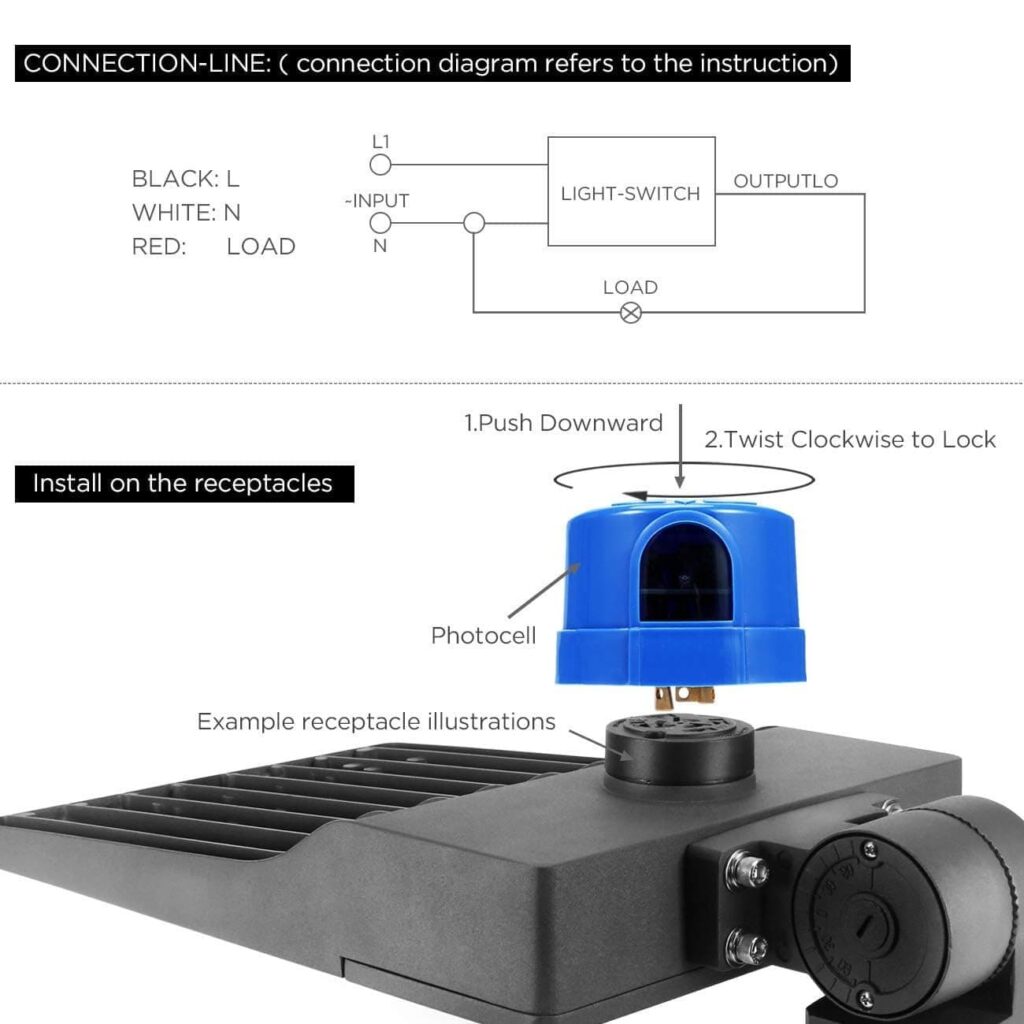
What Does The North Arrow On A Twist-Lock Photocell Mean?
The “NORTH” mark can be confusing. Many people misunderstand it. They see it and wonder what it means. Is it a compass, or a special instruction they do not understand?
It is even simpler than that. The mark shows which way the light-sensitive window should face once you install it properly.
North is the target direction. The sun rises in the east and sets in the west, while north remains steady. A north-facing sensor avoids the direct morning and afternoon sun. This helps it measure the overall outdoor light level without glare affecting the reading.
That makes it react to true daylight change rather than a passing shadow or a reflection.
Why Is The North Arrow Useful During Installation?
Install fifty photocells across a project and you will understand why this matters.
Every lamp sits in a different spot. Every spot has different sun exposure, different shadows, different surrounding buildings or trees. Without a reference, an installer has to think through the geometry every single time. With the arrow, they align it to north and move on.
It is especially helpful for newer installers or crew members on their first big job. No guessing.
Installation Point | With North Arrow | Without North Arrow |
Direction Check | Easy to see and follow | Installer may guess |
Beginner Use | More helpful | Easier to make mistakes |
Field Speed | Faster alignment | Slower checking |
Risk Of Wrong Position | Inferiore | Più alto |
Miglior utilizzo | Street lights, parking lights, LED lighting | Simple lighting only |
Is The North Arrow Mandatory For Every Photocell?
Not every project needs it.
Some simple outdoor lights sit in open spaces with soft, even ambient light. A photocell can work acceptably there even if the orientation is not perfect. The sensor reads similar light levels no matter which way it faces.
But most real outdoor sites are not like that. Walls nearby, trees, reflective glass, other light sources, low winter sun throwing long shadows. In these places, orientation becomes critical. The difference between facing north and facing south can mean the lamp switches two hours apart.
Is The North Arrow Just A Marketing Gimmick?
No. This one is real.
The problem it solves shows up constantly in the field. A photocell sensor depends on light entering through the window. Put that window facing strong direct sun, and glare washes out the sensor.
Problema comune | What May Happen | How The North Arrow Helps |
Sensor faces strong sunlight | Lamp may turn off too early | Gives a safer direction guide |
Sensor faces deep shadow | Lamp may turn on too early | Helps avoid poor placement |
Sensor faces reflective surface | False switching may happen | Supports better alignment |
Installer guesses direction | Inconsistent results | Gives one clear reference |
Why Is The North Arrow More Important In Winter?
Winter changes everything about how a photocell sees light.
The sun sits much lower in the sky. Days shrink. Shadows stretch across the whole fixture and the road around it. When the sun angle is that steep, direct light and reflected light can hit the sensor in ways that confuse it. The sensor may read daylight that is not really there, or miss daylight because the angle is all wrong.
Region Or Site Condition | North Arrow Importance | Motivo |
High-Latitude Areas | Alto | Low winter sun affects sensing |
Snowy Areas | Alto | Snow can reflect strong light |
Narrow Streets | Medium To High | Buildings create long shadows |
Open Parking Lots | Medio | Reflections from cars may affect sensor |
Simple Garden Lights | Inferiore | Less critical if light is even |
Does An LED Street Light Still Need A North Arrow?
People sometimes assume LED fixtures are different, that they do not need the same careful light sensing. That assumption is wrong.
An LED lamp saves energy, yes. It still needs the correct signal to turn on or off, though. If the photocell sensor keeps false-triggering — switching when it should not — it stresses the LED driver. Frequent wrong switches annoy users and kill the quality of the lighting.
A north arrow helps prevent that. It supports clean light reading, which means fewer confusion signals. For LED street light projects, this matters because you want the driver running smoothly, not cycling on and off from bad sensor data.
Long-Join’s JL-205C is designed for street lighting, garden lighting, passage work, doorway applications. It comes in multiple voltage options and different IP ratings, which means it can fit various outdoor conditions.
How Does The North Arrow Work With A Rotatable Base?
Here is a practical problem: the fixture is already mounted, and it does not face the right direction.
The north arrow shows you where it should face. The rotatable base or receptacle lets you turn the photocell until it does. Together, they solve what might otherwise be a mounting problem.
Long-Join’s wiring guide says to adjust the receptacle position as needed after pointing the sensor toward north. This is important because you cannot always rotate the entire lamp. Older poles are fixed in place. But you can usually rotate the photocell receptacle to get a better angle.
When Can A Photocell Work Without A North Arrow?
Simple outdoor lights in simple conditions do not always need it.
A basic wall light in an open area, steady natural light, no reflection, no shadows, no nearby buildings. That sensor can work fine with or without the arrow. Some low-cost applications intentionally skip it to save a few cents per unit.
But there is still risk. Without a direction mark, different installers align the sensor different ways. One light on the street switches correctly. Another switches an hour early. Across fifty fixtures it becomes obvious that nobody knew how to position them consistently.
Domande frequenti
Close is good enough. True north is the aim, but within a few degrees usually works fine for normal outdoor work.
Yes, especially if the installer is guessing or the site has shadows and reflections.
Lower sun angle, longer shadows, reflected light bouncing at weird angles. The sensor has more ways to misread the light.
Yes. Correct direction cuts false switching, which protects the driver and improves the whole system.
Arrow shows the target direction. Rotatable base lets you adjust the photocell until it points that way.
Conclusione
Should twist-lock photocells have a north arrow? For any serious outdoor lighting project, yes.
The arrow solves a real installation problem. It points the sensor in a steady direction, reduces false switching, and helps outdoor lights work from dusk until dawn. It helps beginners and supports LED fixtures. It also matters in winter. In high-latitude areas, or places with shade and glare, it becomes essential.
Link esterno:
●https://ieeexplore.ieee.org/document/10909273/
●https://www.cie.co.at/publications/technical-reports
●https://gml.noaa.gov/grad/solcalc/azel.html


 Italian
  English
  Russian
  Spanish
  Portuguese
  Arabic
  Japanese