
Installation And Maintenance Guide For Lamp Post Photocells
Introdurre
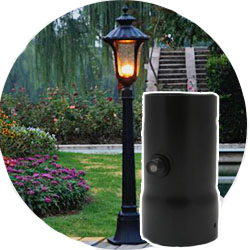
Lamp posts are common in outdoor spaces. You see them in courtyards, patios, gardens, lawns, pathways, and driveways. They help people walk with ease and stay safe. They also make a space look better and keep outdoor areas useful after dark.
What Does A Lamp Post Photocell Actually Do?
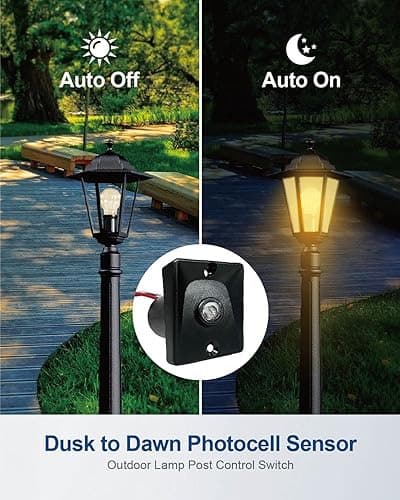
A lamp post photocell is a small light-sensing switch. It helps cut wasted electricity in daylight hours. Long-Join describes both the JL-103 E JL-403 families as photoelectric switches that control lighting automatically according to ambient light level.
This small part matters more than many buyers realize. For outdoor work, this causes complaints. It also adds more maintenance and wastes energy.
Which Long-Join Photocells Are Commonly Recommended For Lamp Posts?
For this type of project, two wired button models often come up. They are the Long-Join JL-103A series and the JL-403C series. Long-Join lists both in its button photocell category and product catalog. The JL-103A is a 120VAC button-type photocell, while the JL-403C is a mini button photocell rated for 120–277VAC.
The JL-103A is often used where a simple, economical light photocell is enough. Long-Join says it suits landscape lights, garden spotlights, LED floodlights, wall pack lights, and barn lights. It is also listed by Long-Join as a 120V option for yard light and public-area lighting.
Quick Comparison Of Recommended Lamp Post Photocells
Articolo | JL-103A Series | JL-403C Series |
Typical Rated Voltage | 120 V CA | 120–277 V CA |
Product Style | Button type, wire-in | Mini button type, wire-in |
Common Uses | Yard lights, garden lights, floodlights, wall packs | Street lights, passage lights, doorway lights |
Miglior adattamento | Simple fixed-voltage projects | Projects needing wider voltage flexibility |
Main Benefit | Simple and economical | More adaptable across fixture types |
How Do You Match A Photocell To Lamp Voltage And Power?
Start with the fixture label. Check the rated voltage first. If the lamp uses 120V, the JL-103A may work well. But if the project needs a wider voltage range, the JL-403C may be a better fit. Long-Join rates it for 120–277VAC.
Next, check the load. The photocell must handle the total lamp load, not just the name of the fixture. Long-Join’s selection guidance says users should add up the wattage of all lamps or Driver LED controlled by the same sensor, compare that figure with the rated loading, and leave a safety margin rather than running at the limit.
Simple Matching Checklist Before You Buy
Check Item | What To Confirm | Perché è importante |
Voltaggio | Does the fixture voltage match the photocell rating? | Prevents misoperation or damage |
Total Load | Is the total wattage below the photocell’s rated loading? | Helps avoid overload |
Modalità di errore | Do you want fail-on or fail-off behavior? | Affects safety and maintenance response |
Ambiente | Is the site exposed to rain, salt, or dust? | Helps guide IP and sealing choice |
Mounting Style | Does the fixture accept a wire-in button photocell? | Prevents installation mismatch |
How Should You Install A Lamp Post Photocell Safely?
The first rule is simple: cut power before touching the wiring. Long-Join’s installation guides say to turn off power first and make sure the line voltage matches the value shown on the photocontrol label.
Then wire the unit according to the diagram. Long-Join’s JL-103 installation guide warns that loose copper strands, poor tightening, and wrong wire order can cause failure. It also notes a common color pattern: black for line, red for load, and white for neutral.
Placement matters too. Do not mount the photoelectric sensor where the controlled lamp shines directly into it. Long-Join warns that artificial or reflected light can make the unit cycle on and off at night. That kind of false triggering is one of the most common field complaints.
Why Do IP Rating And Waterproofing Matter So Much?
Outdoor lighting lives in rain, dust, heat, and moisture. If the sealing is weak, water can enter around the housing or wiring point and shorten the life of the photocell switch. Long-Join’s installation guide for the JL-103 series says secure mounting helps keep the IP65 seal intact, and its troubleshooting notes point to moisture and salt corrosion as a cause of short life in harsh sites.
Good waterproofing is not only about the product shell. It also depends on tight wiring, correct mounting, and checking the gasket area. If the seal is damaged, even a good ip65 photocontrol can fail early in the field. That is why installers should inspect the sealing point during setup and again during routine maintenance.
What Maintenance Checks Help A Photocell Last Longer?
A good maintenance routine is simple. Clean the lens, check the wire tightness, test the switching response, and inspect the gasket or sealed area. Long-Join’s JL-103 maintenance guide recommends cleaning the lens every 3 months, checking wiring and sensor response every 6 months, and inspecting the gasket yearly. It also suggests replacing aged units after about 5 years for stable switching accuracy.
Suggested Maintenance Schedule
Maintenance Task | Suggested Interval | Main Purpose |
Clean sensor lens | Ogni 3 mesi | Rimuove la polvere e la pellicola di umidità |
Controllare il serraggio dei cavi | Ogni 6 mesi | Helps prevent flicker and overheating |
Test on/off response | Ogni 6 mesi | Confirms proper switching |
Inspect seal or gasket | Ogni 12 mesi | Maintains waterproof protection |
Review aged units | Around 5 years | Supports stable long-term operation |
What Should Buyers Look For Before Placing An Order?
Do not buy on price alone. Check certifications, rated voltage, loading, sealing level, and product fit for the site. Long-Join’s quality certificate page says its certifications include CE, CB, FCC, RoHS, Zhaga Book 18, UL-related certificates, UKCA for some products, and ISO 9001:2015 quality management compliance.
It is also smart to request samples before going into volume. Long-Join’s sample-service pages say they support sample flow and function testing before larger production. That is useful because it lets you test the outdoor light sensor switch in the real fixture, not only on paper.
After-sales support matters too. Long-Join shows both pre-sale and after-sale support on its site.
Frequently Asked Questions
Fail-on keeps the lamp on when the control fails. Fail-off keeps the lamp off. Choose based on whether darkness risk or wasted lighting matters more.
Mount the unit tightly, protect the sealing area, and inspect the gasket or housing fit. Also keep wiring tight and sheltered from moisture.
The most common causes are bad wiring and a dirty lens. It could also be deep shade, or light hitting the sensor directly.
Check voltage, total load, mounting style, and failure mode. Then compare them to the product sheet before buying.
Conclusione
A lamp post photocell is small, but its job is big. It controls the lights each day. It also affects wasted energy and how often the site needs service.
Pick the right voltage, load, and setting. Then install and seal it well. Your outdoor lighting system will work better and last longer. For many lamp post jobs, the JL-103A and JL-403C are good places to start. But the final choice should still match the real fixture and site conditions.
Link esterni:
●https://www.electricalcounter.co.uk/articles/what-is-ip65?srsltid=AfmBOooX0QGb-mBcGolK1MlpeZw25nxop3PpQ1amw5cHyvCnbTlCQmtJ
● https://www.ledlightexpert.com/what-is-an-led-driver?srsltid=AfmBOopndPKutGc-S_jKAg2-wxOOV3gGoiTV_H-xMES_Ixv9y_maQCHm
●https://www.renkeer.com/what-is-a-light-sensor/

 Italian
  English
  Russian
  Spanish
  Portuguese
  Arabic
  Japanese