
How Long-Join Photocell Manufacturer Responds To The New EU PPWR Regulations: Certification And Compliance Review
Introdurre
Selling into Europe used to be about electrical safety and product performance. Now packaging gets just as much scrutiny.
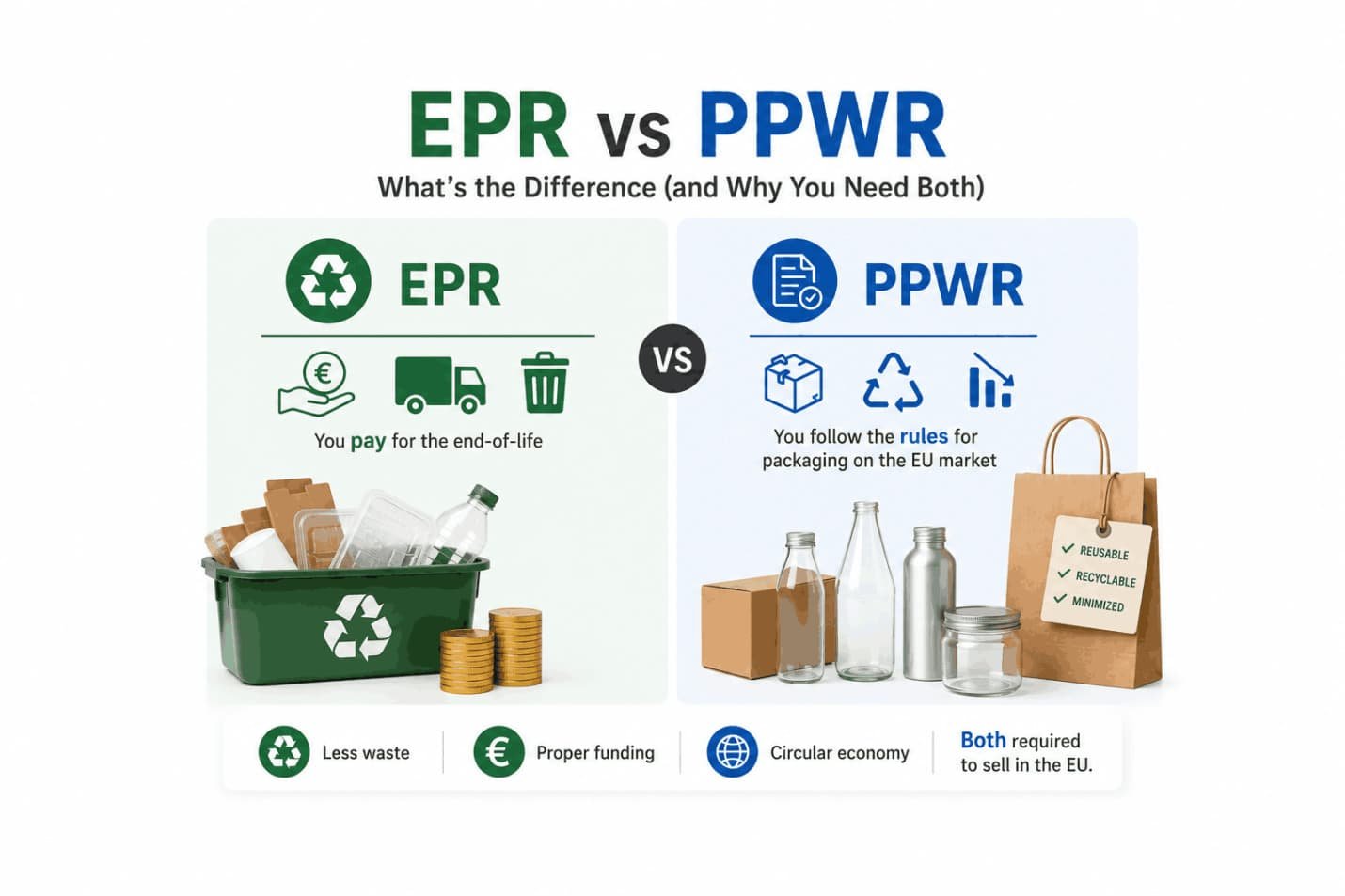
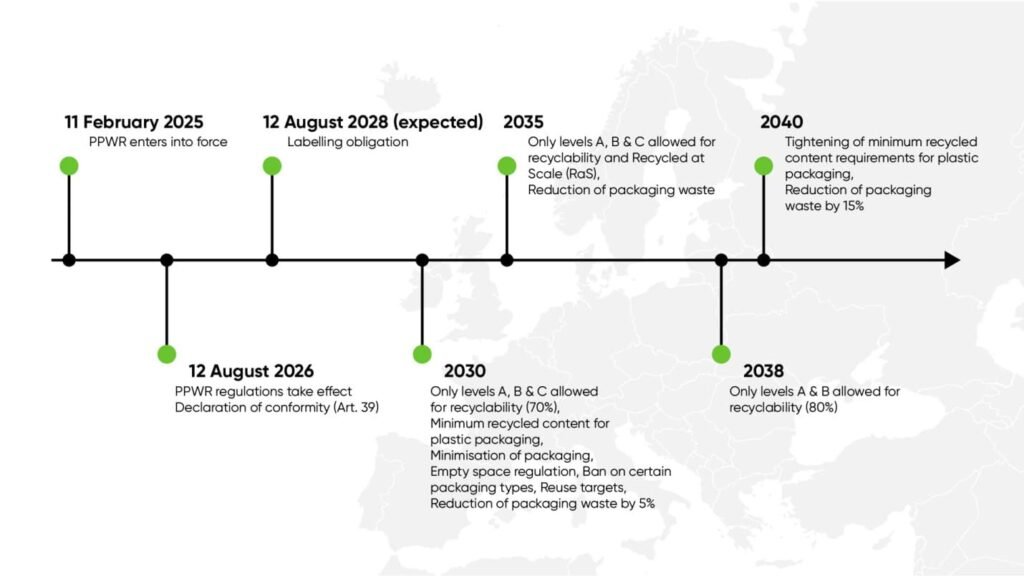
The EU Packaging and Packaging Waste Regulation. PPWR. Applies across the EU from August 12, 2026. One framework for packaging design, material info, waste reduction, recycling, producer responsibility. All of it.
Per Long-Join and its buyers, that means the box, the plastic bag, the foam, the tape, the strap, the pallet around a photocell — all of it can end up in the compliance file. Real answer? Keep the packaging data clear, traceable, easy for EU customers to actually use.
What Is PPWR, And Why Should Suppliers Care?
Think it’s just another packaging label rule? It’s not.
Covers the whole life cycle. Design, material choice, collection, waste treatment. Everything.
Kicks in August 12, 2026 across the EU. Packaging manufacturers need technical documentation and an EU declaration of conformity for packaging placed on the market. Material suppliers have to hand manufacturers the info needed to prove compliance. Some labelling duties start later — the harmonised material-composition label is one of them.
Requirement | Meaning | Why Buyers Care |
Packaging conformity | Must meet PPWR rules | Cuts compliance risk |
Technical records | Files must be kept | Gives importers evidence |
Material information | Composition must be traceable | Helps reporting, sorting |
EPR | Producer registers, funds waste duties | Affects contracts, fees |
Bottom line for a photocell manufacturer: product compliance and packaging compliance have to move together now. Not separately.
How Does Long-Join Actually Prepare For This?
Nobody wants a great photocontrol arriving with missing paperwork.
Long-Join’s approach starts before the carton even gets closed. They already publish product qualification files on their Quality Certificate page — CE, Direttiva RoHS, UL, CB, FCC, UKCA, Zhaga Libro 18, ISO 9001, plus selected REACH and ANSI reports. For packaging specifically, each order gets matched with material list, weight, and supplier evidence where it exists.
Important to keep the rules separate too. CE, LVD, EMC, RoHS relate to product or electrical compliance. PPWR is packaging. WEEE is its own thing entirely — covers waste electrical and electronic equipment, includes producer responsibility for collecting and treating that waste. Don’t lump WEEE in as “just another certificate.” It isn’t.
Goal for buyers is simple. One clear file. What the product is, how it’s packed, what evidence backs it up.
What Should A Packaging BOM Actually Show?
Confused by “packaging BOM”? Think of it as a parts list for everything protecting the product during shipping.
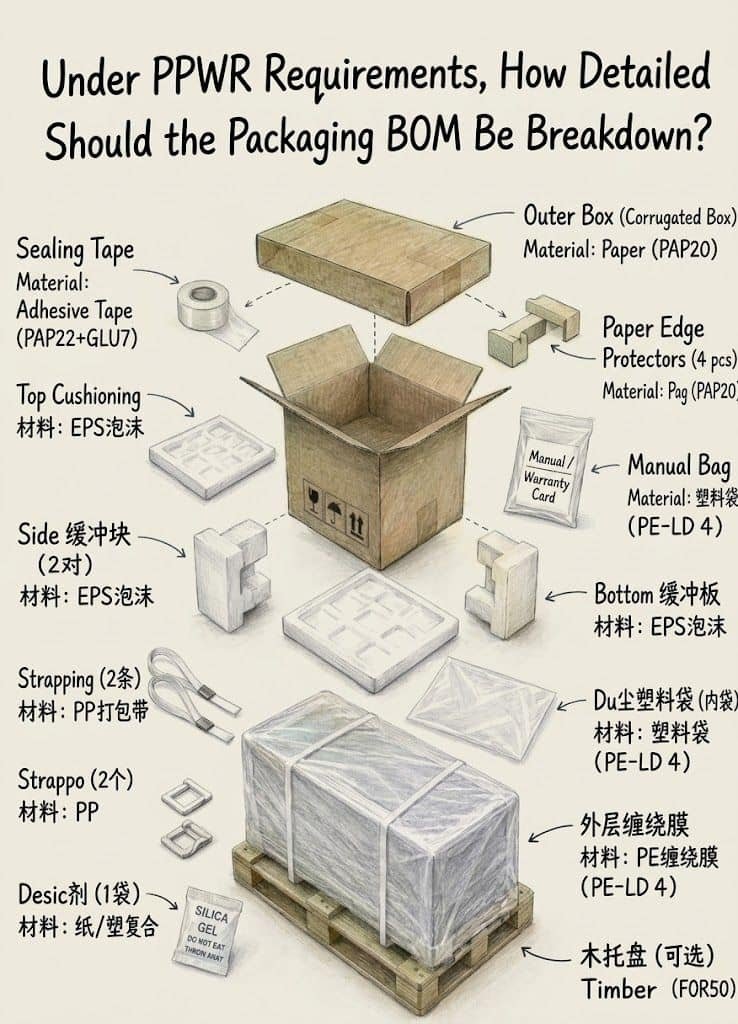
A useful BOM records each layer, its material, its weight. PPWR doesn’t demand every supplier hand over a document literally called a “packaging BOM.” But detailed material data supports technical documentation, EPR reporting, customer declarations — practically, it does the job. PPWR technical documentation can include packaging design, manufacturing details, materials used in components.
Packaging Item | Materiale | Scopo |
Outer corrugated box | Paper, PAP20 | Main shipping carton |
Paper edge protector | Paper, PAP20 | Protects corners |
Manual/warranty bag | PE-LD4 plastic | Protects documents |
Dust-proof inner bag | PE-LD4 plastic | Keeps product clean |
Cushion (top/bottom/side) | EPS foam | Absorbs shock |
Packing strap | PP | Holds carton |
Packing buckle | PP | Locks strap |
Sealing tape | PAP22 + GLU7 | Seals carton |
Outer stretch film | PE-LD4 | Wraps cartons |
Wood pallet (optional) | Wood, FOR50 | Bulk transport support |
Desiccant | Paper/plastic composite | Controls moisture |
These codes work as identifiers. Final reporting should still follow whatever the customer’s market actually requires. Break the shipment into measurable packaging parts. Don’t just treat it as one mystery carton.
Who Handles EPR — Long-Join Or The EU Buyer?
This is where export deals get confusing fast. Who registers? Who pays? Who reports?
Under PPWR, extended producer responsibility generally follows whoever first makes packaging or packaged products available in a Member State. In a normal import chain, that’s often the EU importer, distributor, or brand owner. Changes if a company outside the EU sells packaged products directly to end users inside a Member State.
Long-Join’s role is providing accurate packaging data and supporting documents. The EU buyer’s role may include registration, declarations, EPR fees — if that buyer actually meets PPWR’s definition of producer.
Put it in the contract. Who supplies data. Who registers. Who reports. Who pays fees. Who updates records. Who handles packaging changes. Skip this, and both sides end up assuming the other one’s got it covered. Nobody does.
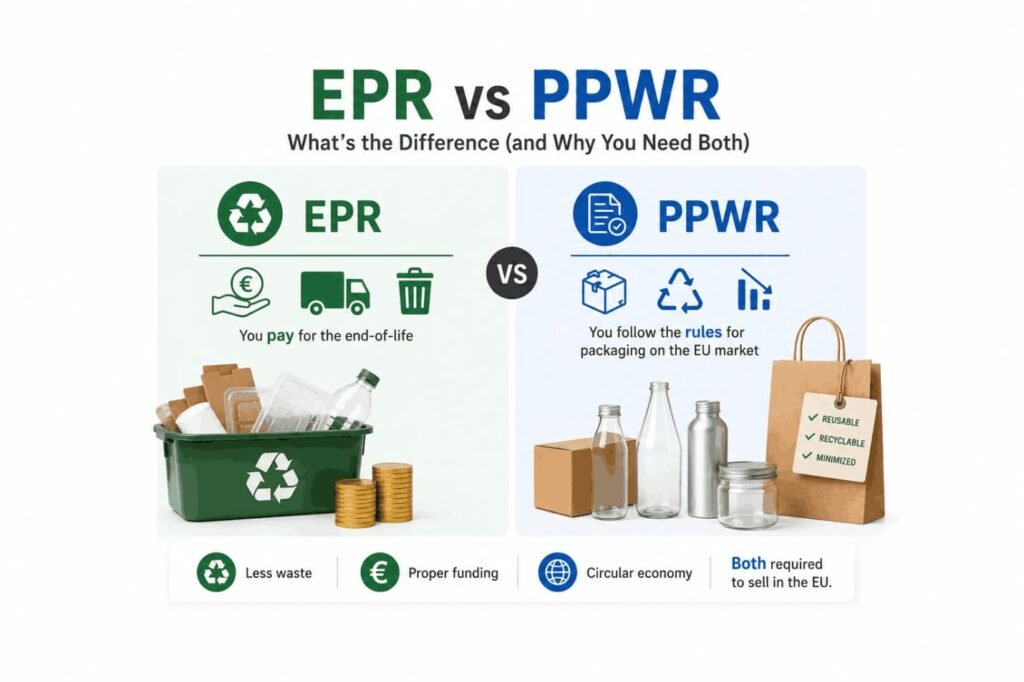
PPWR also requires producers under its EPR rules to register in the relevant Member State producer register. Which is exactly why buyers and suppliers need to sort responsibilities out before goods hit the market. Not after.
What Documents Can Long-Join Actually Provide?
Buyers need two separate files usually. One for the product. One for the packaging.
Document Group | Contains | Helps With |
Product documents | CE, RoHS, UL, CB, FCC, UKCA, test reports | Product review |
Packaging file | BOM, material descriptions, weights, supplier evidence | PPWR checks |
EPR data pack | Packaging hierarchy, material categories, weights, shipment data | Local EPR reporting |
Long-Join’s public certificate library gives buyers a starting point on product evidence. Their produttore di fotocellule pagina also covers OEM/ODM support, including custom packaging. Packaging changes? Material and weight data needs updating too. Don’t let that slip.
Buyers reviewing photocontrol receptacle info for sourcing should check the same page for certificates and testing support across product ranges.
Before shipment, request documents tied to the exact model and packaging configuration. One certificate for one product family isn’t automatic proof for every model. Ask specifically.
Why Does This Matter When Buying From China?
Low price loses its shine fast if the importer has to rebuild packaging data after goods already arrived.
Good supplier prep cuts down repeated questions, makes EPR reporting easier. Carton switches liner or cushion material? Update the BOM instead of guessing what changed.
For Long-Join, compliance becomes part of manufacturing, not an afterthought bolted on post-production. Buyers looking at a photocell, photocontrol, or receptacle need both technical performance and traceable documentation. Not one or the other.
Buyers sourcing twist-lock units should check Long-Join’s twist-lock photocell sensor range alongside the certification and packaging data required for their specific market.
Domande frequenti
The EU's regulation for packaging and packaging waste. Sets common rules for design, information, recycling, waste reduction, producer responsibility.
Combines product certificates with packaging material, weight, and supplier info so buyers get one clearer file per order.
Every packaging part, its material, its weight, its place in the structure. Cartons, bags, foam, straps, tape, film, pallets — all of it.
Depends on who qualifies as producer in the Member State. Often the EU importer or brand owner in typical B2B imports.
Relevant product certificates, packaging BOM, material and weight data, supplier evidence, shipment data for EPR reporting.
Conclusione
PPWR adds real packaging responsibilities. Gets easier when product and packaging data get prepared early instead of scrambled together later.
Clear material records, packaging BOM details, supporting compliance documents — Long-Join can help EU buyers handle reporting and EPR requirements without the usual headache.
For anyone sourcing a photocell or lighting control product, the point is simple. Confirm product compliance and packaging information before shipment. Cuts delays. Avoids missing data. Keeps the whole supply chain ready for EU market rules.c
Link esterni:
●https://environment.ec.europa.eu/topics/waste-and-recycling/packaging-waste/packaging-packaging-waste-regulation_en
●https://www.iso.org/standard/62085.html
● https://en.wikipedia.org/wiki/RoHS
●https://en.wikipedia.org/wiki/UKCA_marking
●https://environment.ec.europa.eu/topics/waste-and-recycling/waste-electrical-and-electronic-equipment-weee_en


 Italian
  English
  Russian
  Spanish
  Portuguese
  Arabic
  Japanese