
Comparative Analysis And Wiring Guide For NEMA 3-Pin Vs. 7-Pin Receptacles
Introdurre
Street lights look simple from the road. But inside the pole, one small interface often decides whether your lighting control works smoothly or turns into a maintenance headache.
That interface is the NEMA twist-lock receptacle. It’s the “socket” on top of a luminaire that lets you plug in a control device like a photocell or a smart controller.
In this guide, we compare both options side by side. We explain real wiring in plain language, so it’s easy to follow. Then we help you pick what fits your project and your budget.
NEMA Receptacle And Why It Is Important For Street Lights
fixture. It lets you install, replace, or upgrade controllers with ease. You don’t have to rewire the whole fixture.
If you’ve ever used a shorting cap while testing, you already know the value. If you’ve swapped a controller on-site in minutes, you’ve seen it too. It makes maintenance faster. Installs look cleaner. And it cuts down on wiring mistakes.
In many traditional projects, a 3-pin receptacle is often enough. It usually gets the job done. For smart systems, the 7-pin receptacle is the usual upgrade. It keeps the three power pins. It also adds low-voltage pins for control and communication. LONG-JOIN builds both ANSI C136.10 and ANSI C136.41 receptacle options for different street lighting outdoor needs.
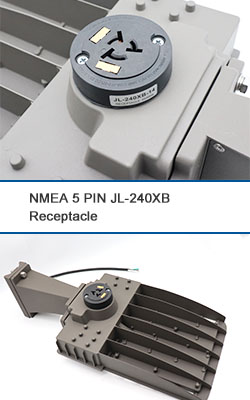
The Main Difference Between NEMA 3-Pin And NEMA 7-Pin Receptacles
The easiest way to think about it is this:
- 3-pin is mainly for power switching (ON/OFF).
- 7-pin is power switching plus dimming/control signals.
A NEMA 3-pin receptacle follows ANSI C136.10 and typically uses line, neutral, and ground—so a plugged-in control can switch power to the driver. LONG-JOIN’s ANSI C136.10 3-pin receptacle pages describe it as a match for twist-lock controls used for automatic lighting based on ambient light.
A NEMA 7-pin receptacle follows the ANSI C136.41 standard. It still has the same three power contacts. But it also adds four low-voltage contacts. These carry dimming signals, like 0–10V or DALI.
They also link to sensors and controllers for connection and control. LONG-JOIN’s ANSI C136.41 receptacles are built for LED luminaires that need multi-control through the receptacle.
Here’s the quick comparison:
Lorem ipsum dolor sit amet, consectetur adipiscing elit. Ut elit tellus, luctus nec ullamcorper mattis, pulvinar dapibus leo.
Wiring And Functional Features Comparison Table
Articolo | NEMA 3-Pin Receptacle | NEMA 7-Pin Receptacle |
Standard | ANSI C136.10 | ANSI C136.41 |
Number of pins | 3 | 7 |
Core job | Switch power ON/OFF | ON/OFF + low-voltage control |
Supporto di oscuramento | Not built in | Supports 0–10V and DALI signaling (depending on design) |
Smart expansion | Limitato | Supports smart controllers + sensors |
Best fit | Basic automatic lighting | Smart lighting + dimming + monitoring |
Typical upgrade path | Add a controller only | Add controller + dimming + sensing |
When A NEMA 3-Pin Receptacle Makes The Most Sense
If your goal is dependable “lights ON at night, OFF in the morning,” a 3-pin receptacle is often the simplest, cleanest setup.
It fits well when:
- You want basic dusk-to-dawn control using a dusk to dawn photocell sensor
- You don’t need dimming schedules
- You want a cost-effective setup for large rollouts
- Maintenance teams prefer simple parts with fewer signal lines
In practice, many cities still use 3-pin for standard GUIDATO streetlights where the control device only needs to switch power and react to light level. LONG-JOIN’s 3-pin receptacles are positioned for street, garden, passage, and doorway lighting that turns on/off based on ambient lighting.
A helpful field tip: when troubleshooting, a shorting cap is often used to keep the luminaire powered while you test or wait for a control device. LONG-JOIN’s JL-208 shorting cap is described as a temporary solution for troubleshooting and maintenance.
When A NEMA 7-Pin Receptacle Makes The Most Sense
If your project includes dimming, remote management, or add-on sensors, the 7-pin option is usually the better foundation.
A 7-pin receptacle fits well when:
- You want adaptive dimming (late-night dim, early-morning brighten)
- You need remote monitoring and alarms
- You plan to add sensors (motion, ambient, traffic)
- You’re doing a smart retrofit and want room to expand later
The key win is the low-voltage pins. They let the controller “talk” to the driver using dimming methods like 0–10V or DALI, depending on your system. Many ANSI C136.41 dimming receptacles are designed specifically for these dimming contacts while keeping the same robust twist-lock power contacts.
And the energy side is real. Studies on adaptive smart street lighting have reported savings around the mid-30% range under certain control strategies—often by dimming when roads are empty and brightening only when needed.
How To Wire A NEMA 3-Pin Receptacle The Right Way
The 3-pin wiring is straightforward because it is focused on mains power.
Most setups follow this logic:
- Line (hot) brings power in
- Neutral completes the circuit
- Ground protects the fixture and people
When you plug in a controller, it typically acts like a switch on the line path. In the day, it opens the circuit so the driver is off. At night, it closes the circuit so the driver turns on.
LONG-JOIN’s JL-230 series is described as a receptacle intended to be pre-mounted on luminaires designed to fit an ANSI C136.10 twist-lock photocontrol.
3-Pin Wiring Checklist Table
Checkpoint | What You’re Verifying | Perché è importante |
Line connected correctly | Hot feed goes to the correct lead/contact | Prevents “always on” or “never on” issues |
Neutral secured | Neutral has a solid connection | Avoids flicker and intermittent start |
Ground bonded | Ground is continuous to the luminaire body | Safety and surge reference |
Orientation mark considered | Controller points the right direction | Better sensing accuracy in real installs |
How To Wire A NEMA 7-Pin Receptacle For Dimming And Smart Features
Con 7 pin, you still wire line/neutral/ground like a 3-pin. The difference is you also wire low-voltage leads for control signals.
Those extra leads are commonly used for:
- 0–10V dimming (simple analog control signal)
- DALI (digital addressable lighting control)
ANSI C136.41 dimming receptacles are commonly offered with dimming contacts specifically intended to support 0–10V or DALI, while still providing the three twist-lock power contacts.
For DALI, the widely referenced international standard is IEC 62386.
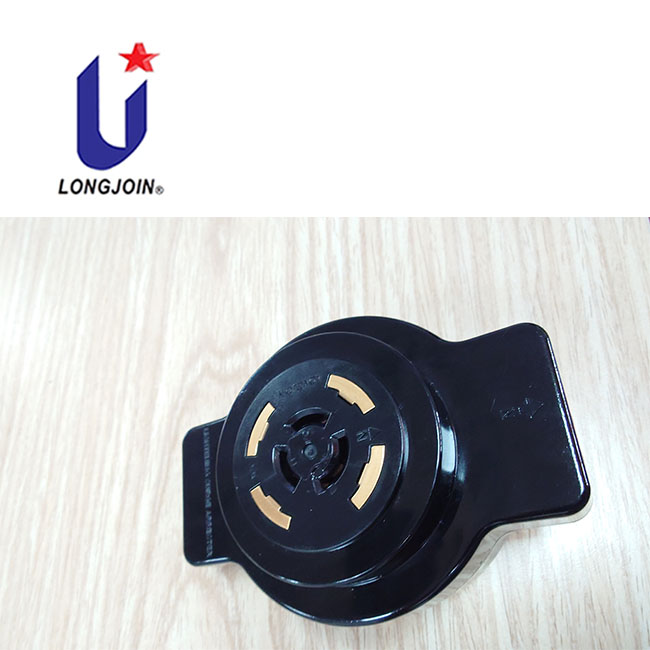
LONG-JOIN’s NEMA standard connector category also references receptacles supporting 0–10V and DALI dimming signals for smart light poles, depending on the specific model family.
7-Pin Wiring Checklist Table
Checkpoint | What You’re Verifying | Perché è importante |
Power pins wired like 3-pin | Line, neutral, ground are correct | The luminaire must power safely first |
Signal wires separated | Low-voltage wires are not mixed with mains | Prevents noise and damage |
Dimming protocol matched | Driver and controller agree on 0–10V or DALI | Avoids “dimming not working” complaints |
Controller type fits project | Smart node vs basic photocell for street light | You don’t want overkill or under-control |
Caps and accessories planned | Use shorting caps for testing/commissioning | Faster rollout and fewer service calls |
Installation Mistakes That Cause Failures And How To Prevent Them
Most failures are not “bad parts.” They are small install details that snowball.
Here are the most common ones:
- Wrong line path: the luminaire stays on 24/7 because line and load wiring were mixed.
- Loose neutral: causes flicker, random shutoffs, or driver stress.
- Signal wires tied with mains: creates noise on dimming lines and unstable dim levels.
- No plan for commissioning: installers don’t use a shorting cap or test method, so faults are found too late.
Also, choose the right photocontrol receptacle model for your environment. For example, some ANSI C136.41 receptacle designs include features like rotation limiting to match standard requirements and keep orientation stable.
Conclusione
NEMA 3-pin receptacles are the practical choice for simple automatic street lighting. NEMA 7-pin receptacles are built for smart control, dimming, and sensor-ready expansion.
If your project is staying basic, keep it simple and dependable with 3-pin. If your project needs smarter control—or will need it soon—7-pin is the better foundation.
Link esterni:
●https://www.nema.org/standards/technical/ansi-c136-series-standards-for-roadway-and-area-lighting-equipment
●https://www.dali-alliance.org/standards/IEC62386.html
●https://en.wikipedia.org/wiki/Light-espiring_diode
https://en.wikipedia.org/wiki/NEMA_connector


 Italian
  English
  Russian
  Spanish
  Portuguese
  Arabic
  Japanese