
Common Photocell Faults And Solutions For Individual Users In Daily Use
Introdurre
Your porch light is glowing away at lunchtime. Or the garden stays pitch black after sunset. Or the driveway lamp has taken to blinking on and off half the night.
Hold off on a new bulb. Quite often the bulb is fine and the photocell is the one that’s confused.
The Faults That Turn Up Most
Around the house it’s usually one of four things. The light won’t switch, or it won’t stop switching, or the relay inside is wearing out, or water and dust have got in.
Long-Join’s fotocellula crepuscolare application guide notes that a blocked sensing area can keep a light on through the day, and a sensor that can see light from its own fixture can end up switching over and over.
Light Stuck On, or Stuck Off
Lamp still on at noon? Dead dark after sunset? Don’t swap the photocell sensor yet. Go and look at what it’s looking at.
More often than you’d think, something is sitting on the window. A leaf that blew up there in the autumn. A spider that decided it was a nice spot. Paint from when the wall got redone. A soft cloth sorts most of it. Still misbehaving? Then look at the lamp, the supply and the wiring.
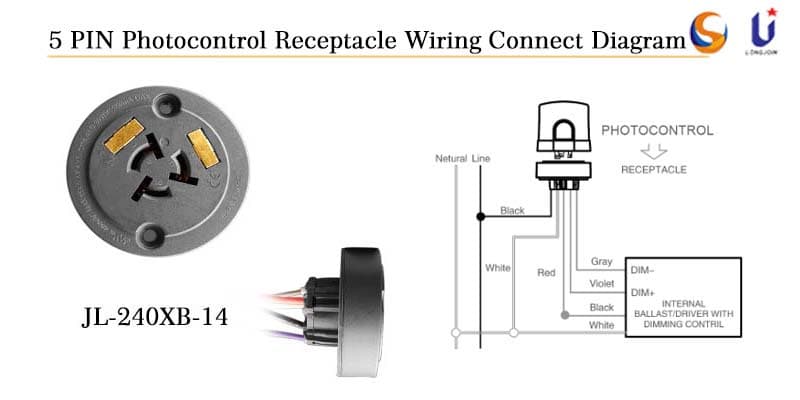
Wiring catches people out too. Mix up the line, load and neutral on a wire-in unit and a perfectly healthy control can look dead. With a twist-lock, it’s often been turned halfway and left there, so it never properly seats in the receptacle. Switch the power off at the board before you touch any wiring, and if mains voltage isn’t something you’re trained for, get a qualified electrician round.
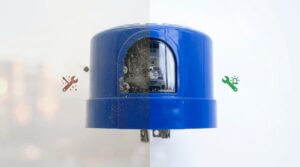
Cleaned it, checked the position, checked the wiring, still nothing? The control may simply be worn out, in which case a replacement like Long-Join’s JL-205C twist-lock photocontrol is worth a look.
When the Lamp Won't Settle
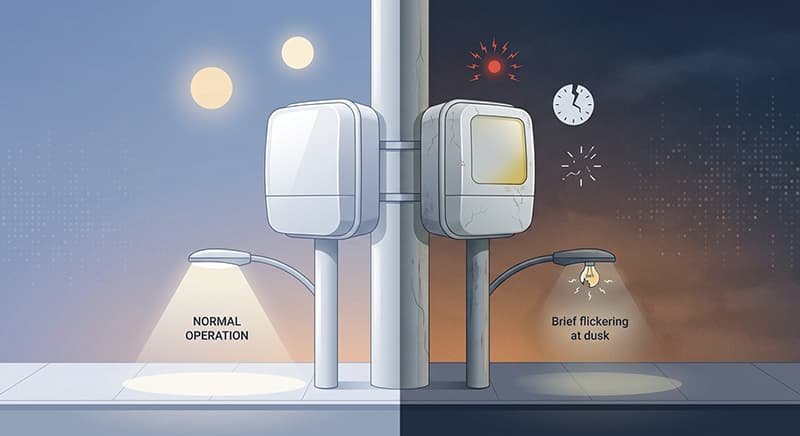
Lamp comes on, goes off a few seconds later, comes back on, and round it goes. It looks like a faulty interruttore fotocellula. Quite often it’s just pointing the wrong way.
If the lamp’s own light reaches the sensor, the unit decides morning has arrived and turns the lamp off. Then it’s dark again, so on it comes. Sometimes it isn’t the lamp’s own light at all. It might be next door’s security floodlight, headlights swinging in off the road, or glare off a freshly painted white wall.
Usually the fix is giving the sensor a different view. A quarter turn or a small shield often does it. Some controls also wait a short moment before switching, so a lightning flash or a passing car doesn’t flip the lamp. Long-Join builds that delay into several of its outdoor controls.
What Wears Out the Relay?
Sensor’s clean, yet the light only works some of the time? Then the trouble is probably inside, where the switching happens, or the lamp is pulling more than that control was ever meant to handle.
Think how often that relay works. Twice a day, every day, for years on end. It copes fine. Being pushed is another matter. A lamp heavier than its rating, a terminal that’s worked slightly loose or the wrong voltage all make it work harder, and so does an evening spent chattering on and off. Bit by bit that turns into patchy contact, and eventually nothing.
What Water and Dust Do to It
A good dusk to dawn photocell sensor can shrug off years of weather, right up until water finds its way to the electrics. After that you get corrosion, odd switching, contacts that come and go, and once in a while a short.
Dust works more quietly. It coats the window until the unit thinks the yard is darker than it is.
Have a look at the housing, the gasket, the stem and the sealing points. Long-Join’s photocontrol installation guide recommends proper sealing around certain stem-mounted controls. Where condensation might form, it also suggests running the wires downward with a drip loop, so water drips off instead of creeping toward the control.
Check the Grado di protezione IP before fitting a control somewhere exposed. If you do find water inside, turn the power off before you go anywhere near it. Once the seals have given up and the inside has corroded, a new unit is usually less hassle than trying to rescue the old one.
Looking After One at Home
A two-minute look can save you a dark garden later. Wipe the sensor window. While you’re up there, have a look round. Has someone put up a new light? Has the hedge grown? Look at the cover too. Any cracks? Any tide marks where water’s been sitting? If the power’s off at the board, give each wire a gentle tug. Changed the bulb or fitting lately? Check it isn’t more than the photocell can take.
How often? That varies a lot. If you’re by the sea, or on a dusty road, or your porch light is a moth magnet every summer, look more often. A sheltered back garden can go longer. Otherwise every so often is fine, and straight away if it starts doing something new.
The first sign is usually small. The porch light that used to come on with the streetlights now comes on while the kids are still out playing. That’s your cue for a wipe or a nudge.
Picking a Long-Join Photocell for Home Lighting
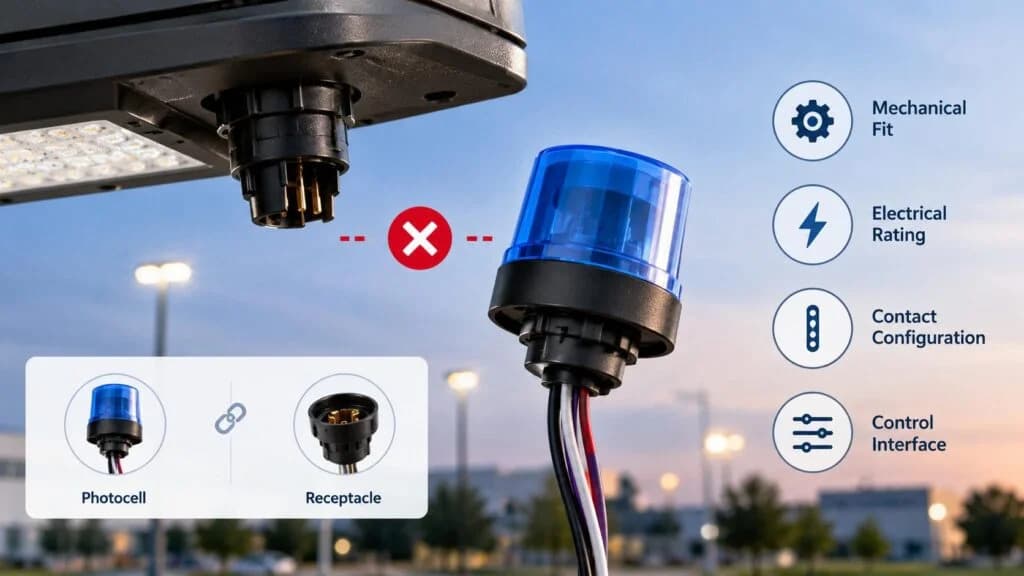
The light over your back door and the one at the end of a long driveway may need quite different controls. It comes down to voltage, how it mounts, what load it switches and how much weather it takes.
Long-Join makes both wire-in and twist-lock options.
Modello | Typical Fit | Useful Feature |
JL-205C | Garden, passage, doorway, street lighting | 110–277VAC twist-lock; IP54/IP65/IP67 options |
JL-104A | Passage and doorway lighting | 120V swivel; 180° horizontal adjustment |
JL-118A | Passage and doorway lighting | 120V stem; swivel version available |
JL-202A | Garden, passage, doorway, street lighting | 120V thermal twist-lock; time delay against false operation |
For an angled sensor there’s the JL-104A swivel photocell, or the JL-118A stem photocell for passages and doorways.
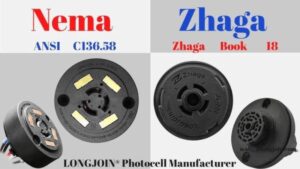
On twist-lock fittings, the JL-202 photocontrol series has the 120V JL-202A. It holds off for more than 30 seconds before switching, so a car’s headlights sweeping past won’t fool it.
Watch the model codes, though. The JL-104A runs on 120V, but other JL-104 versions are built for different voltages.
Domande frequenti
With the window and the bulb. A dirty sensor or a dead lamp is behind more of these than you'd expect. If both look fine, it's probably a loose wire, water inside, or it's just old.
It can usually see something it shouldn't. Its own lamp, a shiny wall, the headlights coming up the drive. Give it a different view, or pick a model with a time delay.
Partly. Long-Join states the voltage and load ratings, and some series add a time delay or surge protection. None of that helps if the lamp is heavier than the rating.
Your supply voltage and the lamp load. Then how it mounts, how much weather it'll take, and what socket it needs.
Conclusione
Most of the faults in this article never happen if the window stays clean, the sensor can see the sky and not much else, the lamp isn’t too heavy for it, and water stays out. When one does go wrong, do the boring checks first. A photocell that’s been fitted properly and gets wiped once in a while will usually just keep doing its job, year after year.
External Lnks:
●https://en.wikipedia.org/wiki/Twistlock
●https://electrical.com.ng/index.php?route=product/product&product_id=688
●https://www.iec.ch/ip-ratings

 Italian
 English
 Russian
 Spanish
 Portuguese
 Arabic
 Japanese