
The Impact Of Surge Protection On Photocontrols And Lighting Lifespan
Introdurre
Outdoor lighting does not fail only because of rain or heat. The bigger problem is the invisible “hit” from power surges. A surge can be triggered by lightning in the area, switching on a big load, or unstable grid events. Without proper protection, a small spike can slowly weaken a photocell and the lamp it controls, until something suddenly dies.
This article breaks the issue down in plain terms. You’ll see why surge protection matters, what goes wrong in real projects, and how surge-protected Long-join models reduce failures in the field.

Why Do Outdoor Lights Fail Even When The Wattage Looks “Safe”?
Many people assume “my lamp is 200W, the controller is 600W, so I’m safe.” That feels logical, but it ignores how outdoor power behaves.
A lamp may only consume 200W during normal running. But when it starts up, or when the grid gets noisy, the current can jump higher for a short moment. A surge is worse. It is a fast, high-energy pulse that can punch through sensitive parts inside the photocell switch long before the load rating ever becomes the problem.
Surge events are also not rare in outdoor systems. IEC’s surge immunity standard describes surges caused by switching and lightning transients, and it even defines common test waveforms used to simulate these hits in the lab.
What Happened In The “600W Photocontrol, 200W Lamp Failed” Case?
Here’s the simple version of the customer complaint:
- The customer bought a photocontrol rated for 600W.
- The lamp connected to it was 200W.
- After a few days, the lamp failed suddenly.
- The customer assumed the photocontrol was “bad quality.”
What likely happened is this: the system experienced surges that exceeded what the controller (or the lamp driver) could tolerate. The damage is not always a clean “blow up” on day one. Sometimes it is slow stress that weakens components, then the failure looks sudden.
Long-join also highlights this reality in its own product guidance by calling out built-in MOV surge protection levels (for example, 460J/10kA options) and why that matters in harsh outdoor grids.
What Are The Most Common Reasons Photocontrols And Lamps Lose Lifespan Early?
Outdoor lighting failures usually come from a small set of repeat problems. The surge issue is often the biggest one, but it’s not the only one.
The Top “Silent Killers” In Outdoor Lighting
Problem In The Field | What It Does | What You See Later |
Surge current hits the controller | Damages internal parts and weakens protection | Random on/off issues, early failure |
Mismatched load type (not just watts) | Creates abnormal electrical stress | Flicker, overheating, driver damage |
Voltage spikes and lightning transients | Pushes voltage beyond safe levels | Burnt components, dead lamp |
No real surge protection design | Makes the system “naked” in harsh grids | Frequent replacements, complaints |
Even a good photocell for street light can struggle if the system is installed in an area with unstable power and no surge strategy.
What Is Surge Protection In Simple Words, And Why Does It Work?
Protezione contro le sovratensioni is like a pressure valve for electricity. When the voltage shoots too high, the protection device reacts fast. It diverts or absorbs the extra energy before it can reach the sensitive circuit.
One of the most common protection parts in outdoor controllers is the MOV. MOVs respond quickly and can absorb energy from spikes. That fast reaction is a big reason they are used in photocontrols.
IEC 61000-4-5 is widely referenced in surge discussions because it defines surge immunity testing approaches for equipment under switching and lightning-induced events.
The key takeaway is simple: a surge-protected controller is built to “take the hit” so the lamp and control circuit don’t have to.
How Does A Surge Protector Stop Damage To Both The Photocontrol And The Lamp?
A surge can travel through the power line and reach both the controller and the lamp driver. If the controller has no strong protection, that energy can pass deeper into the circuit.
A robust surge design helps in three practical ways:
- It clamps the spike early.That means less stress enters the control circuit.
- It reduces repeat micro-damage.Small surges add up over time.
- It protects the lamp driver.Many LED failures start inside the driver, not the LED chip.
This is why people see “the lamp died” and blame the lamp brand, when the real issue was repeated surges hitting a system with weak protection.
Which Long-Join Photocontrol Models Commonly Use Surge Protection?
Long-join’s button photocell guidance clearly positions JL-423C for harsher environments and notes built-in MOV surge protection as part of why it fits high-power poles and tough grids.
From your outline, these are the models to focus on:
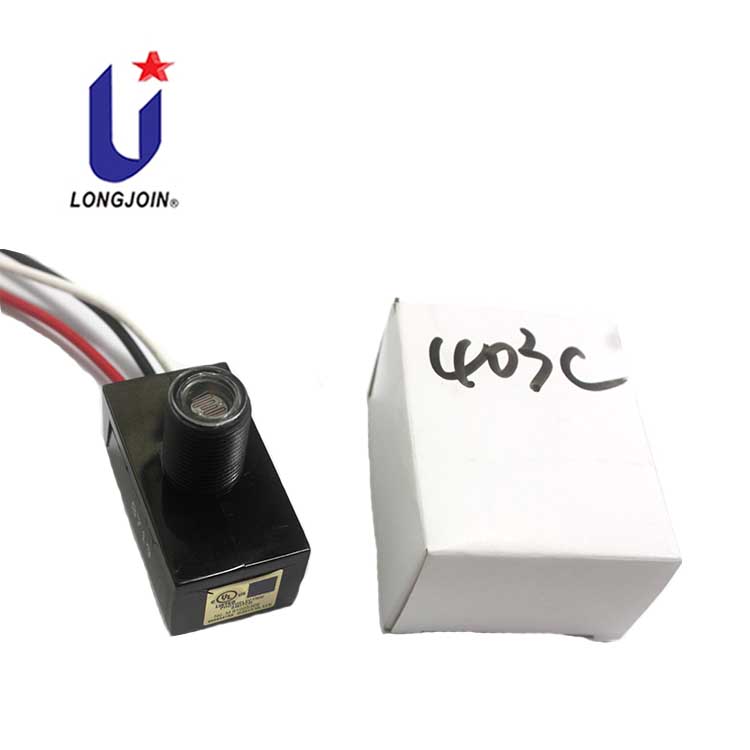
Long-join also documents surge arrester options such as MOV 460 Joules / 10,000 Amps, which aligns with the “MOV23” choice shown in its customization list.
Quick Comparison Table
Modello | Where It Fits Best | Why It Helps Lifespan |
JL-423C | Harsh outdoor grids, higher-power fixtures | Built-in MOV surge protection helps reduce spike damage |
JL-423CM | Same environments, but more demanding conditions | Enhanced surge options + zero-cross support in the family line |
JL-403 Series (and variants) | Universal-voltage fixtures, compact installs | Time delay helps avoid mis-operation from brief light events |
If you’re dealing with unstable power, pairing surge protection with correct wiring and correct load type is what stops repeat failures.
What Does “460 Joules / 10kA” Actually Mean In Real Life?
This is the part many buyers see on a spec sheet and ignore. But it matters.
- Joules(energy rating) tells you how much surge energy the MOV can absorb before it degrades.
- kA (kiloamps)relates to surge current handling capability.
Long-join lists built-in MOV options such as 460 Joules / 10,000 Amps as a selectable protection level.
Here’s the simplest way to think about it: higher surge ratings usually mean the controller can survive more surge events before protection weakens.
Surge Rating “Rule Of Thumb” Table
Ambiente | Typical Risk Level | Practical Recommendation |
Stable city grid, short cable runs | Inferiore | Basic surge protection may be enough |
Areas with unstable voltage or long outdoor runs | Medio | Choose a controller with stronger MOV options |
Lightning-prone zones / exposed poles | Alto | Use surge-protected controller + add system-level surge protection too |
A controller can be strong, but if the site is extreme, you still want system-level protection upstream. That’s how utilities reduce repeat truck rolls.
How Do You Choose Surge Protection Without Overbuying?
You don’t need the biggest number just to feel safe. You need the right match for the site.
A Simple Checklist Table
Domanda | If “Yes” | Perché è importante |
Is the site exposed (open roads, poles, wide outdoor areas)? | Choose higher surge protection | Exposure increases lightning-induced events |
Do you see frequent lamp driver failures? | Upgrade surge strategy | Driver damage often points to surge stress |
Is the grid known for spikes or sudden drops? | Prefer surge-protected models | “Dirty power” ages electronics fast |
Are cable runs long and outdoor? | Add more protection | Long lines can pick up surge energy |
If you’re buying for street lighting outdoor projects, this checklist saves money because it cuts replacements and callbacks, not because it chases specs.
Conclusione
Surge protection is not a “nice extra.” It is one of the main reasons outdoor lighting stays reliable over time. The watt rating alone does not protect you from surge pulses, switching spikes, or lightning-induced transients.
When you match the right surge-protected photocontrol to the real site conditions, you reduce sudden failures, protect lamp drivers, and extend system life. That is what customers notice: fewer replacements, fewer complaints, and steadier controllo dell'illuminazione.
Link esterni:
●https://en.wikipedia.org/wiki/Light-espiring_diode
● https://en.wikipedia.org/wiki/Surge_protector
●https://en.wikipedia.org/wiki/Varistor
https://webstore.iec.ch/en/publication/4223

 Italian
  English
  Russian
  Spanish
  Portuguese
  Arabic
  Japanese