
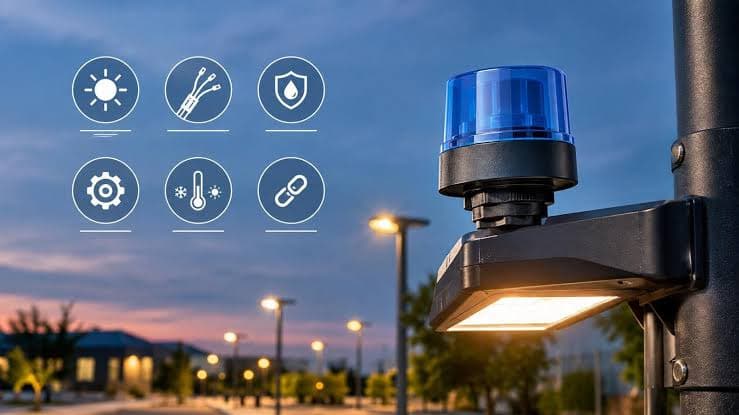
Why Are Some Lighting Fixtures Not Suitable For Adding Photocell Controllers?
Introducir
A photocell looks like the easiest upgrade in lighting.
On the right fixture, that’s true. On the wrong one, it causes more trouble than it fixes.
Some lights just aren’t built for it. They might already have their own controls. The housing might be sealed. There might be no room inside, or nothing for the sensor to see through, or no socket to plug into. Force a controller in anyway and you can end up with leaks, safety problems, or a lamp that switches at strange times.
Fixtures That Don't Take a Photocell Easily
Not sure if a fixture can take an external controller? Look at how it’s powered, sealed and already controlled.
Fixture Type | Why It Can Be a Problem | Better Direction |
Integrated solar streetlights | Often have built-in sensing and battery control already | Use the original or a compatible solar control |
Sealed explosion-proof fixtures | Drilling may affect sealing and certification | Use an approved control method |
Compact wall or decorative lights | No room for a twist-lock unit or extra wiring | Consider a small wire-in photocell switch |
Fully enclosed globe and post lights | The cover can stop the sensor reading outdoor light | Put the sensor where it sees daylight |
LED wall or floodlights with built-in photocells | A second sensor means double control or false switching | Keep the built-in control |
LED streetlights without a NEMA interface | A twist-lock unit has nowhere to plug in | Pick a compatible fixture or add the interface at design stage |
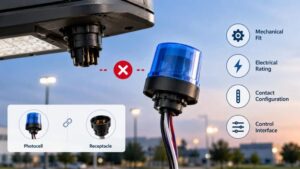
A photocell sensor needs two things. A proper electrical connection, and a clear view of outdoor light. Take away either one and the control gets unreliable.
Why Do Solar Streetlights Fight With Extra Photocells?
Does your solar streetlight already come on by itself at night? Then it has its own control logic. A lot of integrated models pack the panel, the battery, the LED driver and the light sensing into one unit.
Now add another control de fotocélula. You’ve got two devices trying to run one lamp.
One decides it’s dark. The other isn’t so sure yet. The lamp comes on early, late, or flicks about before settling.
So check the original controller first. If automatic lighting is already there, another dusk to dawn photocell usually isn’t needed.
Sealed and Explosion-Proof Fixtures Are a Different Story
Thinking of drilling one small hole in a sealed fixture? That hole changes the whole enclosure.
Explosion-proof and tightly sealed lights depend on their original joints, glands and seals. Open the body up and it may not keep out water, dust, gas or vapour the way it did when it was tested.
Picture a light hanging in a chemical plant. Its housing isn’t just a cover. It’s part of the safety design.
Use a control solution approved for that fixture. Or, where the design allows it, put the control outside the sealed housing. Drilling a hole for a light sensor may not be a safe shortcut.
What Usually Gets in the Way?
Why does one fixture take a controller with no fuss while the one next to it won’t? Most of the time it comes down to one of five things.
Obstacle | What Can Go Wrong |
Physical limits | No room, no flat spot, no opening for a sensor or NEMA socket |
Functional conflict | Built-in and added sensors both try to control the lamp |
Protection loss | Cutting the housing weakens waterproofing or dust sealing |
Sensing distortion | A globe, wall, cover or the lamp’s own light skews the reading |
Maintenance difficulty | Custom wiring and odd mounting make replacement harder |
That’s why the first question should be “Can this fixture take a photocell?” Only after that comes “Which photocell should I buy?”
A controller that fits badly can work fine on day one. Six months later a technician is up a ladder in the rain trying to get it out. Multiply that across a few hundred fixtures and the labour bill grows fast.
Can Small Wall Lights and Floodlights Still Use One?
Yes. A small wall pack or floodlight can still switch itself on and off. A big twist-lock unit just might not be the right part for it.
Compact fixtures often don’t have space for a photocontrol receptacle. A wire-in or button sensor tends to fit better. Long-Join’s JL-412C miniature button photocell needs only a small M10 mounting hole and carries an IP65 rating. The JL-103A button photocell is also made for floodlights, garden lights and wall-mounted lights.
Say the lamp shines straight onto the sensing window. The sensor reads its own light and thinks it’s daytime. Off goes the lamp. Then on again. Round and round.
Streetlights Need the Right NEMA or Zhaga Socket
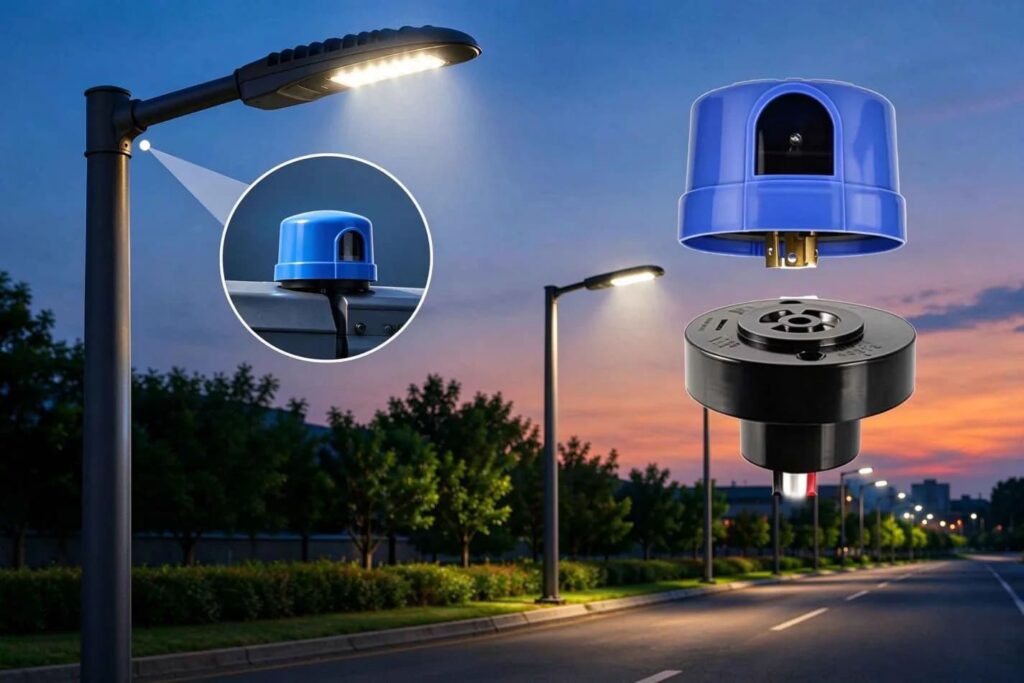
Planning to fit a twist-lock controller to an LED streetlight? Look at the socket first.
Long-Join’s JL-240XA NEMA 7-pin receptacle follows ANSI C136.41. It has low-voltage contacts for extra control functions. For smaller smart-lighting modules, there are the JL-700 Zhaga Book 18 sockets.
The interface really belongs in the fixture design from the start. With a NEMA socket, swapping a twist-lock controller takes minutes. A Zócalo Zhaga works well for smaller low-voltage smart modules.
Without a reserved interface? You’re looking at drilling, extra wiring or a custom mount. At that point, a different fixture is often the simpler answer.
What Should Buyers Check Before Ordering?
Buy the lamp first and think about controls later, and you may end up drilling, hunting for adapters, or changing fixtures altogether. Check for a standard interface. Check for controls already inside. Think about the site and who will maintain it.
For bigger street and area lighting jobs, Long-Join supplies twist-lock photocontrols along with NEMA and Zhaga interface products. That way the controller can be matched to the lamp at the start. Nobody has to cut into an unsuitable fixture later.
Picking the Right Photocell Setup
Lost in socket and sensor options? Start with the fixture. Leave the controller for later.
Does the lamp already switch itself? Check that first. After that, the receptacle. Then the voltage. Then space, waterproofing and where the sensor sits.
Small fixtures often suit wire-in controls. NEMA streetlights usually suit twist-lock units. Compact smart luminaires can work better with Zhaga.
Need heavy cutting or rewiring just to get the controller in? Look at the fixture again. A design that was ready for it is easier to install and replace.
Preguntas frecuentes
Most already have built-in sensing and battery control. Add another photocell and the two can end up fighting over the lamp.
Opening the sealed housing can let in dust, gas, water or vapour. It can also undo the certified design the fixture was tested to.
A compatible wire-in controller can work. So can an external control box. The cleaner option is a fixture designed with a NEMA or Zhaga interface.
Sometimes. Both controls have to be designed to work together, so check the wiring and the control logic before adding anything.
Look for a compatible NEMA receptacle. Then confirm the fixture voltage and the controller standard before you place the order.
Conclusión
A célula fotoeléctrica only helps when the fixture is ready for it. Sealed lights, small decorative fittings, solar streetlights and lamps with sensors already inside may need a different approach.
Look at the interface. Look at the space and the sealing. Check where the sensor will sit and what controls are already there. Do that before buying, and the install goes in clean.
Enlaces externos:
●https://www.zgsm-china.com/blog/nema-vs-zhaga.html
●https://www.te.com/content/dam/te-com/documents/appliances/global/lumawise-endurance-n-rotatable-dimming-receptacle.pdf
●https://en.wikipedia.org/wiki/Twistlock


 Spanish
 English
 Russian
 Portuguese
 Arabic
 Japanese
 Italian