
Function Comparison Analysis Of Long-Join Smart Light Controllers JL-246CG And JL-723A1
Представлять
Cities and utilities are not just buying “boxes” anymore. They are choosing smart building blocks for future lighting networks. Long-Join’s JL-246CG and JL-723A1 sit in that space: both are compact controllers that plug into modern luminaires, but they solve slightly different problems.
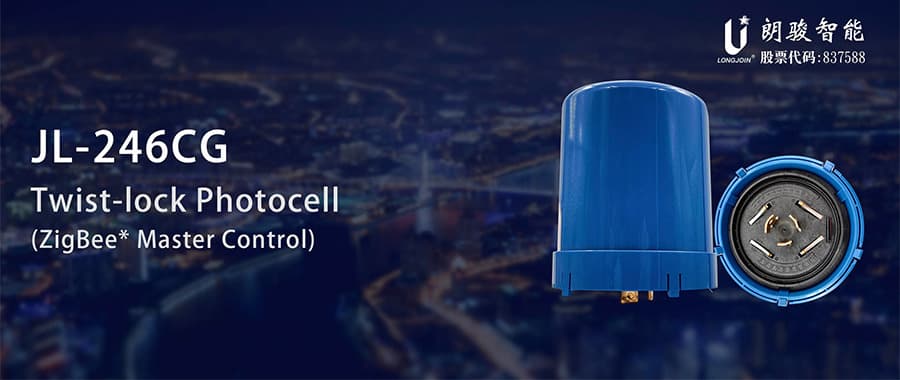
JL-246CG works as a Zigbee master street light controller with 0–10V dimming, usually sitting in a NEMA-style head and talking to many field nodes. JL-723A1 is a compact Zhaga sensor/controller with DALI-2 dimming, light sensing and motion detection designed to sit closer to the light source.
What Are JL-246CG And JL-723A1 Designed To Do In A Smart Lighting Project?
If you see JL-246CG as the “coordinator” and JL-723A1 as the “local sensor brain”, the picture becomes clear.
- JL-246CG
- A master street light controllerwith Zigbee mesh and LTE uplink.
- Typically mounted in a twist-lock head on the top of a luminaire, in a photocontrol receptaclethat follows the NEMA form factor.
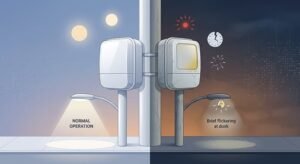
- Talks to downstream nodes such as JL-245CZ and pushes data to the cloud, supporting dusk-to-dawn photocellcontrol and group dimming.
- JL-723A1
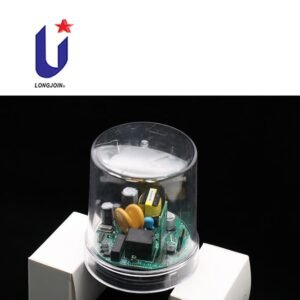
- A compact Zhaga sensor/controllerwith DALI-2 dimming output.
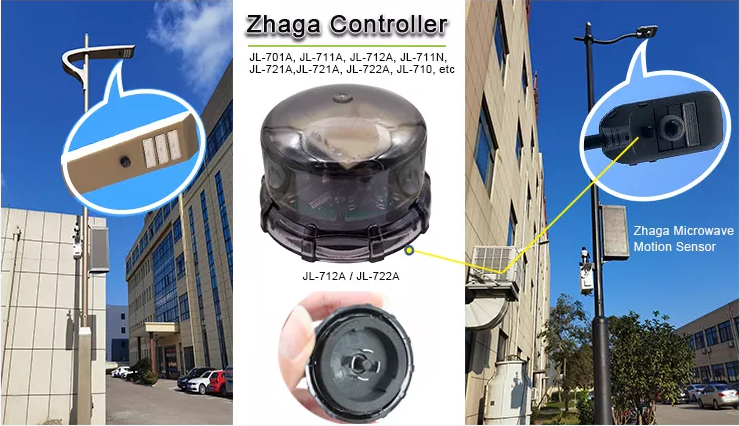
- Plugs into a Zhaga socket on the side or bottom of a luminaire, close to the LED driver.
- Combines light sensing with PIR/motion detection for local, on-demand dimming and presence-based control.
Basic Positioning Table
Элемент | JL-246CG | JL-723A1 |
Main Role | Zigbee master street light controller | Local Zhaga sensor/controller |
Typical Mounting | Top of luminaire, NEMA-style head | Side/bottom, Zhaga interface |
Main Use | Remote management, group dimming, dusk-to-dawn | Local sensing, presence-based dimming |
Регулировка яркости выходного сигнала | 0–10V (and PWM in some variants) | DALI-2 digital bus to driver |
Network Role | Uplink to cloud + downlink to many nodes | Node-level device inside one luminaire |
How Do NEMA And Zhaga Interfaces Change Your Installation Strategy?
и Жага hardware philosophies. That shows up in how you design and install poles.
NEMA style (JL-246CG)
- Uses a round twist-lock base, often called a nema socket, sitting on top of the luminaire.
- Plenty of space for higher-power electronics, wireless radios and surge protection.
- Very common in North American–style road lighting, with many legacy fittings already using twist-lock photocell
Zhaga style (JL-723A1)
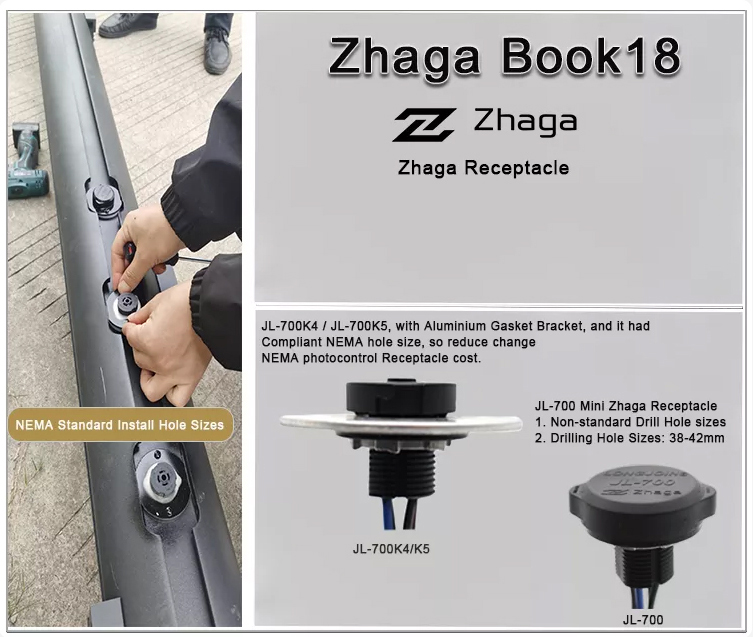
- Follows Zhaga Book 18/20 compact interface for sensors and control nodes (Zhaga-D4i).
- Lower profile, often side- or bottom-mounted on the luminaire body.
- Designed for plug-and-play sensors and communication nodes with guaranteed interoperability.
Interface Comparison Table
Аспект | NEMA (JL-246CG) | Zhaga (JL-723A1) |
Typical Socket Name | NEMA 3/5/7-pin head/ photocontrol receptacle | Zhaga Book 18 / 20 interface |
Mounting Position | Top of luminaire | Side or bottom of luminaire |
Space For Electronics | Larger volume, good for radios + surge + sensing | Compact, optimised for low-power sensor/controller |
Типичное использование | Twist-lock photocell heads and controllers | Plug-in sensors, D4i control nodes |
Лучший вариант | Highway, main roads, retrofits with existing NEMA | New LED projects, smart-ready luminaires, tight spaces |
Which Dimming Protocol Fits Better: 0–10V Or DALI-2.0?
Both controllers dim LED drivers, but they speak different “languages”: 0–10V for JL-246CG and DALI-2 for JL-723A1.
0–10V with JL-246CG
- Simple, analog signal: 0 V ≈ off, 10 V ≈ full brightness.
- Very well known in outdoor and industrial projects; many drivers already support it.
- Easy to commission and troubleshoot with a multimeter.
- Less suitable when you need rich feedback from each driver (energy, faults, runtime).
DALI-2 with JL-723A1
- Digital, two-way protocol defined in IEC 62386.
- Each driver and sensor has an address; the system can ask for status and diagnostics.
- Ideal when you want scene-based control, flexible grouping and remote fault reporting.
- Requires DALI-2-ready drivers and careful bus wiring, but the result is a more intelligent network.
Dimming Protocol Table
Фактор | JL-246CG (0–10V) | JL-723A1 (DALI-2.0) |
Signal Type | Analog voltage | Digital, addressable bus |
Communication Direction | One-way (controller → driver) | Two-way (status and diagnostics from driver) |
Driver Requirements | Any 0–10V-capable driver | DALI-2 / D4i driver |
Typical Complexity | Низкий | Medium–high |
Лучший вариант использования | Cost-sensitive retrofits, simple profiles | Smart projects needing fine-tuned lighting control |
How Do The Two Controllers Sense Light And Motion In Real Streets?
Sensing is where the two modules really diverge. Both rely on light measurement, but only JL-723A1 adds motion.
JL-246CG – light-focused sensing plus remote logic
- Uses an optical system and internal photocell-style sensor to measure ambient illuminance over a broad spectral range, then runs dusk-to-dawn strategies.
- Acts as part of Long-Join’s интеллектуальный фотоэлементный датчикfamily, where the controller can combine local lux levels with cloud-side rules (weather, events, time schedules).
- Best when your main trigger is natural light plus central schedules, not human movement.
JL-723A1 – dual sensing for “on-demand” light
- Combines light sensing with PIR (or, in some variants, microwave) motion detection, using the Zhaga form factor.
- Can keep luminaires at a low standby level, then boost to full when people, bikes or vehicles enter the detection zone.
- Fits the Zhaga-D4i trend where a compact sensor provides both occupancy and lux data over the DALI-2 bus.c
Sensing And Control Table
Аспект | JL-246CG | JL-723A1 |
Светочувствительность | Yes – wide spectral light sensing | Yes – light sensor built in |
Обнаружение движения | Not built-in (handled by network or other nodes) | Yes – PIR / motion mode integrated |
Main Control Logic | Cloud + gateway logic via Zigbee/LTE | Local sensor logic over DALI-2 |
Typical Behaviour | Dusk-to-dawn, time-based profiles | On-demand boost with standby dimming |
Ideal Scenes | Highways, industrial roads, uniform lighting | Paths, parks, plazas, mixed-use streets |
How Do Spectral Response And Pole Height Affect Project Performance?
Light sensors are not just “on/off” switches. Their spectral response and mounting height shape when and how lights react.
JL-246CG – broad spectral window for stable dusk-to-dawn control
- The module’s optical system measures light across a wide spectral range (typically around 350–1100 nm, with a peak near the visible band) to track natural dusk and dawn reliably.
- When you mount JL-246CG at standard pole heights (for example 8–12 m), it “sees” sky and ground reflections rather than only a nearby light source, which helps avoid false switching.
- Paired with Long-Join’s other photocellproducts, it can be tuned for regional skyglow and weather conditions.
JL-723A1 – mid-height motion sensing with recommended limits
- PIR or microwave sensorshave a practical detection cone. In many designs, optimal results are reached when the luminaire is up to around 10–12 m, with a detection radius of roughly half that height.
- Beyond that, small moving objects become harder to distinguish and “dead zones” appear. To keep energy use under control, many operators set brightness to drop when motion is no longer detected within that radius.
- In real deployments, these parameters are often set per road type: lower mounting for pedestrian areas, slightly higher for car lanes, but still inside the sensor’s sweet spot.c
Installation And Height Table
Параметр | JL-246CG | JL-723A1 |
Main Sensing Focus | Sky/ambient light | Ambient light + motion |
Typical Pole Height Range | Standard road poles (e.g. 8–12 m) | Mid-height poles (often ≤ 12 m recommended) |
Risk If Too High | Slightly less accurate lux reading | Motion missed, shorter effective radius |
Design Tip | Keep a clear view of sky, avoid strong backlight | Align sensor cone with target area (sidewalk, crossing, lane) |
What Does The Power Consumption Difference Mean For Energy And Opex?
Controllers do not use much power compared with luminaires, but across thousands of poles, every watt counts.
JL-246CG – low standby consumption
- Manufacturer data shows typical consumption around 1.2 W in steady operation.
- That makes it attractive for large rollouts where you want wireless control plus a modest energy overhead.
JL-723A1 – higher draw, but more sensing
- JL-723A1 integrates sensors and a DALI-2 controller; naturally its power draw is higher than a simple head.
- In return, you avoid external motion sensors, extra wiring and separate controllers, which would also consume power and take space.
To see the impact, use a rough rule of thumb:
- 1 W running 24/7 ≈ 8.76 kWh per year.
- On a 10,000-pole project, adding 5 W per pole just for extra electronics could mean ~438,000 kWh per year.
Power Consumption Table
Фактор | JL-246CG | JL-723A1 |
Typical Power Use | ≈ 1.2 W (steady operation) | lower, due to sensing + DALI logic |
Extra Components Needed | Often works with separate end-nodes | Combines sensor + controller in one |
Opex Impact In Large Fleets | higher per-node, due to adding nema receptacle cost | lower per node, no any tool you can direct mount, and book 18 socket much lower |
Best Optimisation Strategy | Focus on central optimisation and profiles | Focus on deep local dimming and demand response |
Заключение
A simple way is to ask three questions: What is my luminaire interface? What kind of control do I need? How much sensing per pole?
In many modern tenders, the most robust solution is hybrid: JL-246CG or similar NEMA controller as the backbone, combined with Zhaga sensors like JL-723A1 in target zones that need local intelligence. Long-Join already builds this thinking into its wider portfolio of photocell switches, smart Zhaga modules and semi-finished controllers like JL-265CX for customised projects.
Внешние ссылки:
●https://www.zhagastandard.org/index.php?option=com_content&view=article&id=340:zhaga-enables-iot-upgradeable-outdoor-led-lighting-fixtures&catid=22
●https://www.nema.org/membership/products/view/lighting-systems
●https://www.dali-alliance.org/standards/IEC62386.html
●https://www.sciencedirect.com/topics/earth-and-planetary-sciences/microwave-sensor

 Russian
  English
  Spanish
  Portuguese
  Arabic
  Japanese
  Italian