
Why Cheap Outdoor Photocells Fail In Coastal Cities
Introduzir
Coastal cities in Brazil, Chile, Ecuador, Colombia, and Mexico look beautiful, but the air is tough on outdoor electronics. Salt fog, heavy humidity, strong UV sunlight, storms, and corrosion can turn a “cheap” dusk-to-dawn sensor into a short-term fix.
When a low-grade photocell fails, it is not just one small part to replace. It can shut off lights, damage relays, and lead to more truck rolls. In systems with hundreds or thousands of lights, the cost can rise fast.
Why Do Coastal Environments Break A Typical Outdoor Photocell So Fast?
Coastal air is harsh. It puts daily stress on every outdoor seal and connection.
Salt mist can carry electricity when it gets wet. That makes metal parts rust faster. Humid air also drives water into weak seams. UV rays break down plastic over time. The housing fades, cracks, and gets weak. Photodegradation happens when sunlight breaks down polymers. It can crack the surface and cause damage to the material.
Here is a simple way to see what the coast is doing to a device every day:
Coastal Stress | What It Does | What You Often See In The Field |
Salt Fog | Speeds up corrosion on metal parts and terminals | Rusty terminals, bad contact, random switching |
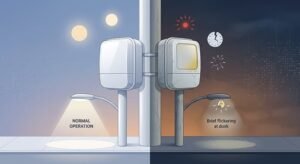
High Humidity | Forces moisture into weak seals | Short circuits, flickering, “stuck ON” or “stuck OFF” |
Strong UV | Weakens plastics through long exposure | Yellowing, cracks, brittle housing |
Storms / Wind | Adds shock, vibration, and water impact | Loose parts, water entry, broken covers |
Why Does Poor Waterproof Protection Cause Fast Failure?
Because water only needs one small path to ruin a sensor.
Cheap units often have poor seals. Their housings are thin, and IP protection is low. Once moisture gets in, it can rust metal parts. It can also cause short circuits and unstable switching.
A simple rule helps buyers: an Classificação IP is about how well an enclosure blocks dust and water. IEC 60529 defines the IP code system used worldwide. If your project is near the ocean, you want sealing that is built for real outdoor spray, not “light splashes.”
Also, many coastal problems start small: a tiny gap, a poor gasket, or uneven glue. Then humidity does the rest.
Why Does Weak UV Resistance Crack Cheap Photocells?
Because sunlight slowly “eats” weak plastic.
Cheap plastic housings may discolor, chalk, or become brittle after long sunlight exposure. Once the housing starts cracking, the waterproof seal usually fails next—then the internal electronics are exposed to moisture and salt.
Photodegradation is commonly described as sunlight + air causing oxidation and damage in materials, including plastics, which can lead to cracking and failure over time.
So Resistência UV is not “nice to have” near the coast. It protects the housing first, and the electronics second.
How Does Salt Fog Corrosion Destroy Dusk-To-Dawn Sensors?
Salt mist testing exists for a reason: it is a real-world killer for metal parts.
IEC 60068-2-11 is an international test method used to assess corrosion resistance of electrotechnical products in a salt mist environment. That tells you the industry already treats salt fog as a serious environment that needs proper design and materials.
In cheap products, salt fog can speed up:
- terminal rust and oxidation
- relay contact damage
- unstable electrical contact points
Once the contact area is damaged, the photocell may start switching randomly, fail to turn on at night, or stop turning off in the morning.
Why Does Low Mechanical Strength Matter During Coastal Storms?
It may work today. That does not mean it will survive next month’s weather.
In coastal areas, strong winds and storms can shake fixtures. They can strain covers and push water through weak seams. If the housing is thin or brittle, UV damage can make it worse. It may crack or come loose.
That is why a strong, heavy-duty structure matters. A tough housing helps the seal stay tight. And a stable base helps prevent internal movement that can damage wiring and contacts over time.
What Does The Failure Comparison Look Like In One Table?
If you want a fast decision tool, compare design outcomes—not just price.
Problema | Cheap Photocell | LONG-JOIN Solution |
Impermeabilização | Weak sealing | Options including IP65 / IP66 designs (model-dependent) |
Resistência UV | Ordinary plastic | Outdoor-ready structure choices and UV-focused designs |
Corrosion Resistance | Baixo | Reinforced materials and corrosion-focused options |
Relay Lifespan | Short | Long-life relay designs (series-dependent) |
Outdoor Durability | Limitado | Heavy-duty design options for harsh sites |
Por exemplo, LONG-JOIN’s JL-207C series listing notes multiple IP options (depending on configuration), and positions the series for automatic outdoor lighting control.
Which LONG-JOIN Models Make Sense For Coastal Projects?
Pick based on your site type: roadway, smart-city node, or compact control point.
Which Model Fits Coastal Roadway Lighting Best?
If you need a strong everyday roadway controller, JL-207C is a common starting point. LONG-JOIN positions JL-207 series photocontrols for street and outdoor area lighting control, and the product page lists multiple IP rating options depending on build choices.
Which Model Works Best For Coastal Smart Cities?
If your project needs smart-node compatibility and stronger sealing, look at the JL-240F receptacle family. The JL-240FXA page describes an enhanced sealing approach (including O-rings and silicone sealing) and lists an IP66 rating for that model.
This kind of design is useful when you want a smarter control setup while still protecting the connection point.
Which Model Is A Compact “Simple And Stable” Option?
JL-126A is described by LONG-JOIN as a heavy-duty die-cast aluminum swivel photocell switch, and it also mentions corrosion-focused material options for harsh environments like chlorine and salt spray conditions.
That is useful when size and rugged housing matter.
How Can Buyers Avoid Coastal Photocell Failures Before They Happen?
Use a short checklist before you approve a purchase order.
Coastal failures usually come from predictable weak points: sealing, UV, corrosion, and surge stress. Your goal is to remove “unknown quality” from the system.
IEC 60529 says IP ratings use two numbers. One shows dust protection. The other shows how well it resists water. For coastal lighting, you need protection from water jets, not just splashes.
This simple buyer table will help.
Buyer Check | What To Ask For | Why It Matters At The Coast |
Classificação IP | IP65/IP66 for outdoor enclosures | Better defense against wind-driven rain and spray |
Resistência UV | UV-stable housing material | Prevents cracking that leads to water entry |
Salt Mist Readiness | Salt mist / salt fog testing approach | Helps verify corrosion resistance |
Proteção contra surtos | Surge-protected designs when needed | Storms often bring voltage spikes |
Proof, Not Promises | Data sheets, certifications, real model specs | Avoids “cheap but unclear” product risk |
Perguntas frequentes
Salt mist plus humidity speeds up corrosion and helps moisture enter weak seals. Over time, switching becomes unstable or the unit stops working.
Salt mist attacks metal terminals and contact points, causing oxidation and poor electrical contact. That can lead to relay damage and random switching.
A common target is IP65/IP66, because IEC 60529 defines these as strong protection levels for dust and water jets/powerful water jets.
UV sunlight can degrade plastics over time, leading to discoloration, brittleness, and cracking—then moisture enters more easily.
JL-207C is widely positioned for street lighting control, and its product page lists multiple configuration options and IP ratings depending on the build.
Conclusão
fast. Weak sealing fails. Poor UV protection breaks down. Low corrosion resistance leads to rust. The relay life is short.
Choose models made for rough outdoor use. Then check the specs for long-term reliability. LONG-JOIN options like JL-207C, JL-240F series receptacles such as JL-240FXA, and JL-126A are made for coastal use. They focus on strong sealing and durable materials.
Links externos:
●https://www.sciencedirect.com/topics/engineering/photodegradation
●https://www.iec.ch/ip-ratings
●https://en.wikipedia.org/wiki/IP_code

 Portuguese
  English
  Russian
  Spanish
  Arabic
  Japanese
  Italian