
The CB Scheme Is Globally Recognized, But We Need to Understand 12 Common Misconceptions Correctly
Introduzir
The CB Scheme is one of the most widely referenced systems in international product certification, and also one of the most consistently misunderstood.
The misconception that a CB certificate is a global market authorisation has caused real problems for manufacturers who relied on it without understanding its actual scope.
Correcting these misconceptions before they influence procurement or certification planning saves time, money, and compliance risk.
What Is the CB Scheme?
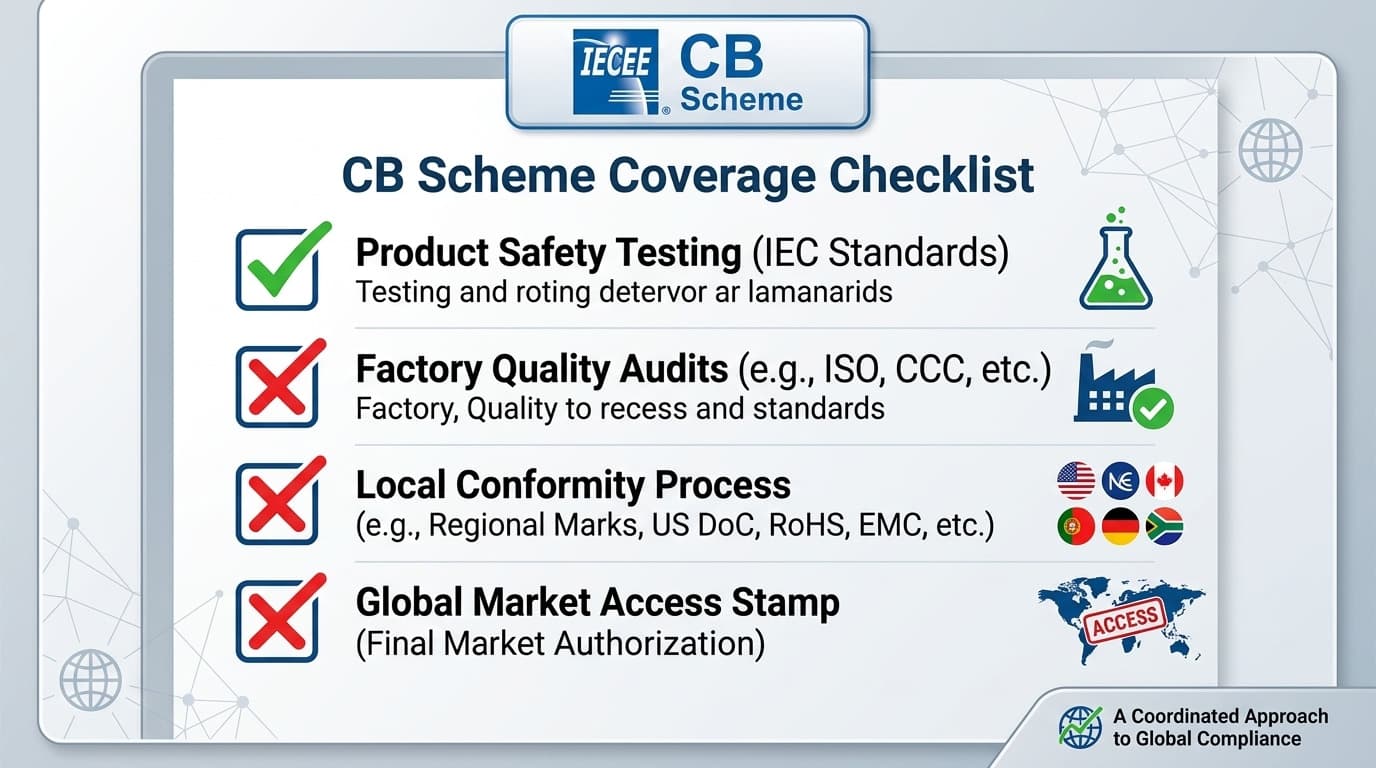
The CB Scheme (IECEE CB Scheme) is a global testing and certification mutual recognition system based on CEI rules, designed to achieve mutual recognition of test results and improve certification efficiency.
O Esquema CB operates through accredited national CB testing laboratories and certification bodies across more than 50 member countries. A product tested at any accredited laboratory generates a CB test report that participating national bodies accept as technical evidence when issuing their own national certifications.
This way, CB test reports reduce duplicate testing. However, it does not replace national certification. Every market still requires its own conformity process.
In summary, here is what you need to know:
Value Point | Descrição |
Test Report | The CB Test Report is an internationally recognised test report accepted by multiple countries |
National Recognition | Many countries accept CB testing data as the technical foundation for issuing their own local certificates |
Misconceptions | CB is neither a globally recognised certificate nor a commonly used mark or label, and it is definitely not a market access licence |
What Are the 12 Common Misconceptions About the CB Scheme?
Based on experience, twelve different misconceptions consistently appear in procurement and certification discussions about the CB Scheme, each reflecting a misunderstanding of what the scheme does and does not provide.
Misconception No. | Misconception Description | Explanation and Details |
3.1 | CB is test result recognition, not certification recognition | CB reports reduce duplicate testing, but each country issues its own certification (UL, CCC, PSE, etc.) |
3.2 | CB is not equivalent to CE or UL in Europe and the US | Europe: CB can be part of CE technical files, but CE still requires DoC, risk assessment, EMC, RoHS, etc. US: UL does not accept CB as final certification but may refer to it to reduce retesting |
3.3 | CB is not equivalent to CCC in China | CCC requires factory audit, system documentation, Chinese standards (GB) tests, and a certificate by the certification body. CB only serves as a partial test reference |
3.4 | CB is not equivalent to PSE in Japan | Japanese PSE requires local testing; CB can only reduce some duplicate tests, not replace them |
3.5 | CB is not equivalent to KC in Korea | Korea KC requires Korean standards and local lab testing; CB only reduces partial tests |
3.6 | CB is not equivalent to SAA in Australia | Australian SAA requires accredited local lab and local standards; CB serves as reference only |
3.7 | CB is not equivalent to SASO/G Mark in the Middle East | Middle Eastern countries require local regulation and registration; CB provides only technical foundation |
3.8 | CB is not equivalent to INMETRO/IRAM in South America | South America requires local testing and certification; CB reduces part of the testing |
3.9 | CB’s global applicability depends on product category | Products like photocells and LED drivers under the IEC system suit CB use; others (batteries, comms devices, medical, appliances) coverage varies |
3.10 | CB’s global applicability depends on standards consistency | Large differences between national standards and IEC (e.g., UL, GB, PSE) lower CB value, requiring additional testing |
3.11 | CB’s applicability depends on certification body attitude | Some certification bodies accept CB but require supplementary tests, re-testing of key items, or renewed documentation audits |
3.12 | CB’s broad applicability depends on product design consistency | Globally designed products benefit more from CB; single-market products have reduced benefits or might not use CB at all |
Each misconception creates a different category of real-world problem, ranging from failed customs clearance to wasted certification budget to unexpected re-testing requirements after a product launch.
Misconception 3.1 is the root of most of the others. Once a manufacturer understands that CB recognition applies to test results rather than to certificates, the market-specific nature of everything that follows becomes logical rather than surprising.
A CB test report does not have a stamp that grants market access anywhere. It is a technical document that reduces the laboratory work required to obtain the stamp that does.
Should You Verify CB Certification When Purchasing Products?

Verifying the authenticity and scope of a supplier’s CB certification matters because the certificate’s value depends entirely on:
- What product was tested
- What standards were tested
- Which accredited body was considered
A CB certificate is traceable. The IECEE public database allows buyers to verify that a CB certificate is genuine and issued by an accredited body. Checking this before relying on a supplier’s CB certification in a procurement decision takes minutes and eliminates the risk of acting on a certificate that doesn’t cover the product or scope being purchased.
Understanding the link between CB certification and the specific national regulations of the target market is equally important. A buyer specifying products for the US market who relies on a supplier’s CB certificate without understanding that UL is still required has created a compliance gap that will surface at import or inspection.
Long-Join’s CB test reports cover photocell products within the IEC system and are available as part of the certification documentation provided to customers evaluating compliance for specific markets.
Frequently Asked Questions on CB Scheme Misconceptions
CB Scheme provides mutual recognition of test results across participating countries, not a market authorisation certificate. National certifications like UL, CCC, and CE are actual market access marks that each require their own conformity process.
By completing IEC-standard safety testing at an accredited CB laboratory, manufacturers generate a test report that participating national certification bodies accept as technical evidence, reducing the laboratory testing they need to repeat when applying for each country's national certification.
Because each national certification has requirements beyond safety testing. The CB report addresses testing only and doesn’t cover factory audits, national standard compliance, documentation, and registration.
In China, CB provides partial test reference for CCC but does not satisfy the factory audit or GB standards requirements.
In the US, UL may credit CB test data but still requires its own certification process.
In Europe, CB data can support CE technical files, but CE requires additional documentation that CB does not provide.
Long-Join uses CB test reports as the testing foundation for entering multiple markets, reducing laboratory duplication while still completing the specific national certification requirements for each target market.
Conclusão
The CB Scheme provides genuine value as a test result mutual recognition system that reduces duplicated laboratory work across more than 50 participating countries. However, it does not provide global market authorisation, and can’t replace other national certifications.
Understanding these 12 misconceptions correctly allows manufacturers to use CB certification as the efficient testing foundation it was designed to be, while completing the national certification processes that actual market access requires.
Links externos
●https://www.iec.ch/homepage
●https://en.wikipedia.org/wiki/CB_Scheme


 Portuguese
  English
  Russian
  Spanish
  Arabic
  Japanese
  Italian