
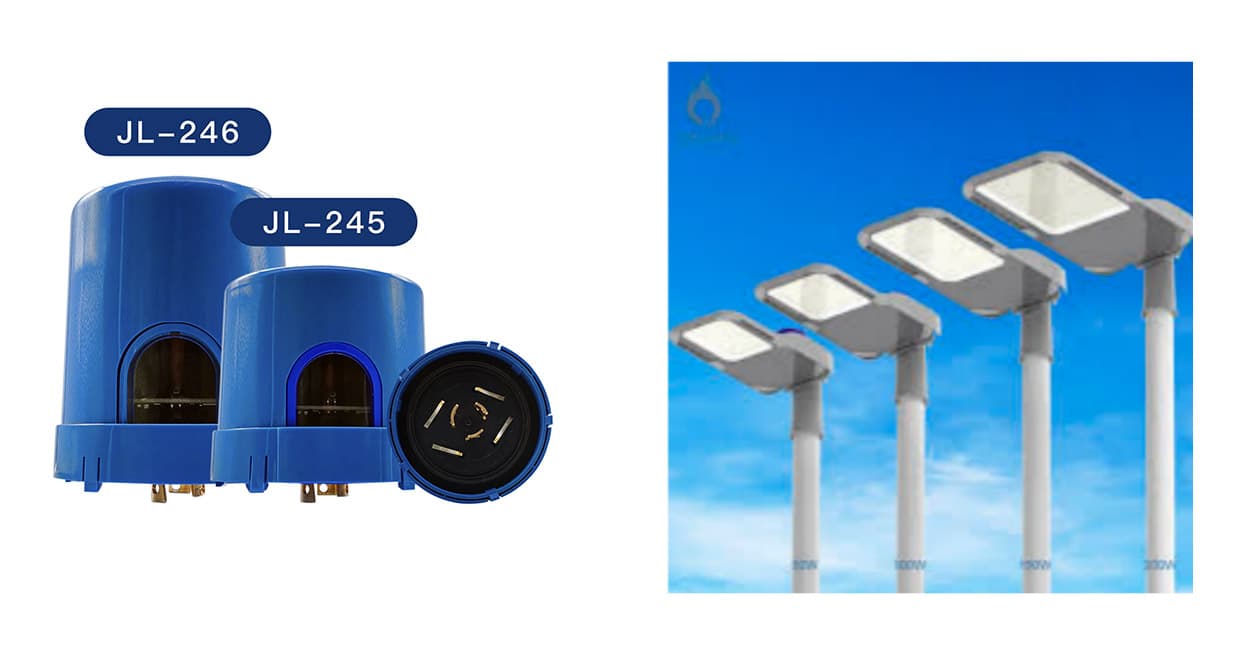
Overview Of Long-Join Smart Photocell Sockets And Their Applications
Introduzir
Some lights use hybrid designs. A NEMA 7-pin socket and a Zhaga Book-18 socket share one luminaire, now common in smart-city tenders. In real projects, it is a lot more complex. Cities want dimming, sensors, data, and room to upgrade in the future—without sending crews back to rewire every pole.
This is where Long-Join’s smart photocell sockets sit in the middle of the system. They form the standard interface between the luminaire and the control node. Through Soquetes NEMA (3-pin, 5-pin, 7-pin) and Soquetes Zhaga, Long-Join connects classic twist-lock photocell lighting sensor heads, advanced wireless controllers, and DALI/0-10 V drivers into one flexible platform.
The goal of this guide is simple: turn the technical choices around sockets into everyday language, and give you a clear path to pick the right photocontrol receptacle for each project.
What Role Do Smart Photocell Sockets Play In Modern Outdoor Lighting?
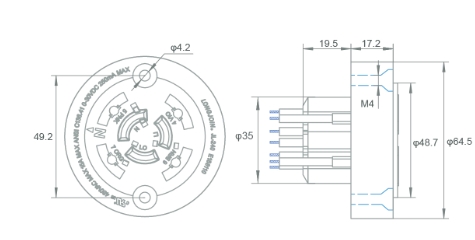
Are you upgrading to smart lighting, but worried that every new sensor or node means fresh wiring and long outages? That is the main pain point smart sockets are built to solve.
At a basic level, a smart photocell socket is a standardized plug interface on the luminaire. Long-Join focuses on two global standards:
- ANSI C136.x NEMA twist-lock sockets– 3/5/7-pin round interfaces used on most photocell for street light heads worldwide
- Zhaga Book 18 interfaces– compact, low-profile interfaces designed for modern smart street lighting outdoor and sensor nodes
In practice, that means the luminaire body can be manufactured once, and the “intelligence” can change over time. For city engineers and OEMs, that reduces redesign work, simplifies lighting control, and keeps street lights open to future upgrades.
Typical Problems In Outdoor Lighting And How Smart Sockets Help
Problem from the field | How smart sockets help |
Need to add new sensors later (air quality, traffic, CCTV) | Use a 7-pin NEMA ou Soquete Zhaga to plug in extra modules |
Different control systems in different cities / tenders | Keep the same luminaire; change only the controller plugged into socket |
Fear of vendor lock-in | Standardized interfaces support multiple controller brands |
Maintenance teams spending time on rewiring | Swap plug-in nodes instead of opening the gear compartment |
Need to test new smart nodes on a few poles first | Install sockets on all poles; populate only pilot sites at the start |
How Do Long-Join NEMA And Zhaga Sockets Support Different Control Technologies?
Long-Join structures its offering into three main families:
- NEMA Standard Connectors (3/5/7-pin)
- Designed for twist-lock photocontrols and smart nodes
- 3-pin: basic on/off control via light photocell sensor
- 5-pin: adds two wires for 0-10 V dimming or auxiliary signals
- 7-pin: adds four low-voltage signal contacts, used for DALI/D4i, sensor inputs, and data
- Zhaga Book 18 Sockets (e.g. JL-700, JL-700L)
- Compact form-factor for side/top/bottom mounting on luminaires
- Designed to carry low-voltage power and digital communication to node modules
- Twist-Lock Photocontrols (e.g. JL-205 series)
- Plug into a NEMA socket as the photocell sensoritself
- Provide dusk-to-dawn photocell controlfor street, garden, and passage lighting
On the control side, these sockets can host:
- Classic dusk to dawn photocellheads (like Long-Join JL-205C)
- Smart wireless nodes that control the street light controllervia 0-10 V or DALI
- Hybrid solutions where a NEMA 7-pin socket and a Zhaga Book-18 socket co-exist on the same luminaire (increasingly common in smart-city tenders)

How Do 3-Pin, 5-Pin, And 7-Pin NEMA Sockets Compare In Real Projects?
When you look at a pole top, all twist-lock interfaces look similar. The real difference is in the number of pins and what they are wired to do.
Some lights use hybrid designs. A NEMA 7-pin socket and a Zhaga Book-18 socket share one luminaire, now common in smart-city tenders.
Quick Comparison Of NEMA Socket Types
Socket type | Typical Long-Join use case | Control signals available | Example Long-Join products |
3-pin NEMA socket | Basic on/off control using a light sensor photocell switch | Line, neutral, load only – no extra dimming contacts | JL-200X series, kits with JL-205C |
5-pin NEMA socket | Projects needing simple 0-10 V dimming | 3 power contacts + 2 dimming signal wires | NEMA 5-pin receptacles in Long-Join connector family |
7-pin NEMA socket | Full smart-city nodes with sensors + DALI/D4i | 3 power contacts + 4 low-voltage communication / sensor pins | JL-240FXA, JL-250F, JL-250P |
A few practical examples:
- A small town that only wants photocell street lighton/off can mount a 3-pin NEMA socket with a JL-205C photocontrol on top.
- An industrial park that wants night-time dimming at 50% can choose a 5-pin socket and a controller that sends a 0-10 V dimming signal to the driver.
- A smart-city pilot with motion sensors, central management software, and energy reporting will almost always choose a 7-pin photocontrol receptaclelike JL-240FXA, because it supports both power and data in one interface.
How Do You Choose The Right Socket For DALI / D4i And Digital Control Systems?
Have a tender that mentions “DALI2” or “D4i” and you are not sure what to order? This is where the 7-pin NEMA and Zhaga sockets really matter.
O DALI Alliance defines DALI and D4i as digital protocols for addressing and dimming luminaires, and for exchanging diagnostics and energy data between drivers and controllers.
From a hardware point of view, you mainly need two things:
- A socket and wiring that can carry DALI / D4i signals
- A control node that speaks the protocol correctly
Long-Join supports this in two main ways:
- Tomadas NEMA de 7 pinos– provide four extra low-voltage pins that can be wired to DALI / D4i and auxiliary signals, while keeping three robust power contacts for mains.
- Zhaga Book-18 JL-700 / JL-700L sockets– compact interfaces that are explicitly designed to host D4i-ready drivers and control nodes on the luminaire.
DALI / D4i Project Requirements And Socket Choices
Project requirement | Recommended socket setup | Why it works |
Need DALI broadcast dimming only | 7-pin NEMA receptacle, DALI wired on signal pins | Leaves room for future sensors via unused pins |
Need full D4i driver diagnostics + sensor data | 7-pin NEMA or Zhaga socket with D4i-certified node | D4i uses the same physical lines for data and control |
Want small, low-profile nodes on decorative luminaires | Zhaga Book-18 JL-700L or similar | Compact size; mount on top, side, or bottom of luminaire |
Hybrid design (both NEMA and Zhaga on one luminaire) | 7-pin NEMA + Zhaga Book-18 on same housing | Keeps compatibility with legacy NEMA nodes and future Zhaga |
If you are not sure which path to choose, Long-Joins Catálogos de produtos page groups photocell, NEMA 7-pin receptacles, and Zhaga Book-18 products together so you can quickly compare options per project.
Which Socket Options Fit Multifunction Smart Poles Best?
Smart poles are no longer just about light. One smart pole holds cameras/Wi-Fi and EV-chargers. It also carries air sensors and banners. The biggest technical headache is usually how to power all this equipment safely without cutting into the pole and violating standards.
Long-Join tackles this from two angles:
- 7-pin NEMA Receptacles With Data Capability
- Devices like JL-240FXA give you an IP66 photocontrol receptaclethat meets ANSI C136.41 and offers enough pins for power + data.
- This is ideal when your main smart controller is a NEMA twist-lock node.
- JL-250P NEMA Type Power Tap Receptacle
- The JL-250P power tap is installed between the NEMA socket and the photocell or controller.
- It safely “taps” auxiliary power from the pole head so you can feed cameras, access points, or small IoT boxes without rewiring the luminaire.
In simple terms, JL-250P turns the pole head into a small power hub while the main photocell street light control still runs through the socket. For cities, this reduces the number of cabinets and avoids unsafe field modifications.
For projects that want even more integration—especially where Controller intelligent lighting functions and compact designs are key—Long-Join’s Soquete Zhaga JL-700L offers a Book-18 compliant, cable-wrapped solution that can host multi-sensor, multi-radio nodes in a very small footprint.
When Is A Simple 5-Pin Socket The Best Choice?
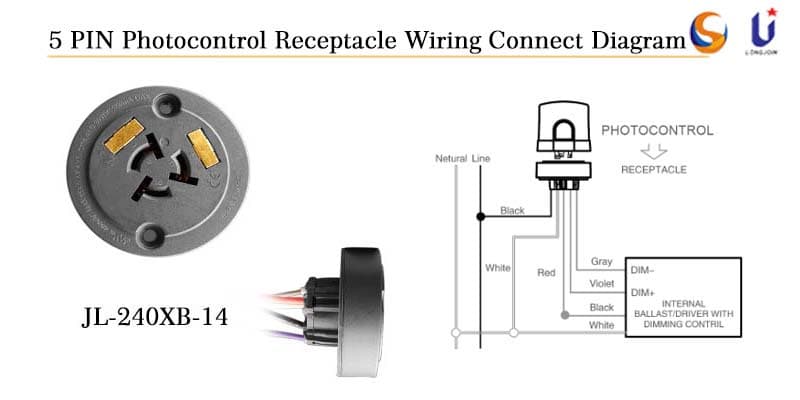
Not every project needs full IoT. Many customers only want street light controller automatic dimming at fixed times or schedules. In those cases, a 5-pin socket is often the sweet spot between cost and flexibility.
You should consider a 5-pin NEMA socket when:
- The driver already supports 0-10 V dimming, and no DALI / D4i is required
- The control node is simple (timer-based or basic wireless node)
- The tender focuses on energy saving and not on rich telemetry
A typical architecture looks like this:
- 3 pins: feed mains to the driver through the light photocellor controller
- 2 pins: carry the 0-10 V dimming signal from the controller to the driver
From a purchasing point of view, using a 5-pin instead of 7-pin NEMA socket can lower BOM cost across thousands of poles, while still supporting later upgrades with compatible controllers. Long-Join groups these products under the Conector padrão NEMA family, so OEMs can re-use the same cut-outs and mounting styles across multiple product lines.
Which Socket Options Fit Multifunction Smart Poles Best?
Choosing the right socket is no longer a minor mechanical decision. It defines how flexible your luminaires will be for the next 10–15 years.
Long-Join’s mix of Soquetes NEMA, Soquetes Zhaga, and twist-lock fotocélula products is designed to keep things simple: one mechanical interface on the pole, many options for controllers, dimming protocols, and smart services. By starting with the application—basic on/off, 0-10 V dimming, DALI/D4i, or full smart poles—you can select the right socket family and grow from there.
Conclusão
Choosing the right socket is no longer a minor mechanical decision. It defines how flexible your luminaires will be for the next 10–15 years.
Long-Join’s mix of Soquetes NEMA, Soquetes Zhaga, and twist-lock fotocélula products is designed to keep things simple: one mechanical interface on the pole, many options for controllers, dimming protocols, and smart services. By starting with the application—basic on/off, 0-10 V dimming, DALI/D4i, or full smart poles—you can select the right socket family and grow from there.
Links externos:
01://www.zhagastandard.org/index.php?option=com_content&view=article&id=340:zhaga-enables-iot-upgradeable-outdoor-1 led-lighting
02: fixtures&catid=22https://www.nema.org/membership/products/view/lighting-systemshttps://www.dali-1200 03: alliance.org/https://en.wikipedia.org/wiki/NEMA_connector




 Portuguese
  English
  Russian
  Spanish
  Arabic
  Japanese
  Italian