
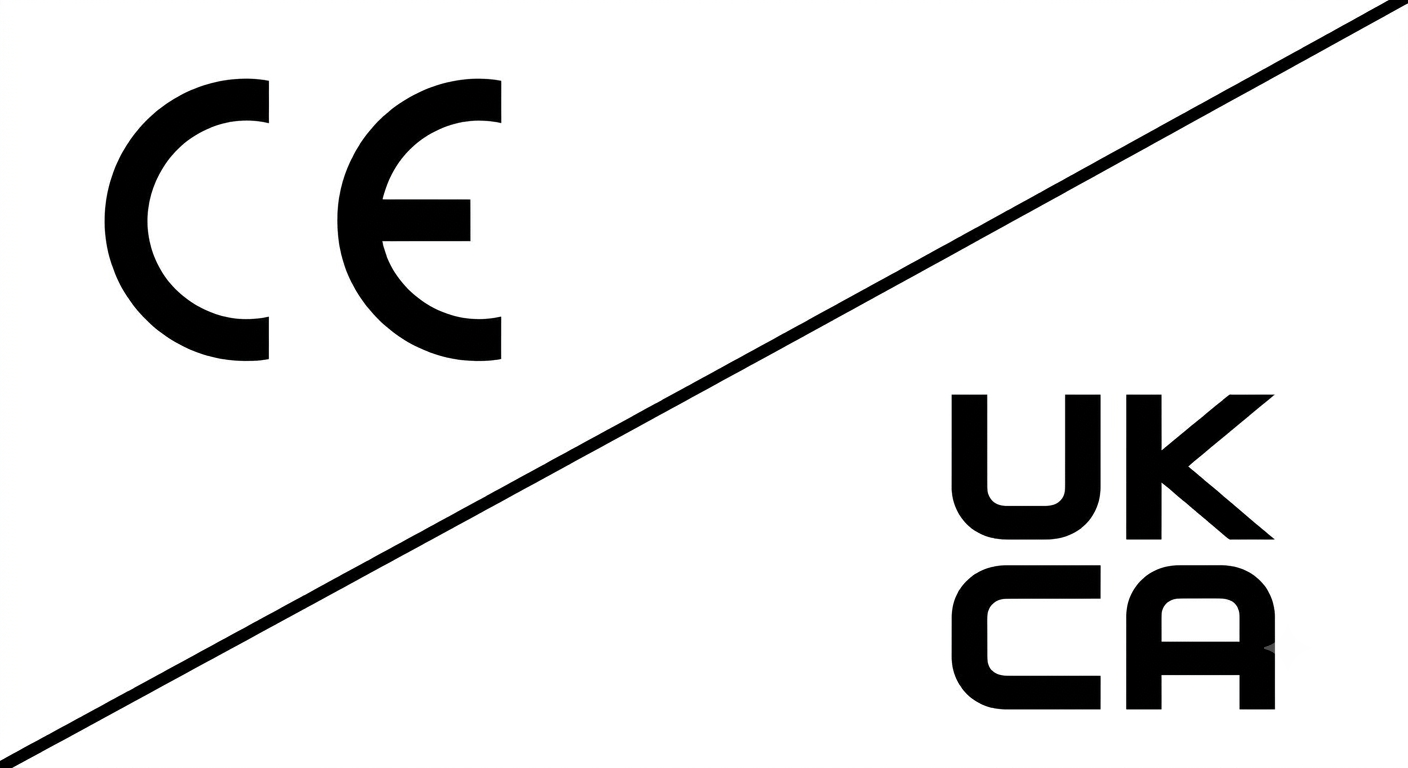
Is UKCA Just CE? What Are the Differences?
導入
Most people new to compliance ask frequently if UKCA is basically a CE in disguise. The short answer is no, UKCA is not just CE with a different sticker.
They look similar, their technical requirements overlap significantly, and for a time CE was legally accepted in both the EU and UK markets. But they belong to different legal systems, are issued by different bodies, and cover different geographic territories.
Treating them as interchangeable creates compliance gaps that become problems when products reach customs or tender qualification.
What Are CE and UKCA?
To get a clearer picture, let’s look at them individually.
CE stands for Conformité Européenne, and it is the EU’s product compliance framework. UKCA, on the other hand, is the UK Conformity Assessed, a post-Brexit equivalent of CE, established for the UK mainland market.
Conformité Européenne (CE)
CE applies across:
- 27 member states of the EU
- European Economic Area
- Northern Ireland.
It is based on EU directives including the Low Voltage Directive そして Electromagnetic Compatibility (EMC) Directive, with testing and certification conducted through EU-authorised Notified Bodies listed on the NANDO database.
UK Conformity Assessed (UKCA)
UKCA was introduced after Brexit. It applies to:
- England
- Scotland
- Wales
It falls under independent UK legislation, most recently the Product Regulation and Metrology Act 2025.
Certification is conducted through UK-recognised Approved Bodies listed on the UKMCAB database. Northern Ireland is a special case, though; it continues to accept CE marking or the UKNI mark under the Windsor Framework arrangements.
What Are the Main Differences Between UKCA and CE?
Five dimensions separate the two certifications: geography, legal basis, certification bodies, reference standards, and market policy.
Explaining their differences with these will help paint a clearer picture of their distinguishing factors.
側面 | CE | 英国CA | 説明 |
Applicable Area | EU 27 + EEA + Northern Ireland | UK mainland (England, Scotland, Wales) | Northern Ireland continues using CE or CE+UKNI marks |
Legal System | Based on EU directives and regulations (e.g., LVD, EMC) | Based on independent UK legislation (Product Regulation and Metrology Act 2025) | Fundamentally different laws and distinct regulatory agencies |
Certification Bodies | EU-authorised Notified Bodies (NANDO) | UK-recognised Approved Bodies (UKMCAB) | Certificates are not mutually recognised or interchangeable |
Reference Standards | EU Harmonised Standards | UK Designated Standards | Standards have high consistency but differ in legal frameworks |
Market Policy Support | Unified recognition | Announcement from 2024-2026 extends CE indefinite legal use in the UK | Extension ensures smooth market transition period |
The mutual non-recognition point matters most in practice. A CE certificate issued by a German Notified Body is not accepted by UK Approved Bodies as evidence of UKCA compliance, and vice versa.
For products entering both markets, separate conformity assessments are required even when the underlying technical testing is essentially the same.
Why Does the UK Still Accept CE?
The UK government has extended its acceptance period for when CE marking is legally accepted in the UK mainland market, most recently through 2026 and potentially beyond.
This extension was necessary when looking at the reality of things. The manufacturing and certification supply chain adjusted slowly after Brexit, and requiring immediate UKCA compliance across all product categories would have caused significant disruption.
The extension does not make CE and UKCA equivalent. It is a temporary market access policy, not a recognition of technical equivalence between the two frameworks, and knowing this should help guide decision-making when procuring products.
How Does Long-Join Address This for Photocell Products?
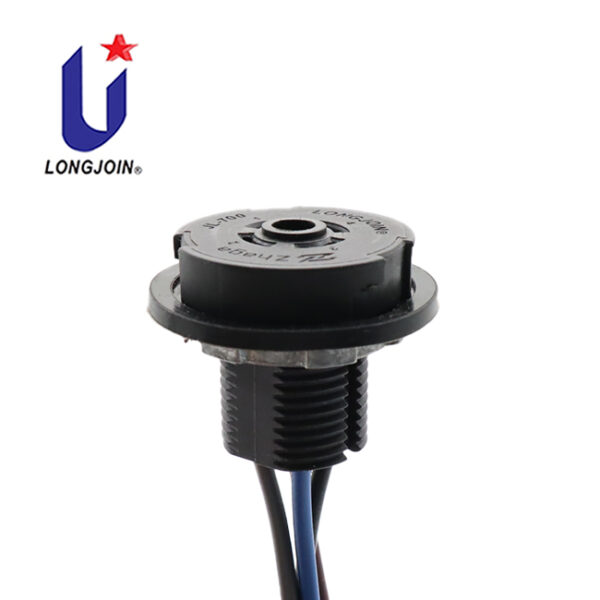
Long-Join’s photocell sockets carry dual CE and UKCA certification, covering regulatory requirements for both EU and UK independent markets.
For buyers specifying products for projects that span both territories or for distributors supplying both EU and UK customers from a single inventory, dual certification eliminates the compliance documentation gap that a single-market certification creates.
Long-Join has this explained in detail in its certification documentation, as well as the different supplier assessment documents
Frequently Asked Questions
CE covers the EU 27 member states, the European Economic Area, and Northern Ireland. UKCA covers England, Scotland, and Wales. Northern Ireland is a special case that accepts CE or UKNI marks under the Windsor Framework.
They are issued by different bodies under different legal frameworks. An EU Notified Body certificate is not accepted by UK Approved Bodies as UKCA evidence, and a UKCA certificate does not satisfy EU conformity requirements. Separate assessments are required for each market.
UKCA is based on UK-specific legislation including the Product Regulation and Metrology Act 2025. CE is based on EU directives including the Low Voltage Directive and EMC Directive. The underlying technical standards have high overlap, but the legal frameworks and regulatory authorities are entirely separate.
Long-Join's photocell products undergo separate conformity assessments for each framework, with CE certification through EU-authorised Notified Bodies and UKCA certification through UK-recognised Approved Bodies. Both certifications are maintained concurrently, covering EU and UK markets from a single product line.
The extension reflects the time needed for the manufacturing and certification supply chain to transition to UKCA procedures after Brexit. It is a market access policy to prevent supply disruption, not a recognition that CE and UKCA are equivalent. Products relying solely on this extension face compliance uncertainty if UK policy changes.
結論
UKCA and CE are not the same certification in different packaging.
They belong to different legal systems, are issued by different certification bodies, cover different geographic territories, and cannot be mutually substituted in compliance documentation.
The technical overlap is high, but the regulatory frameworks are distinct. Long-Join’s dual CE and UKCA certification covers both markets without compromise, giving procurement teams and distributors the documentation they need for EU and UK projects from a single supplier.
外部リンク
●https://single-market-economy.ec.europa.eu/sectors/electrical-and-electronic-engineering-industries-eei/low-voltage-directive-lvd_en
●https://single-market-economy.ec.europa.eu/sectors/electrical-and-electronic-engineering-industries-eei/electromagnetic-compatibility-emc-directive_en
●https://find-a-conformity-assessment-body.service.gov.uk/
●https://en.wikipedia.org/wiki/CE_marking


 Japanese
  English
  Russian
  Spanish
  Portuguese
  Arabic
  Italian