
Can Photocells Experience Short Circuits Due To Condensation?
導入
Photocell looks sealed from the outside. Doesn’t mean moisture can’t get in.
Coastal areas, hot humid regions, places where temperature swings hard between day and night — moisture becomes a real problem there.
Yes. Condensation can cause leakage current, false switching, corrosion, and in bad cases, a full short circuit. Risk goes up when moisture reaches the PCB, relay contacts, or terminals and mixes with dust, salts, whatever else is floating around inside.
For a street light photocell, this shows up as flickering. Daytime switching. Lamp stuck on. Lamp suddenly dark for no reason. Good sealing, stable materials, moisture control, proper installation — all of it matters.

How Does Water Even Get Inside A Sealed Unit?
Opened an outdoor electrical part and found water droplets even though nothing was leaking? That’s condensation. Classic sign.
Warm air holds more moisture than cool air. Trap humid air inside a photocell, temperature drops, moisture turns to droplets. Repeat that cycle every hot day and cool night, and the problem builds. Small gaps in seals, joints, cable entry points — humid air finds its way in through any of these.
状態 | What Happens | 結果 |
Hot day, cool night | Trapped air cools, forms droplets | Moisture settles on PCB or contacts |
Weak or damaged seal | Humid air slowly enters | Condensation builds over time |
Coastal environment | Moisture carries salt | Faster corrosion, electrical leakage |
Poor mounting | Water follows wires, collects near entry | Reaches internal parts |
Long-Join’s installation guide recommends pointing exiting wires downward, forming a drip loop where condensation might occur. Simple detail. Keeps water from traveling toward the control instead of dripping away.
Why Does Condensation Actually Cause Short Circuits?
Water in an electrical control is never good news. But it’s more complicated than just “water conducts electricity.”
Fresh condensation has low mineral content on its own. Touch it to dust, flux residue, salts, metal surfaces, dirt inside the unit, and it gets more conductive fast. Creates a path between parts of the circuit that were supposed to stay separate.
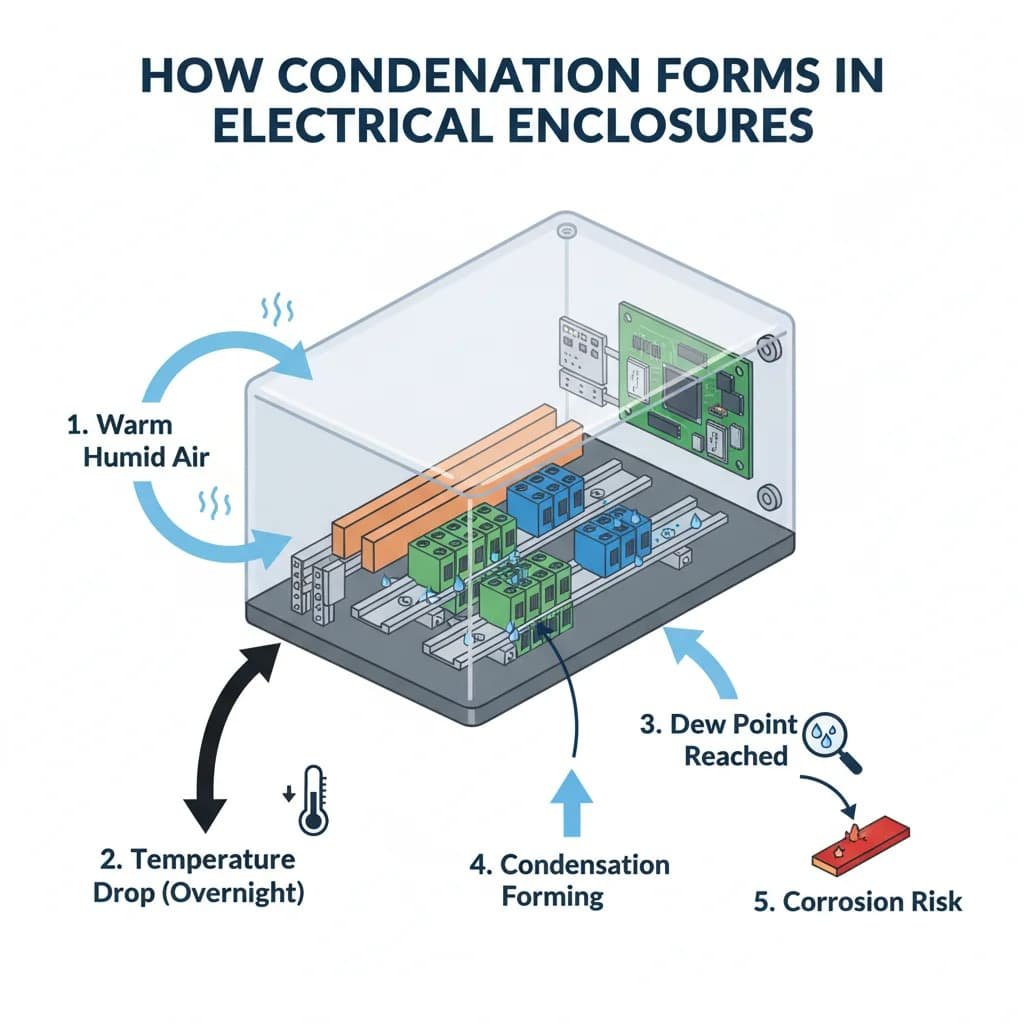
A photocell works with small sensing signals too. Doesn’t take a full short to cause trouble. Even a tiny leakage path can throw off the sensing circuit or control section. Result? Wrong-time switching. Unstable operation. Sometimes complete failure.
UL Solutions lists high humidity, moisture and rain, corrosion, salt fog, and IP testing as environmental checks for lighting products. Not a coincidence they check all of these.
What Faults Actually Show Up?
Not every moisture problem looks the same. One light flickers. Another stays on all day. A third fails only after one cold night.
Fault | What You See | How Moisture Fits In |
Lamp turns on during day | Switches even when bright out | Moisture disturbs sensing circuit |
Lamp turns off at night | Suddenly goes dark | Leakage or control error affects output |
Lamp stays on | Won’t switch load off | Relay or switching parts affected |
Lamp flickers | Cuts in and out repeatedly | Wet or corroded contacts, unstable connection |
Shorter service life | Problems get more frequent | PCB tracks, terminals, metal corrode |
Cycling light isn’t always condensation though. Long-Join also warns that artificial light shining back onto the sensor can make a photocontrol switch on and off repeatedly. So troubleshooting needs to check sensor position, wiring, sealing, moisture — all of it before pointing at one cause.
How Does Long-Join Actually Fight This?
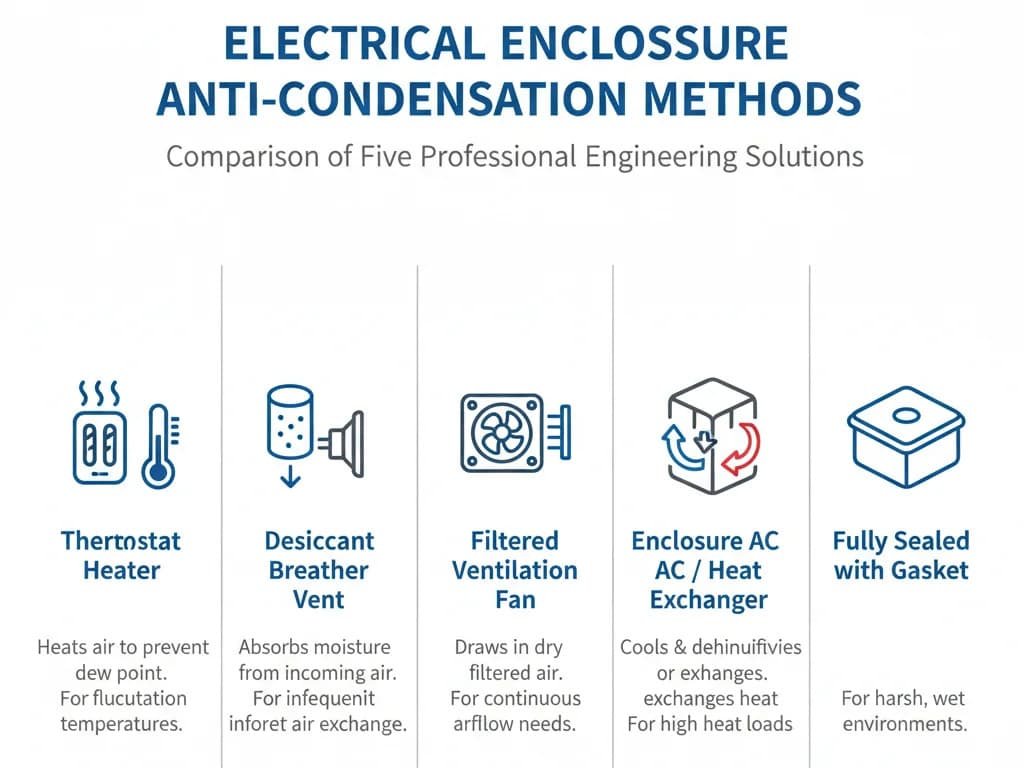
Outdoor protection starts with the housing and seal. Weak structure that can’t handle heat, rain, dust, temperature swings, and the electronics inside face more risk. Simple as that.
Long-Join uses glass-fibre reinforced PBT, UV stabilizers, industrial-grade EPDM gaskets, ultrasonic-welded housing joints as part of its outdoor sealing approach. Their NEMA SS-1 guide explains these choices help the housing hold shape and the gasket keep compression through temperature changes.
Some designs go further. The JL-242JV smart photocell base uses a waterproof breathable-film structure, built to balance pressure between inside and outside the controller. Reduces condensation inside an enclosed chamber. Clever fix for a real problem.
特徴 | Why It Helps |
Glass-fibre reinforced PBT | Keeps the base strong, stable outdoors |
EPDM or silicone sealing | Blocks moisture at joints and contacts |
UV-resistant housing | Reduces cracking that weakens the seal |
Waterproof/breathable design | Manages pressure, cuts condensation |
Higher IP options | Gives a clearer protection level |
Long-Join lists the JL-207C in IP54, IP65, and IP67 versions depending on the build. UL and RoHS certified too.
What Should Buyers Actually Check For Humid Areas?
Buying for a dry inland road isn’t the same as buying for a coastal highway. High humidity, salt air, heavy rain, big temperature swings — sealing becomes a main spec, not an afterthought.
Start with IP rating. Don’t stop there though. Ask how the cover and base are joined. Check the gasket material. Ask if the supplier has humidity, waterproof, salt-fog, or environmental test data for the exact model you’re buying. Not a similar model. The exact one.
A dusk-to-dawn photocell also needs stable sensing and reliable switching parts. Supplier offers several versions? Confirm which model and protection level the test report actually covers.
UL 773 is a direct safety standard for plug-in locking-type photocontrols. UL 1598 covers luminaires as a whole. Know which certification belongs to the photocell switch and which belongs to the fixture. They’re not interchangeable.
Regular inspection still matters. Cracked covers, loose seals, corrosion around pins, water marks, repeated cycling — catch a sealing problem early in coastal projects and you prevent bigger failures down the line.
よくある質問
Moisture mixes with salts, dust, or residue and creates an unwanted electrical path between circuit points that should stay separate.
False switching, flickering, lamps staying on, unexpected shutdowns, corrosion, shorter service life. Take your pick, it can cause all of them.
Good sealing reduces risk a lot. But pressure changes, installation quality, material aging, and temperature cycling still matter. Nothing's bulletproof.c
No. Wiring faults, damaged contacts, poor sensor position, or light feedback can cause the exact same symptoms. Don't assume.
IP rating, sealing method, housing material, certification, environmental test reports, quality control for the exact model. Not the product line in general.
結論
Yes. Condensation is a real threat to outdoor photocells. But it’s controllable.
A well-built photocell combines strong housing material, dependable seals, sensible pressure and moisture management, stable electronics, and correct installation. For humid or coastal street lighting, these details decide whether you get steady switching or a stream of service calls.
Don’t just ask “is this photocell waterproof?” Ask how it stays protected after months of heat, cooling, rain, humidity, daily temperature swings. That’s where long-term reliability actually gets decided.
外部リンク:
●https://www.sciencedirect.com/science/article/pii/S0925521422004033
●https://www.ul.com/
●https://www.ul.com/industries/products-and-components/lighting/lighting-performance
●https://www.ensingerplastics.com/en/shapes/tecadur-pbt-gf30-natural
●https://www.sciencedirect.com/topics/chemistry/ultraviolet-stabilizing-agent
 Japanese
  English
  Russian
  Spanish
  Portuguese
  Arabic
  Italian