
Lights On At Noon: When A Photocell Is Right And Everyone Thinks It’s Broken
Introducir
You’re walking past at lunchtime, the sun’s out, and there’s a street light glowing away above you as if it’s the middle of the night. Most people’s first thought is that the célula fotoeléctrica must be broken. Quite often it isn’t.
A photocell doesn’t know what time it is. It only reacts to how much light is landing on its sensor, so if that sensor is shaded, pointed the wrong way or set to a different light threshold than you’d expect, it can keep telling the fixture to stay on while everything around it looks bright. Work out what it’s actually seeing before you fit a new one.
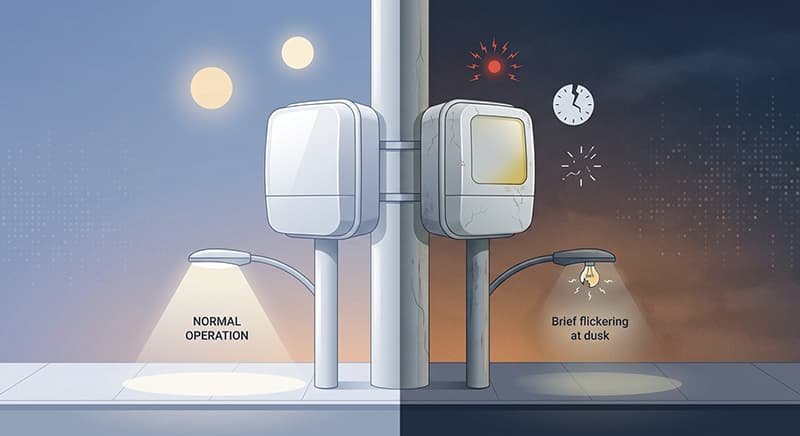
How Does a Photocell Decide When to Switch?
No timer is involved at all. It’s all about ambient light.
Inside a sensor de fotocélula there’s a light-sensitive part keeping an eye on the brightness around it. Once the light drops below one set point the control switches the fixture on, and once daylight climbs back above another set point it switches it off. Different photocells don’t all respond at exactly the same brightness, though, which explains a lot of confusion on site.
Most controls also have a short time delay built in, so the lamp doesn’t react every time a cloud drifts over, or a lorry’s headlights sweep past. Long-Join’s JL-104A, for instance, uses separate turn-on and turn-off light levels and has a delay of 20 to 120 seconds.
There are also Long-Join photocell products with different operating levels, voltages, delays and sensing arrangements.
Why Would It Keep the Light On at Noon?
So why does the light sensor think it’s dark?
The thing is, you’re looking at the whole area while the photocell only sees whatever light reaches its little sensing window. A sunny road doesn’t help much if the sensor itself is tucked behind the fixture housing, a branch or a roof edge. The angle matters too, since a window pointed at a dark wall or blocked from open sky will measure a lot less light than you’d guess from standing underneath it.
Possible Cause | What the Photocell Sees | What You Might Notice |
Sensor in shade | Less daylight than the open street | Lamp on during the day |
Facing the wrong way | A darker surface | Late switch-off |
Threshold set too high | A fairly bright day counted as “dark” | Comes on earlier than expected |
Dirty or covered window | Less light getting through | More daytime burning |
Heavy cloud or local shadow | A temporary dip | Lamp may come on briefly |
Buildings or objects nearby | Uneven light round the fixture | Neighbouring lamps switch at different times |
That’s why a light burning at noon doesn’t automatically mean the photocell switch has failed. Long-Join’s installation guide lists not enough daylight reaching the photocontrol’s “eye” as one reason a fixture may stay on, and the fix it suggests is simply moving the photocontrol so it faces stronger natural light. Intermatic gives similar advice: mount the control where it can see natural daylight, away from its own lamp.
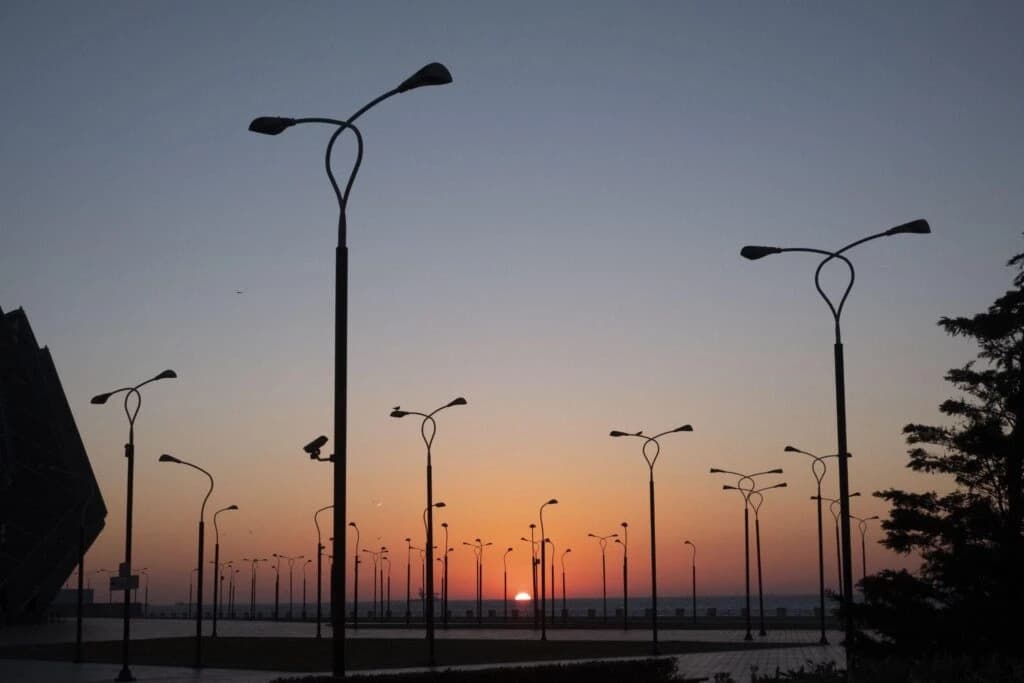
Two Photocells a Few Metres Apart Can See Different Things
It catches people out, but two units only a few metres apart really can behave differently. One might have a clear view of the sky while the other sits under a tree, beside a wall or behind part of the luminaire.
Reflections cause their own trouble. A glossy wall, a glass shopfront, a metal panel or a nearby lamp can throw odd light at the sensing window, or cast a heavy shadow over it later in the day.
The aim isn’t the brightest thing around, just a steady view of ordinary daylight. Long-Join’s photocell wiring guidance warns against putting a control where the sensor faces artificial or reflected light, because that’s a common cause of unwanted switching.
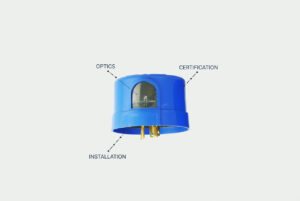
Where getting the direction right is awkward, a swivel-type photocontrol makes the job a lot easier. The JL-104 series lets you turn the head horizontally after it’s mounted, and you can see how that works on the Long-Join JL-104A directional photocell page.
What Long-Join Photocells Do About False Switching
The photocell itself has a couple of ways to cope with changing outdoor light. Sensible turn-on and turn-off levels, and a delay that lets it wait when the sensor goes dark for a second or two.
Long-Join makes several photocell families with different light levels, delay settings, protection ratings and adjustment options, and on some of them the target lux values and delay periods can be customised for the job. Swivel heads help find a better view of the sky, and NEMA y Zhaga options suit different street-light designs.
El JL-428C is a good example, with customisable turn-on and turn-off levels, a customisable time delay and an IP65 rating, and there’s more detail on the Long-Join JL-428C photocell sensor page. For bigger street-lighting designs, you can explore Long-Join NEMA and Zhaga solutions as well.
Which feature matters most really depends on the project. A simple wall light might only need a basic dusk-to-dawn control, while a council street-light scheme may need smart-control options.

How Should You Check a Light That Stays On During the Day?
Should you swap the photocell the minute someone reports a lamp on in daylight? Usually not.
Have a proper look at the sensor before you open anything up. Is something covering it, is the window grimy, has a tree grown around it, or is it facing a wall or sitting under part of the lamp housing? After that, compare it with the lights around it, because if the others all go off on time and this one doesn’t, the answer is probably in its own surroundings.
Then check the model’s operating light level and delay, since a control that suited one site perfectly can behave quite differently somewhere else. If it still stays on in clear daylight with nothing blocking the sensor, that’s when you move on to wiring, voltage, load and testing the photocell itself. Long-Join’s installation guide notes that incorrect wiring, the wrong voltage rating, welded contacts and low supply voltage can all leave a fixture stuck on.
And always disconnect the power before opening or rewiring an outdoor fixture.
Preguntas frecuentes
Because a shaded sensor can still read a low light level even when the street around it looks bright.
Depending on the model, Long-Join photocells come with different lux settings, time delays, adjustable positioning, outdoor protection options and customisable operating parameters.
Look for shade, dirt, reflections and poor direction first, then the model settings and the installation. If it's still misbehaving after that, check the wiring and voltage.
No. Some have fixed operating levels and others can be adjusted or customised at the factory, so check the specifications of the exact model you've got.
Keep the sensing window clean and clear, use the right model for the fixture, follow the wiring instructions, and take another look at the installation whenever the surroundings change.
Conclusión
A street light burning at midday looks wasteful, no question, but the photocell may just be doing exactly what it’s meant to with the light that’s reaching it. Rule out shade, a bad angle, dirt, reflections and unsuitable settings before the wiring checks.
Knowing what the sensor actually sees can save a perfectly good photocell from being thrown away for the wrong reason.
Enlaces externos:
●https://en.wikipedia.org/wiki/Photodetector
●https://en.wikipedia.org/wiki/Zhaga_Consortium
●https://www.nema.org/membership/products/view/lighting-systems
 Spanish
 English
 Russian
 Portuguese
 Arabic
 Japanese
 Italian