

Surge And Lightning Protection Of Photocells: Why It Is A Key Indicator For Outdoor Lighting In The Middle East?
Introducir
The Middle East asks more from outdoor lighting than many regions. Heat stays high for long periods. Sunlight is harsh. Dust and sand get into everything. And power quality can swing, especially on long feeder lines and crowded city grids. In this kind of setting, surge and lightning protection stops being a “nice extra.” It becomes one of the easiest ways to predict whether a lighting system will stay stable or become a maintenance headache.
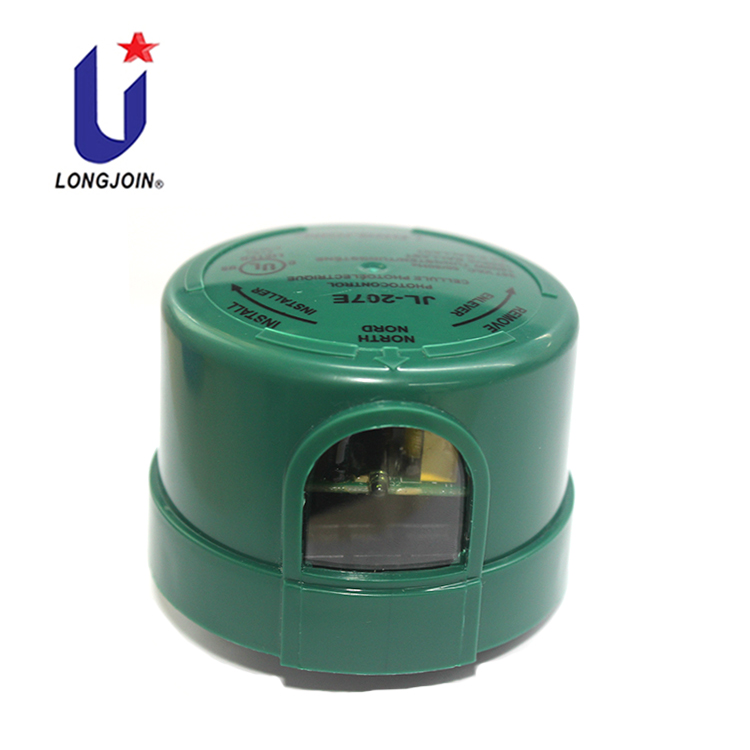
Why Does The Middle East Environment Punish Outdoor Lighting Electronics So Fast?
Because the environment “ages” parts every day. High heat can dry out seals and put stress on electronic parts. Strong UV rays can break down plastics and damage cable jackets.
What does that mean for a lighting controller?
It means your control device has to be built like an outdoor tool, not like an indoor gadget. Housing materials must resist UV. Sealing and venting must be realistic for sand and heat. And surge protection must be strong, because unstable power and storms can send sudden spikes down the line.
What Are The Most Common Surge And Lightning Threats In Outdoor Lighting?
Many surges happen because of switching inside the power grid. This can happen when large motors start, when capacitor banks switch, or when faults are cleared. Standards like IEC 61000-4-5 explain how equipment is tested for surge events. They use common test waveforms, such as the 1.2/50 μs voltage wave and the 8/20 μs current wave.
So where does lightning fit in?
Lightning can couple energy into overhead lines, poles, and outdoor circuits, even if the strike is not direct. Outdoor wiring is exposed, so it behaves like an antenna. That is why outdoor lighting often sees a harsher surge environment than indoor equipment, and why surge categories for “outdoors” are treated as higher risk in IEEE/ANSI guidance.
Why Is Surge Protection A Key Indicator When You’re Choosing A Photocell?
Because it predicts real-world uptime. In the field, a strong surge may not destroy a fixture instantly. Sometimes it damages parts. Then the failure shows up weeks later. It is the worst kind of problem. It is hard to trace, costly to fix, and easy to repeat.
What should you look for on the spec sheet?
Don’t only look at “works on 220–240 V.” Look for surge energy handling and surge current capability, and check whether the design is meant for outdoor surge conditions. A good photocell is not just about switching on at dusk. It’s also about surviving what the grid throws at it.
Which Fixture Types Need The Highest Surge And Lightning Protection In The Middle East?
All fixtures do not need the same protection level. Risk changes with exposure, mounting height, wiring length, and load size.
Why are street lights a high-risk group?
They sit on long pole-to-pole runs, often with overhead sections and wide spacing. That makes surge entry easier. For this reason, a fotocélula para alumbrado público projects should be selected with protection strength as a top filter, not an afterthought.
Why are floodlights even more demanding?
Floodlights usually use more power. They are mounted on tall poles. You often see them in open spaces like yards, ports, stadium edges, and industrial areas. More exposure plus higher load usually means bigger surge stress.
Recommended Surge Protection Targets By Fixture Type
Fixture Type | Recommended Surge Energy Absorption (Joule) | Maximum Surge Current Capacity (Amp) | Why It Matters In Real Life |
Alumbrado público | 350–460 | 7000–10000 | Helps reduce failures from lightning-induced surges and grid switching spikes |
Floodlights | ≥400 | 8000–10000 | Extra headroom for high power loads and high exposure installations |
How do these numbers help you?
They give you a practical buying rule. If your environment is harsh, staying inside this range helps reduce nuisance outages and repeated site calls.
How Do Long-Join JL-403C And JL-423C Fit High-Exposure Projects?
Think coastal cities, open desert highways, tall poles, and industrial zones where the electrical environment is noisy.
They are positioned for high protection needs, with 460 J energy absorption and up to 10,000 A surge current capacity in the outline you shared. That range matches the protection targets in the table above, which is why they are often discussed for extreme outdoor applications.
Where can you connect this to system-level protection?
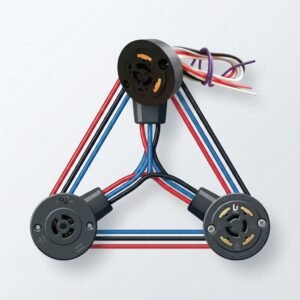
If you’re using a control-ready luminaire with a Toma NEMA, pairing the control with a surge protection approach at the
receptacle/module level can improve common-mode protection and reduce damage from incoming spikes. Long-Join also has receptacle and surge module options designed around ANSI/NEMA roadway lighting interfaces.
How Do JL-205C And JL-215C Support Mid-To-High Intensity Lighting Projects?
Many streets and commercial sites see frequent switching surges, mixed loads, and occasional storm events.
Why do JL-205C and JL-215C show up often?
They sit in that “balanced” zone: protection strong enough for many street and commercial installations, without forcing every project into the highest-tier cost bracket. In practical planning, this is where many contractors and city projects land.
What should you confirm before choosing?
Confirm the fixture wattage range. Check if the wiring is overhead or underground. Note the pole spacing. Also confirm if the project uses dimming signals or smart nodes. A good photocell sensor is one that fits the risk, not just the cost.
Which Long-Join Photocell Models Match Common Middle East Fixture Types?
These usually sit lower than street poles and often have shorter wiring runs. They still face heat and sun, but the surge exposure can be lower than tall pole systems. This is why the JL-412 series is often suggested as a stable, balanced option for these fixtures (based on your outline’s recommendation approach).
What about LED floodlights and area lighting?
How does this relate to lighting behavior, not just protection?
Many sites also want consistent switching at dusk and dawn. That’s where a dusk-to-dawn photocell sensor spec (stability, delay, and reliable thresholds) becomes just as important as surge strength, because nuisance on/off cycling is also a maintenance cost.

Which Long-Join Models Compare Best For Surge Protection?
Modelo | Surge Energy Absorption (Joule) | Max Surge Current (Amp) | Best-Fit Fixture Types | Notas |
JL-403C | 460 | 10000 | High protection LED floodlights, area lighting | High stability for harsh outdoor exposure |
JL-423C | 460 | 10000 | High protection LED floodlights, area lighting | Similar protection class; suited for heavier load use |
JL-205C | 460 | 7500 | Street and commercial lighting | Balanced protection and broad usage |
JL-215C | 460 | 7500 | Commercial & public lighting | Good protection with practical cost-performance |
What Simple Installation Choices Reduce Surge Damage The Most?
Can a strong product still fail because of installation?
Yes. Surge energy looks for weak paths.
What are the most common mistakes?
- Loose grounding points that create high resistance
- Long, unbonded cable runs that increase surge coupling
- Poor sealing that allows dust + moisture to sit on contacts
- No coordinated surge protection strategy (fixture + controller + receptacle)
What is “coordinated protection” in plain words?
It means you don’t rely on one part to do all the work. You support the whole path: good grounding, good interfaces, and surge handling where surges enter. That is also why standards and guides focus on defining surge environments and repeatable surge tests.
Conclusión
In the Middle East, surge and lightning protection is not a small checkbox. It is one of the clearest signs that an outdoor lighting control system can stay stable over time. When you match the fixture type, exposure level, and surge protection strength, you get fewer outages. You also reduce repeat repairs and help the fixture last longer, with fewer surprises.
Enlaces externos:
●https://en.wikipedia.org/wiki/Ultraviolet
●https://en.wikipedia.org/wiki/IEC_61000-4-5
●https://en.wikipedia.org/wiki/Institute_of_Electrical_and_Electronics_Engineers
●https://www.ansi.org/
 Spanish
  English
  Russian
  Portuguese
  Arabic
  Japanese
  Italian