

Why Do Photocells Fail Frequently in High-Temperature Countries?
Представлять
Photocell failures in hot climates follow a predictable pattern. The unit works correctly for several months, then starts false-triggering, then fails to switch reliably, then stops working.
The root cause boils down to 2 common issues: the product was not designed for the actual thermal environment it operates in, or because they are installed at the hottest points on luminaires.
High-temperature countries, particularly in the Middle East, Southeast Asia, and coastal Africa, expose photocells to conditions that standard products from temperate market specifications cannot sustain.
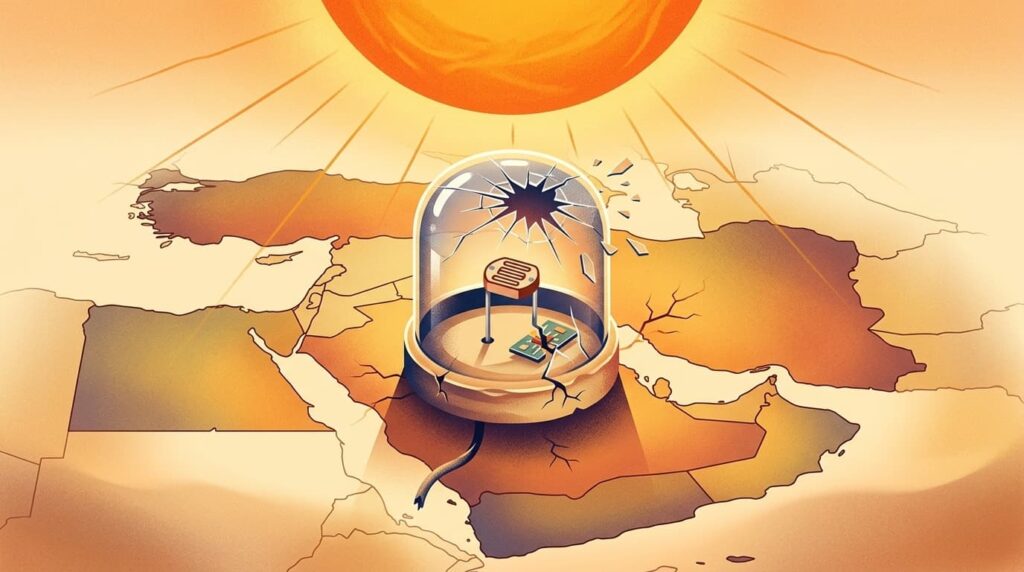
Nine factors account for the majority of these failures.
What Are the Nine Major Factors Causing Photocell Failures in High-Temperature Countries?
Nine thermal, material, and electrical failure mechanisms combine to produce the high failure rates that plague photocells in hot climate installations.
1.Extremely High Installation Temperature
Photocells are typically mounted at three common locations:
- At the top of luminaire housings
- Close to the metal casing
- Near the LED driver heat accumulation zone.
These are the hottest points on the entire fixture. Solar radiation absorbed by the metal housing conducts upward, the LED driver generates heat that rises, and the photocell sits at the convergence of both sources.
Operating temperatures at this position regularly reach 70 to 100°C, which is well above the rated ambient temperature that most standard photocells are designed for.
2.Softening, Deformation, and Cracking of PC Material
Low-end photocells commonly use polycarbonate (PC) for the base and housing. PC has a heat deflection temperature of approximately 110 to 125°C in controlled laboratory conditions, which sounds adequate.
In real outdoor installation on a hot luminaire, the sustained thermal load pushes the base material to 70 to 85°C continuously across long summer days. At these temperatures, PC loses dimensional stability, softens progressively, and eventually develops surface cracking. This deformation breaks the sealing geometry and shortens the product lifespan significantly.
3.Significant Drift of CDS Photosensitive Elements at High Temperature
CDS (cadmium sulphide) фоторезисторы are temperature-sensitive by nature. As the operating temperature rises, their resistance characteristics drift, shifting the lux threshold at which switching occurs.
In high-temperature environments, this causes erratic on/off cycling, delayed switching responses, and switching at the wrong time of day.
Long-Join uses photodiode-based sensing in its higher-specification models specifically because photodiodes maintain stable spectral response and switching threshold across the full operating temperature range, avoiding the drift that CDS elements produce.
4.Relay Contact Sticking and Weld Failure
Standard relay contacts are designed with temperature tolerances that assume a rated ambient operating range. When the actual operating temperature consistently exceeds that range, the contact spring tension changes and the contact surface undergoes accelerated oxidation.
The result is relay contacts that weld in the closed position, causing permanent light-on failure, or contacts that develop high resistance and produce flickering and unstable switching well before their rated cycle life is reached.
5.Sealing Failure Leading to Moisture Ingress
High temperature causes the base material to expand and the sealing rings to lose their designed compression. Once sealing ring compression drops, the housing is no longer effectively sealed against moisture.
In hot climates, the overnight temperature drop causes rapid condensation formation, and this moisture enters through the compromised seal. Once inside, it corrodes the PCB and relay contacts, causing progressive circuit failure.
6.Accelerated Material Aging Due to Salt Spray and High Humidity
The combination of high temperature, salt spray, and high humidity is common across the Middle East, Southeast Asia, and African coastal regions. These three stressors act together:
- Heat accelerates the chemical reactions of salt corrosion
- Humidity provides the electrolyte that drives electrochemical degradation
- UV radiation simultaneously attacks the housing material.
Standard housing plastics, standard gasket materials, and unprotected metal fasteners all degrade faster under this combined loading than under any single stressor alone.
Effective protection requires GF (Glass Fiber) + PBT (Polybutylene Terephthalate) housing material with UV stabiliser and EPDM sealing rings rated for sustained chemical exposure.
7.LED Driver Heat Backfeed and EMI Interference
LED drivers generate switching transients, high-frequency ripple, and in some cases heat backfeed current that reaches the photocell circuit through the shared power line.
In hot climates, where the MCU and relay contacts are already operating near their thermal limits, the additional electrical stress from driver-generated interference eliminates that headroom. The result is relay weld failure, MCU crashes, and misoperation that appears random but is directly caused by driver-generated interference.
RC filter circuits, TVS diodes, and Защита от перенапряжения MOV in the photocell circuit are the engineering responses — and their absence in low-cost CE-only products is a significant reliability gap in hot market deployments.
8.CE Standard Lacks Comprehensive High-Temperature Aging Tests
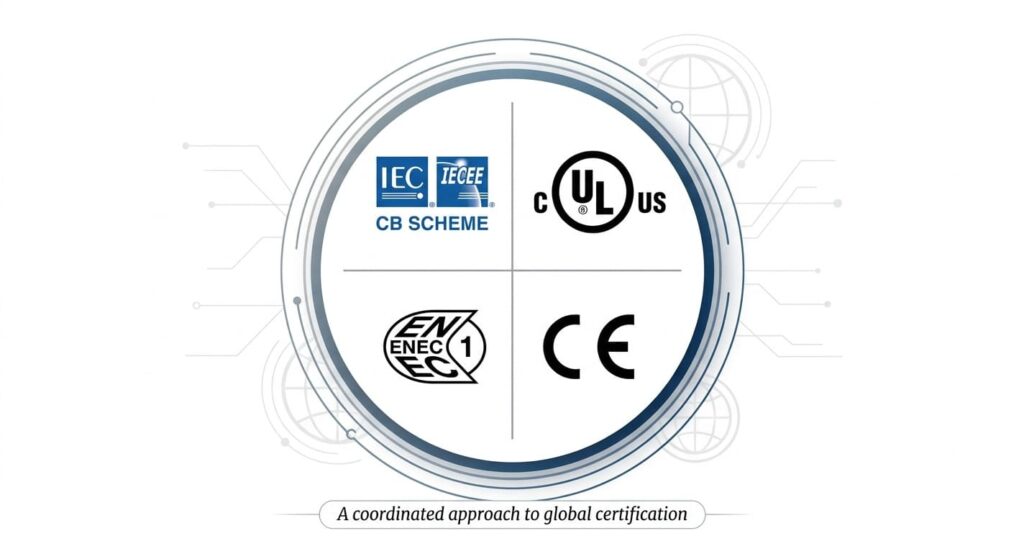
CE compliance does not require the comprehensive high-temperature aging, thermal shock cycling, and system-level testing that UL773, UL1598, and ENEC mandate.
A product carrying only CE marking has met the EU’s legal market entry requirements. It has not been tested for sustained 70 to 90°C operation across a full rated lifecycle.
Many low-end photocells sold into high-temperature markets carry CE marking and no other certification, creating a systematic gap between documented compliance and actual field performance.
9.UV Aging Causing Housing Brittleness and Cracking
High UV intensity in tropical and desert climates attacks housing materials significantly faster than in temperate regions. Without effective UV stabiliser content, PC and standard PBT housings yellow, embrittle, and eventually crack within two to three years.
Once the housing cracks, the structural protection and sealing integrity both fail simultaneously. UV stabiliser additives slow this degradation by absorbing UV radiation before it attacks the polymer chains that determine the material’s mechanical properties.
Long-Join’s high-temperature ассортимент продукции addresses all nine factors through photodiode sensing.
Frequently Asked Questions on High-Temperature Photocell Failures
The top of the luminaire accumulates heat from solar radiation on the metal housing and heat rising from the LED driver, regularly producing operating temperatures of 70 to 100°C at the photocell mounting position.
PC approaches its dimensional stability limit at 70 to 85°C in real outdoor conditions, causing deformation that loosens sealing ring compression and opens paths for moisture ingress and PCB corrosion.
CDS resistance characteristics drift with temperature, causing erratic switching and threshold shift. Long-Join uses photodiode sensing in higher-specification models, which maintains stable response across the full operating temperature range.
Thermal expansion of base materials and sustained heat cause sealing rings to lose compression. In hot climates, photocells are three to eight times more prone to moisture ingress, requiring EPDM sealing rings and ultrasonic-welded housing joints.
GF (Glass Fiber) + PBT (Polybutylene Terephthalate) base material maintains dimensional stability at 70 to 90°C. UV stabiliser additives prevent housing degradation. Photodiode sensing maintains switching accuracy. MOV and TVS protection handles LED driver interference.
Заключение
Photocell failures in high-temperature countries are not random. They follow predictable failure mechanisms tied to factors such as installation position, material limits, sealing failure, LED driver interference, certification gaps, and UV aging.
Addressing these requires material selection, sensing component choice, sealing design, and circuit protection that goes beyond CE compliance. Long-Join’s high-temperature product range is engineered specifically for these conditions.
Внешние ссылки
●https://en.wikipedia.org/wiki/Фоторезистор
●http://en.wikipedia.org/wiki/Surge_protector
●https://enec.com/

 Russian
  English
  Spanish
  Portuguese
  Arabic
  Japanese
  Italian