
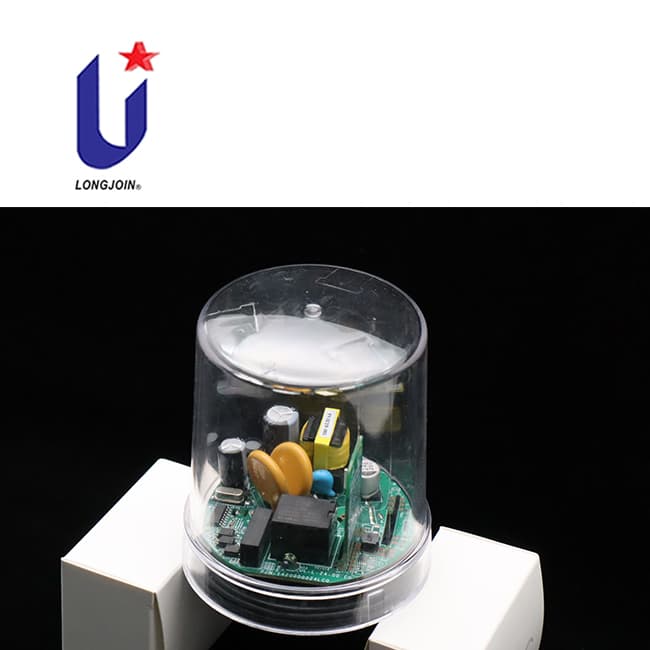
Core Components Of Long-Join Photo Control Sensor With Twist-Lock: MOV, Relay, And Step-Down Capacitor
Представлять
A twist-lock photocell looks simple. Plastic cover, a few pins. Done.
Three parts matter most in a Long-Join twist-lock photocell. The relay. The MOV. The step-down capacitor. Relay switches the load. MOV helps against voltage surges. Capacitor reduces and steadies the power for the control section.
What Are The Three Parts, Exactly?
Look at a circuit board and everything seems to do the same job. It doesn’t. Easier to sort these three by what they actually do.
Компонент | Looks Like | Job |
Relay | Black rectangular block | Opens and closes the lamp circuit |
MOV | Yellow disc | Suppresses sudden voltage surges |
Step-down capacitor | Brown/red rounded rectangle | Lowers voltage for the control circuit |
Relay switches. MOV protects. Capacitor feeds the low-voltage section. That split matters because a photocell has two very different tasks.
Long-Join’s twist-lock range covers street, garden, passage, and doorway lighting, with different surge-protection and operating options.
How Does The Relay Switch The Street Light?
Does the little light sensor carry the lamp current itself? No. Not even close. The relay does the real electrical work.
In the configuration covered here, the relay is an S3-12B-LJ with a 24VDC coil. Contact ratings: 10A at 24VDC, 15A at 120VAC, 12A at 250VAC.
The sequence is simple. Sensing circuit checks the light. Darkness hits the set level, circuit drives the relay. Contacts change state, lamp circuit runs. Dawn comes, circuit responds again, lamp goes off.
This is why relay quality matters so much. It switches again and again, every single day. Long-Join states the relay in its Серия JL-207 can deliver more than 10,000 working cycles. Some versions add zero-crossing technology too, which cuts switching stress.
What Does The MOV Actually Protect?
Outdoor power is rough. Lightning activity, grid switching, nearby equipment, all of it can throw short voltage spikes into the line. Even a fast spike can fry small electronic parts.
That’s the MOV’s job. Metal Oxide Varistor. In normal operation it mostly stays out of the way. Voltage jumps sharply, it starts conducting and limits the surge reaching the rest of the photocontrol.

Long-Join lists several MOV options for the JL-205C series and JL-207C. Published options: 110J/3500A, 235J/5000A, 460J/10000A. Higher ones available on some versions.
MOV Function | Meaning | Выгода |
Overvoltage protection | Reacts to sudden voltage rise | Protects internal parts |
Surge suppression | Limits short spikes | Lowers chance of sudden damage |
Added circuit protection | Absorbs part of the surge | More stable operation |
Why A Step-Down Capacitor?
Unit’s already wired to the street-light supply. Why drop the power?
Because the sensing and control parts inside don’t need lamp-level voltage. They’d cook. The step-down capacitor helps the power section give the control circuit a suitable lower-voltage supply. Small electronics run without sitting at full supply level. Compact size helps too, since a twist-lock housing doesn’t have much room.
It also steadies things. Noise and voltage changes disturb control electronics. Unstable power in a dusk-to-dawn photocell means poor switching, or extra stress on the relay.
Don’t mix up the MOV and the capacitor. MOV reacts to sudden overvoltage. The step-down capacitor belongs to the normal power-reduction section.

How Do The Three Work Together?
Can any one of them make the photocell reliable alone? No. They work as a small team.
Компонент | Job | Contribution |
Relay | Electrical switching | Turns lamp circuit on or off |
MOV | Surge suppression | Protects against overvoltage |
Step-down capacitor | Power reduction, stabilizing | Supports steady sensor and relay operation |
Low-voltage section gets stable power first. Sensing part decides light or dark. Relay does the switching. MOV stands guard if a spike shows up.
Teamwork matters outdoors. Good light sensor, weak relay? Poor performance. Undersized surge protection? Same story. Unstable power section? Same again.
Think of three workers with separate jobs. One prepares the power. One guards against sudden electrical trouble. One switches the lamp.
How Does This Affect Safety And Reliability?
Street-light controls live in heat, rain, repeated switching, voltage changes, long hours outside. Internal parts have to act as one system.
Long-Join lists UL, C-UL, CE, RoHS and other certifications on its Quality Certificate page, with UL file E188110. Published photocontrol models also follow UL and ANSI requirements.
Matters for buyers because safety isn’t only the outer shell. Relay capacity, surge protection, circuit stability, sealing, correct load matching, all of them shape performance.
How Do You Match Relay Rating To The Load?
Is the amp number on the relay enough? Not always. Lighting load type matters too.
LED drivers, ballasts, tungsten lamps draw current differently, especially at startup. Some loads throw a short inrush current far above their normal running current. That punishes relay contacts.
So check the complete photocell rating. Not only the number printed on the relay.
Long-Join’s JL-207C specs split tungsten, ballast, and electronic-ballast ratings instead of giving one number for every lamp type. That’s the honest way to do it.
Часто задаваемые вопросы
S3-12B-LJ, 24VDC coil. Contacts rated 10A/24VDC, 15A/120VAC, 12A/250VAC. Switches the lamp circuit.
No. It suppresses surges within its designed range. Above that range, damage can still happen to the photocell or connected equipment.
Gives the control circuit a suitable lower-voltage supply and supports steadier operation.
Match the full photocontrol rating to lamp voltage, load type, normal current, and any starting or inrush current.
Fewer unwanted switches, less electrical stress, fewer circuit faults. More consistent operation, less unnecessary maintenance.
Заключение
A dependable photocell is more than a light-sensitive part under plastic.
Relay switches the lamp. MOV helps control damaging surges. Capacitor provides suitable, stable power for the control section. Together they let a Long-Join twist-lock photocell respond to day and night while holding up outdoors.
Внешние ссылки:
●https://ww1.microchip.com/downloads/en/appnotes/01332b.pdf
●https://www.electronics-tutorials.ws/resistor/varistor.html
●https://ieeexplore.ieee.org/document/10595089/
●https://www.ansi.org/american-national-standards/ans-introduction/essential-requirements

 Russian
 English
 Spanish
 Portuguese
 Arabic
 Japanese
 Italian