

Enhancing Wireless Smart Photocontrol Systems in Chiang Rai, Thailand: How Long-Join JL-260C and Core Accessories Solve High Signal Interference Issues
Представлять
Chiang Rai is building out умное уличное освещение quickly. Roads, parks, public spaces. Everyone wants the same three things: better control, less power draw, maintenance that does not eat up a technician’s entire week.
But wireless signal interference is real.
А контроллер уличного освещения sitting at the wrong angle, with buildings or trees between it and the receiver, may not pull a clear signal. Commands stack up. Data packets drop. The lamp status report shows up late or not at all. The system still works at the basic level — dusk and dawn switching — but the smart part, the part that made the upgrade worth doing, stalls.
Why Is Wireless Signal Interference A Problem In Chiang Rai Smart Lighting?
Smart lighting lives on stable wireless communication. Without it, you have no remote command, no status feedback, no real control network. You have a light that turns itself on and off, which is what photocells have done for sixty years.
Chiang Rai’s geography makes this tricky. Some roads are flat and open and straightforward to cover. Other sections sit in hilly terrain with dense tree cover, buildings blocking the line of sight, poles spaced irregularly. Each one weakens the signal. A photocell sensor still does its day-night switching, but the wireless data link becomes unreliable.
The physical angle matters more than most installers expect. Shift a photocontrol receptacle a few degrees, point it away from the lamp body or nearby obstruction, and signal quality climbs noticeably.
Site Problem | What May Happen | What The System Needs |
Weak wireless signal | Commands may delay | Better node position |
Heavy interference | Data may drop | Stable smart controller parts |
Difficult pole layout | Installation takes longer | Flexible mounting |
Outdoor rain and heat | Parts may wear faster | Strong material and sealing |
Future upgrade needs | Old sockets may limit control | Smart-ready receptacle design |
A good system is not only software. Socket, base, cover, connection — the physical layer matters more than anyone installing their first smart network usually realizes.
How Does JL-260C Help In Complicated Wireless Environments?
The JL-260C is not a standard fixed NEMA socket. It is external mounting, which means the installer gets more freedom with placement. Not much freedom, but real freedom.
In a basic street light project, the photocell job is simple. Night comes, light goes on. Day comes, light goes off. That is the entire requirement.

JL-260C solves part of this by letting the installer adjust the mounting position. The photocell or smart controller can be angled away from the lamp body, away from the pole, away from trees or buildings that would block transmission. Long-Join groups the JL-260C within its outdoor receptacle and NEMA connector family, designed specifically for smart lighting work.
It is a small thing. It ends up mattering.
Why Is A Rotatable NEMA Socket Important For Smart Photocontrol?
A sensor that reads daylight correctly needs to face natural light, not the light it is trying to control. A wireless controller needs a clear path to its receiver.
Sounds basic. In practice it is where many installations go wrong.
Put the sensor facing the lamp, and it reads artificial light instead of ambient day-night changes. Result: lamp turns on too early, turns off too late, and does not respond quickly to remote switching. Put the wireless node facing the pole structure or a nearby building, and packets drop.
JL-260C Feature | Simple Meaning | Field Benefit |
External mounting | Socket can sit outside the fixture | Better signal exposure |
Adjustable orientation | Device position can be changed | Easier signal tuning |
Outdoor control use | Made for street and area lights | More stable field use |
Smart lighting support | Works with control accessories | Better upgrade path |
Faster installation | Less complex onsite adjustment | Saves labor time |
How Do YS800076 And JL-241J Support Smart Photocontrol Development?
Three parts working together. JL-260C provides the external mounting and connection point. YS800076 and JL-241J fill in what happens inside and beneath.
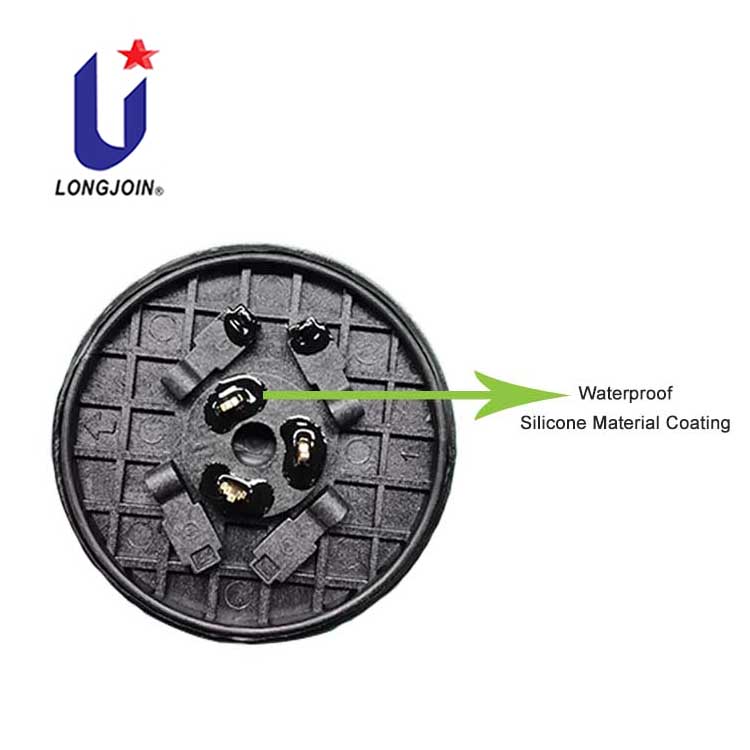
YS800076 for PCB packaging, while PCB is the wireless smart photocontrol terminal. Picture it as the part that handles stable data links and command accuracy. In a street lighting network, this component is what lets the individual node talk to the larger control system. Without it, there is no smart layer, only a dumb photocell.
YS800076 is made from different plastic material, and it is used to Core part PCB outer package cover. Addition, long-join offer a type hard thick shell, one is better for industrial grade environment temperature -40 to 70 degree, and reliable antive-uv.
Компонент | Main Role | Почему это важно |
JL-260C | External receptacle | Helps mounting and signal position |
Core PCB | Wireless smart terminal part | Supports stable data connection |
JL-241J Base | Control base interface | Gives strong electrical support |
NEMA Interface Module | Connection platform | Helps match smart control needs |
YS800076 Cover And Holder Parts
| Protection and fixing | Improves durability |
They are not separate products. They are pieces of one system.
How Does JL-241J Improve Physical And Electrical Reliability?
А умный контроллер needs a base that does not move, does not flex, does not feel loose in the hand.
A weak base means the whole assembly feels loose in the field. Technicians notice. So do customers. The product feels cheap even if it is not, and that feedback cascades back to the buyer wondering if they made the right choice.
JL-241J gives the photocontrol unit a stable interface. It anchors the electrical structure and connects the control section to the power supply and light load. Long-Join twist-lock photocell controllers use the JL-241J base, PCB circuits, and cover assembly. These bases, the company says, provide power and signal interface support for outdoor roadway, street, and area lighting.
So the base does not only sit there. It works.
Why Do Material Quality And Craftsmanship Matter So Much?
Outdoor parts live hard lives. Rain, sun, heat cycling, salt spray if you are near a coast, dust if you are inland.
Material quality is not decorative. It determines safety, service life, and whether someone buying from Long-Join thinks they made a sound decision or got burned.
Feedback from this project said the material compared to other suppliers “feel the quality much much better.” That is the kind of comment that matters. A buyer or installer can feel cheap plastic before they ever install it. They can feel a weak holder, a loose join, parts that seem to shimmy. They notice.
How Does Long-Join Support Smart Lighting Buyers Better?
The product matters. The support matters more.
A buyer in Thailand is not asking “Which socket fits this lamp?” They are asking “Which full set of parts will make my smart lighting system actually work in this difficult area?” That is a different question entirely.
Long-Join answers it with NEMA receptacles, photocontrol bases, covers, terminals, and smart control accessories. All pieces that work together, not items bought separately from different vendors and then hoped to fit.c
Часто задаваемые вопросы
Yes, but not by magic. It helps by giving the controller or sensor a better mounting position, better angle, better line of sight. It does not erase interference, but it can improve how much signal gets through.
No. JL-241J is the base that holds everything up. Without it you have loose parts and a system that does not feel solid.
Yes. JL-260C, YS800076, and JL-241J are built for smart photocell control, especially where the wireless link has to work.
A fixed socket works fine for simple on-off switching. High-interference areas need adjustable mounting. You need to tune the angle, and a fixed socket does not give you that option.
Yes. A smart-ready NEMA platform means you can add better monitoring, control features, and wireless improvements later without replacing the whole socket and base structure.
Заключение
Chiang Rai’s smart lighting market is not looking for basic photocells. It needs wireless control that actually works in difficult conditions, outdoor parts that do not degrade in six months, and installation that does not take half a day because the socket fits wrong.
Signal interference is a real problem, but the right hardware reduces it significantly. Long-Join’s JL-260C external mounting receptacle, YS800076 wireless smart terminal, and JL-241J base work as a set.
Внешние ссылки:
●http://bisgeog.weebly.com/chiang-rai.html
●https://en.wikipedia.org/wiki/Photoelectric_sensor
● https://en.wikipedia.org/wiki/Printed_circuit_board.


 Russian
  English
  Spanish
  Portuguese
  Arabic
  Japanese
  Italian