

UL773 Certification Requirements: Photocell Base Must Use GF+PBT
Introduzir
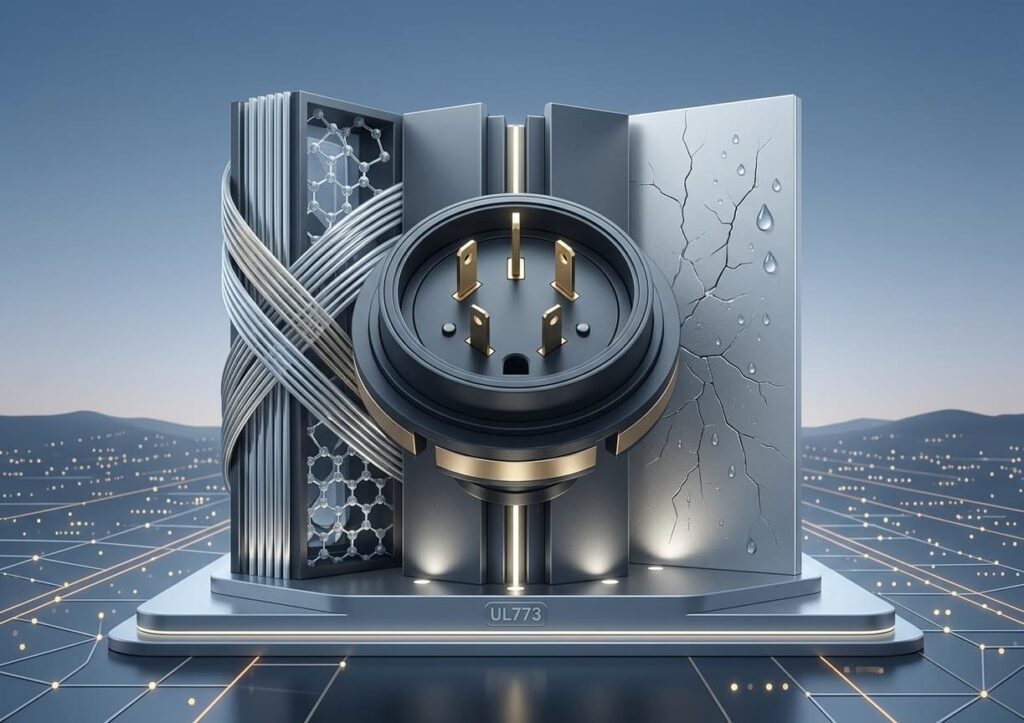
UL773 is the primary safety standard for photocontrol devices entering the North American market. It covers electrical safety, mechanical performance, insulation, waterproofing, and environmental durability.
The material used in the photocell base determines whether a product can meet these requirements.
This article explains what UL773 demands from photocell base materials and why GF+PBT (Glass Fiber and Polybutylene Terephthalate) is the correct material choice.
What Is UL773?
UL773 is a safety standard from Laboratórios Underwriters focusing on the electrical safety and mechanical performance of photocontrol products, and it is a critical entry requirement for the North American photocontrol market.
It requires that, under the conditions that outdoor installation produces, photocontrol products meet defined standards for:
- Insulation spacing
- Impermeabilização
- Heat resistance
- Mechanical strength
What Material Requirements Does UL773 Set for Photocell Bases?
Four material performance categories in UL773 define why PC (Polycarbonate) falls short and why GF+PBT is required.
Requirement Category | Descrição | PC Performance | GF+PA66/GF+PBT Characteristics | Technical Conclusion |
Insulation Distance (CTI) | Material must maintain good insulation performance in high-humidity conditions | PC’s CTI is relatively low; insulation stability is limited | GF materials have higher CTI; higher glass fibre content means more stable CTI | High GF content ensures reliable insulation per UL773 standards |
Heat Resistance (RTI) | Material must resist deformation in environments up to 60-90°C | PC RTI 110-125°C, marginal heat resistance | GF reaches 150-200°C, suitable for long-term high-temp operation | UL773 requires RTI that puts PC near edge; GF has clear advantage |
Mechanical Strength (Plug Force) | Must withstand high NEMA plug pull and insertion forces without cracking or loose screws | PC strength decreases at high temp; prone to cracks and deformation | GF remains rigid and crack-resistant at high temps | Higher GF content facilitates passing mechanical plug testing |
Moisture and Condensation Resistance | Must remain dimensionally stable under humid, wet conditions | PC has high water absorption; its structure is easily affected | GF+PBT has low moisture absorption, stable dimensions and structure | GF enhances water resistance and sealing stability |
Why Does Each Requirement Create a Problem for PC?
Each of the four UL773 material requirements exposes a specific PC limitation in outdoor photocell base applications.
The CTI (Comparative Tracking Index)
CTI requirement addresses the risk of surface leakage current in humid conditions. CTI measures how well a material resists tracking.
PC has a lower CTI than glass-fibre reinforced materials. In the humid, contaminated environment of an outdoor photocell base, this matters for sustained insulation integrity over years of service.
The RTI (Relative Thermal Index)
RTI requirement is where PC’s limitation is most clearly quantified. PC’s RTI of 110 to 125°C sounds adequate against a 90°C operating temperature, but UL773’s RTI requirements account for sustained thermal load rather than peak exposure.
A photocell base at the top of a luminaire in a hot climate experiences 70 to 85°C continuously across long summer days. With a PC base operating consistently near its stability limit, dimensional change accumulates. GF+PBT with RTI values of 150 to 200°C operates well below its stability limit in the same conditions.
The mechanical strength
The mechanical strength requirement specifically addresses NEMA plug insertion and pull-out forces. Every time a photocell is installed or removed from a receptacle, the base undergoes torsional and axial loading.
In hot conditions, PC’s mechanical strength decreases, while GF reinforcement maintains rigidity and crack resistance at elevated temperatures.
The moisture and condensation resistance
Moisture resistance requirement connects directly to sealing performance. PC absorbs moisture from the surrounding environment because its dimensional change with moisture absorption adds to the dimensional change from thermal cycling.
GF+PBT has significantly lower moisture absorption, which means its dimensions remain more stable across the combined thermal and humidity cycling that outdoor service produces. Stable dimensions mean consistent sealing ring compression. Consistent sealing ring compression means sustained waterproof performance.
Is It UL773 or UL1598 That Requires GF+PBT?
UL773 sets the primary material and performance requirements for photocontrol devices specifically, while UL1598 governs the entire luminaire system, including photocontrol components.
UL773 is the most directly relevant standard for photocontrol base material requirements. It specifies the insulation, heat resistance, mechanical strength, and moisture performance criteria that the base material must satisfy as a standalone photocontrol component.
UL1598 covers the photocontrol as part of the complete luminaire assembly, adding requirements for luminaire-level temperature class, salt spray resistance, and system integration that go beyond the component-level UL773 requirements.
Long-Join’s choice of high-glass-fibre-reinforced PBT satisfies both standards, along with full certification documentation. For buyers, the practical procurement check is straightforward:
- Confirm UL773 listing
- Verify that the base material specification includes glass-fibre-reinforced PBT
- Check the glass-fibre content percentage.
Higher GF content provides more stable CTI, better RTI, greater mechanical strength, and lower moisture absorption.
What Are the Procurement Recommendations?
When purchasing photocontrols for North American applications, here are 5 things to do:
- Verify UL773 listing and request confirmation of the base material composition.
- Prefer GF+PBT composites with high GF content to achieve the balance of heat resistance, mechanical strength, and insulation performance that UL773 demands.
- Consider the actual usage environment, such as high-humidity, high-temperature, and salt spray locations
All these increase the performance margin required above the UL773 minimum, and higher GF content provides that margin.
Frequently Asked Questions on UL773 and GF+PBT Requirements
UL773 focuses on electrical insulation integrity, heat resistance under outdoor operating temperatures, mechanical strength under NEMA plug insertion and removal forces, and waterproofing stability under humid and wet conditions.
CTI (Comparative Tracking Index) measures how well a material resists surface leakage current in humid, contaminated conditions. GF materials have higher CTI than PC, providing more reliable insulation stability in the outdoor environments that photocell bases operate in.
RTI (Relative Thermal Index) measures sustained heat resistance. PC's RTI of 110 to 125°C is marginal for photocell bases that experience 70 to 85°C continuously at luminaire top positions. GF+PBT's RTI of 150 to 200°C provides the necessary margin above operating temperatures.
RTI (Relative Thermal Index) measures sustained heat resistance. PC's RTI of 110 to 125°C is marginal for photocell bases that experience 70 to 85°C continuously at luminaire top positions. GF+PBT's RTI of 150 to 200°C provides the necessary margin above operating temperatures.
PC absorbs more moisture than PBT, causing dimensional change that reduces sealing ring compression over time. GF+PBT's low moisture absorption maintains dimensional stability and consistent sealing geometry across the humidity cycling that outdoor photocell bases experience.
Conclusão
UL773 sets four material performance requirements for photocell bases that PC cannot reliably satisfy in the real-world thermal and humidity conditions of outdoor luminaire installation. GF+PBT with high glass-fibre content meets all four requirements with significant margin.
Long-Join specifies high-glass-fibre reinforced PBT as standard across its photocell base range, satisfying UL773 requirements and providing the material performance that outdoor photocell applications demand.
 Portuguese
  English
  Russian
  Spanish
  Arabic
  Japanese
  Italian