
Common Street Light Photocell Problems After Heavy Rain
Introduzir
Heavy rain is one of the fastest ways to expose weak sealing in a street light control setup. When water gets into a dusk-to-dawn unit, it can trigger problems like water ingress, relay damage, flickering, and false ON/OFF switching. In a real roadway network, that means more truck rolls, higher maintenance cost, safety risk, and longer lighting downtime.
This guide breaks down the most common post-rain faults, explains why they happen in plain language, and shows practical ways to prevent repeat failures—using LONG-JOIN product options such as JL-207C e JL-205C where they fit best.

Why Do Street Light Photocells Fail So Often After Heavy Rain?
Because rain does not only “wet the outside.” It finds the smallest gap and keeps pushing in.
A photocell sits outside, often on top of a pole light. When strong wind blows rain against it, a weak seal can let water slip into the control cavity. Once moisture reaches metal parts, you can get corrosion. Once it reaches the circuit, you can get unstable switching.
Also, “waterproof” is not one single thing. Many products rely on gaskets and tight assembly to keep water out. If the gasket is old, thin, or not set in place well, protection drops fast. That is why IP ratings matter so much for outdoor electronics enclosures.
What Does “Water Ingress” Look Like In Real Street Light Systems?
It often looks like random failure that comes and goes—until it becomes permanent.
Water ingress happens when rain gets in through weak housing, cracked covers, loose caps, or worn seals. Once inside the unit, it can cause short circuits, rust, and unstable operation. Sometimes the light works during dry days and fails right after storms. That pattern is a strong clue.
If you are using twist-lock style controls, the interface between the control and the socket must also be tight. Long-join notes optional receptacle kits for its twist-lock products, which is helpful for replacement and maintenance planning.
Why Do Street Lights Flicker After A Storm?
Because moisture can disturb switching parts and make the driver “panic.”
After heavy rain, a common complaint is flashing, rapid cycling, or delayed switching. Moisture can affect relay contact stability. It can also create “leak paths” where tiny currents flow where they should not. For LED fixtures, unstable input can show up fast as flicker.
This is why it helps to match the control to the fixture type. When the relay and the load are not well matched, the system becomes more sensitive during wet conditions. LONG-JOIN positions some models as suitable for outdoor automatic control across street, garden, and passage lighting—meaning they are designed for these environments and switching cycles.
Why Does A Photocell Get Stuck ON Or Stuck OFF After Heavy Rain?
Because the sensing or switching section is no longer reading conditions correctly.
Rain can damage the sensor. Then the lights may stay on in the day. Or they may not come on at night. This can happen when moisture gets into the light sensor. It can also happen when rust changes how the parts work. In simple terms, the unit “misreads” day and night.
If your network uses a dusk to dawn photocell sensor, stuck ON/OFF behavior is one of the most expensive faults—because it wastes energy in the day or removes safety lighting at night. Models that include time delay can reduce nuisance switching during sudden light changes, including lightning flashes. LONG-JOIN describes a preset time delay for JL-205C-type designs to avoid redundant operation.
How Does Corrosion On Socket Contacts Create Bigger Problems?
Because corrosion turns a clean connection into a weak, hot, unreliable connection.
When moisture stays around terminals, oxidation builds up. That can cause rust on terminals, poor electrical contact, higher resistance, and heat. In the field, corrosion can look like intermittent faults: sometimes it works, sometimes it does not. It can also make replacement harder because the contact surfaces are no longer smooth.
If your system uses a photocontrol receptacle (the mating socket), you want materials and plating that resist oxidation better, plus sealing that limits moisture exposure in the first place. LONG-JOIN’s receptacle and controller ecosystem is built around these outdoor plug-in interfaces.
What Are The Most Common Post-Rain Failures And The Best Fixes?
Here is a practical table you can use during inspection and troubleshooting.
Common Failures After Heavy Rain
Problema | What Usually Causes It | What To Do First | Better Long-Term Fix |
Water ingress | Weak sealing, cracked housing, poor gasket seating | Dry the unit, inspect gasket and cover | Choose higher IP options (IP65/IP67 available) |
Flickering | Moisture affecting relay/driver stability | Check wiring tightness and load match | Use an LED-suitable control and stable relay design |
Corrosão | Long moisture exposure on contacts | Clean/replace corroded terminals | Use corrosion-resistant materials and improve sealing |
Sensor failure | Poor housing quality or moisture in circuit | Test with known-good unit | Use UV-stabilized enclosure and outdoor-rated build |
Relay damage after storm | Surges during storms | Check for blown switching behavior | Choose models with surge protection (MOV mentioned) |
Which LONG-JOIN Models Fit Wet Outdoor Environments Best?
It depends on whether your priority is higher protection and long life, or fast, standard twist-lock replacement.
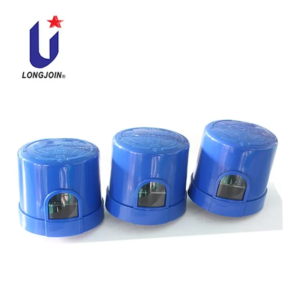
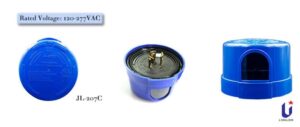
LONG-JOIN’s JL-207C product listing highlights that the JL-207 series is used for automatic control based on ambient light and notes long-life characteristics, with IP rating options listed (including IP65/IP67).
LONG-JOIN’s JL-205C page describes the model as twist-lock, used for street and area lighting control, and lists available IP options and surge arrester (MOV) features on some product descriptions.
JL-207C Vs. JL-205C
Item | JL-207C | JL-205C |
Melhor uso | Roadway lighting needing durable performance | Standard twist-lock replacements and broad use cases |
Waterproof Options | IP54/IP65/IP67 listed | IP54/IP65/IP67 listed |
Key Strength | Long-life focus mentioned in series description | Time delay + surge arrester (MOV) mentioned in description |
Manutenção | Good for reliability-led programs | Easy swap-in style for common fixtures |
If your main pain is water exposure and repeat failures, prioritize an Fotocontrole IP65 (or stronger) option, plus good sealing practice during install. If your main pain is slow maintenance replacement, prioritize twist-lock standardization and keep spares ready.
Why Does Waterproof Design Matter More Than People Think?
Because most “heavy rain failures” are not caused by rain alone. They are caused by weak design details.
A good outdoor unit needs a sealed body and a strong gasket. It should resist sun damage and rust. Cheap products often fail. The silicone seals wear out. The housing can crack in heat and sun. After a few storms, water may reach the inner circuits.
Think of it like a phone case. If the case has one small gap, water will find it. The same happens to a fotocélula para iluminação pública on a pole top.
What Should Buyers Check Before Ordering Street Light Photocells?
Use a short, repeatable checklist so your team does not buy “good-looking” units that fail in the first rainy season.
Procurement Checklist For Rain-Heavy Areas
What To Verify | Por que isso importa | What “Good” Looks Like |
IP rating option | Higher protection reduces water ingress risk | IP65/IP67 options available for the model |
Twist-lock standard fit | Prevents mismatch and loose mounting | ANSI C136.10 twist-lock compatibility stated |
Proteção contra surtos | Storms often come with surges | MOV/surge arrester mentioned in model description |
UV-stabilized enclosure | Sun damage cracks housings over time | UV-stabilized enclosure listed |
LED compatibility | Helps reduce flicker and instability | Control designed for modern lighting loads |
This is also where supplier consistency matters. If you are working with manufacturers photocell vendors, ask for the exact spec sheet for the model you will buy, not a “similar” model.
Perguntas frequentes
Water slips through weak seals and reaches the internal circuit. That can cause shorts, rust, and unstable switching.
For heavy rain areas, IP65 is the safer baseline for most roadway installs.
Moisture can make the relay contacts unstable, so the LED driver keeps restarting.
Water causes corrosion on relay contacts, making switching rough and unreliable.
JL-207C is a strong pick when your main issue is rain exposure and repeat water-related failures.
Conclusão
Heavy rain does not “randomly” break street light sensors. It usually exposes weak sealing, weak housing, or poor contact protection. When you upgrade to better outdoor designs—and install them carefully—you cut flicker complaints, reduce stuck ON/OFF failures, and protect your maintenance budget.
LONG-JOIN models like JL-207C and JL-205C support stronger roadway reliability with listed IP options, outdoor-ready materials, and stable switching features suited for street lighting networks.
Links externos:
●https://www.legrand.sa/en/catalog/products/photoelectric-sensor-ip65-ik07-for-modular-twilight-switch-412860
●https://www.chintglobal.com/global/en/about-us/news-center/blog/metal-oxide-arrester-moa-overview.html
●https://www.samaterials.com/blog/oxidation-processes-and-oxidation-resistance.html
●https://en.wikipedia.org/wiki/Light-emitindo_diode

 Portuguese
  English
  Russian
  Spanish
  Arabic
  Japanese
  Italian