
Introduction To UM Series Photocell Applications: Focusing On UM-205C And UM-204C Photocell Solutions
導入
Outdoor lighting projects get hit from two sides. Cities and utilities
But seasons change. Weather shifts. And sunrise and sunset times move.
That is where a robust photocell lighting sensor becomes a quiet but critical part of the system. The UM Series is Long-Join’s practical mid-range option. The UM-205C and UM-204C stand out the most. It works across a wide voltage range.
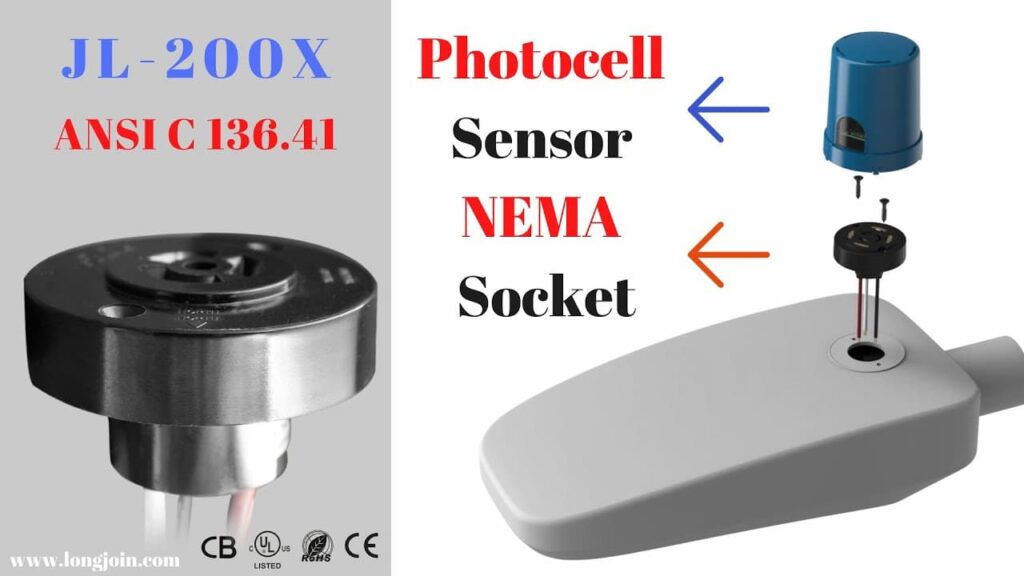
What The UM Series Photocells Solve In Outdoor Lighting
Instead of running on a fixed schedule, each UM Series device uses a photocell sensor. They follow real outdoor light levels, not guesses.
Typical pain points they address:
- Lights wasting power during bright, empty hours
- Manual timer changes every few weeks as seasons change
- Complaints from residents about dark corners in car parks or walkways
- Higher maintenance costs from constant site visits just to tweak settings
使用することで UM-205C or UM-204C as a dusk-to-dawn photocell control, you get:
- Automatic switching based on natural light
- More consistent safety for roads and pathways
- エネルギー料金の削減 because fittings are not burning all day
- Less technician time on site just to adjust schedules
If you’re planning a street-light retrofit or a new build, start with a stable photocell. It gives you a simple baseline. It stays steady, so you can plan with it. Smart controllers can be added later. Add them only when you need them. Don’t add them everywhere.
What A Photocell Is And How Dusk-To-Dawn Lights Work
This turns a standard luminaire into a dusk to dawn photocell luminaire without changing the fixture body. For installers and OEMs, the controller is a small photocell switch. It sits between the power line and the lamp.
To make this clearer, here is a quick look. These are the main parts inside a UM-series photoelectric sensor controller.:
成分 | What It Does In The System | Why It Matters In The Field |
Photosensitive element | Senses ambient light (lux) | Accurate lux sensing means “on” and “off” happen on time |
Control electronics | Interprets the sensor signal and decides when to switch | Stable logic reduces flicker and false triggers |
Relay or triac output | Physically opens/closes the lighting circuit | Handles the lamp load safely and repeatably |
Enclosure and gasket | It protects the electronics from rain, dust, and harsh UV rays. This helps them last longer and keep working well. | Ensures years of operation outdoors |
Terminals / twist-lock | Provides the mechanical and electrical interface to the luminaire | Makes swap-out and upgrades fast for installersIt helps installers swap parts fast. Upgrades are quick too.
|
UM-205C Vs UM-204C At A Quick Look
The table below lists the main details for each model. It lets you compare both at a glance.
It is based on the official UM Series product data.
Key Parameters Of UM-205C And UM-204C Photocell Controls
特徴 | UM-204C (UM Series) | UM-205C (UM Series) | Project Impact |
Nominal Voltage | 120–277 VAC | 120 VAC (UM-205C variant in UM Series) | Covers most mainstream AC grids |
適用電圧範囲 | Approx. 105–305 VAC | Wide operating range (around 90–305 VAC, depending on config) | Helps ride through unstable or “dirty” grids |
Typical Protection Rating | IP54 / IP65 / IP67 options | IP65 | All-weather protection for street and area lighting |
Rated Load (Example) | Up to 500 W tungsten, 850 VA ballast (typical UM-204C) | Sized for common LED street and area luminaires | Suitable for standard photocell street light retrofits |
動作温度 | –40 °C to +70 °C (typical UM-series range) | Similar outdoor temperature range | Safe operation in cold winters and hot summers |
典型的なアプリケーション | Standard dusk-to-dawn street roads and area lighting | Harsher, humid or coastal sites needing robust IP65 housing | Lets you match device to environment |
Price Positioning | Value-tier, balanced spec vs. cost | Value-tier with slightly more focus on cost competitiveness | Easy to win cost-sensitive projects without “no-name” risk |
Here’s a cleaner version that still keeps the same meaning:
If you want a simple rule to follow, use this:
- Pick UM-204C when you need flexible voltage. It offers many waterproof options for wide project portfolios.
- Choose UM-205C when IP65 is enough, and you want a sharper price for large rollouts.
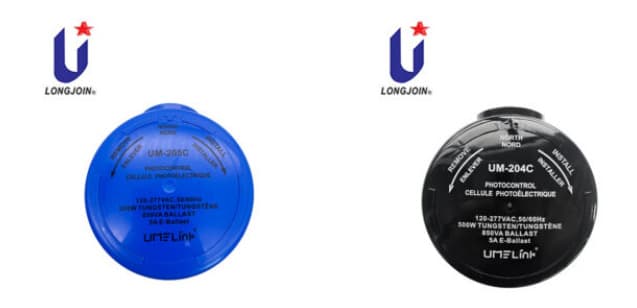
How UM-205C And UM-204C Work Outdoors
UM-204C is a twist-lock 光電池制御. It comes with IP54 to IP67 protection options. It runs on 105–305 VAC. It is built for outdoor use, in temperatures from about –40°C to +70°C.That means it can handle harsh cold in the north. It can also handle hot nights near the equator.
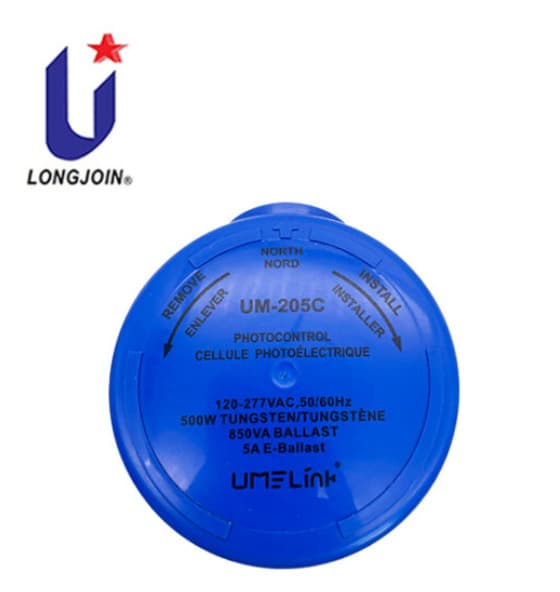
UM-205C is an IP65 photocell street controller built for tough places. It supports a wide working voltage and simple, clear lux settings. That keeps it reliable on weak grids and in humid or coastal emerging markets.
In day-to-day operation, that translates into:
- Stable switching: The photo sensor and control electronics are calibrated to avoid frequent “hunting” on cloudy days.
- Protection against surges: The overcurrent and surge design fits real street lighting needs. It helps the controller survive normal grid bumps.
- Sealed housings: Gaskets and enclosures block dust and moisture from the PCB. This protection helps the photo switch sensor work for many years.
Why UM-205C And UM-204C Are Easy To Use
Do your teams lose time on site because every luminaire seems to use a different controller or mounting method? UM-205C and UM-204C are built to reduce that friction.
Both are twist-lock, NEMA-style photocontrols that drop into standard photocell sockets on compatible luminaires. This keeps installation as simple as: plug, twist, test.
Here is how different stakeholders benefit from this design:
Practical Benefits For Stakeholders
Stakeholder | Typical Concern | How UM-205C / UM-204C Help |
Installer / Contractor | Time on site, wiring complexity | Twist-lock interface; no extra wiring in the field |
Distributor | SKU complexity, stock risk | Two core UM models cover a wide range of standard projects |
City / Utility Buyer | Reliability matters. So do spare parts. You also need support you can count on for years.
| Branded manufacturers photocell with documented specs |
OEM Luminaire Maker | Socket compatibility, integration effort | Fits existing NEMA twist-lock designs and standard cut-outs |
Maintenance Team | Night-time troubleshooting and replacements | Controllers can be swapped quickly, even under poor lighting |
UM-205C and UM-204C are part of a larger family of twist-lock controls, receptacles, and smart controllers. This lets project owners start small and still keep a clear path to upgrade.
For more complex corridors, UM-series controls can also be combined with ネマ または Zhaga receptacles and smart controllers from the same portfolio, giving you a bridge from basic dusk-to-dawn control to full street light controller solutions with remote monitoring.
結論
Your projects may still use manual timers or weak, anonymous controls today. UM-205C and UM-204C make upgrades simple.
They are not the cheapest throwaway choice, and not a fancy luxury device. They are light photocells built for solid value, steady reliability, and long-term support.Many cities, EPC contractors, and OEMs need this balance. It helps keep projects on budget while still protecting safety and good performance overall.
外部リンク:
● https://en.wikipedia.org/wiki/Printed_circuit_board
● https://en.wikipedia.org/wiki/NEMA_connector
● https://www.zhaga.com/products/luminaire-extension-receptacle-14.html



 Japanese
  English
  Russian
  Spanish
  Portuguese
  Arabic
  Italian