
What Are the Warning Signs Before a Photocell Reaches the End of Its Service Life?
يقدم
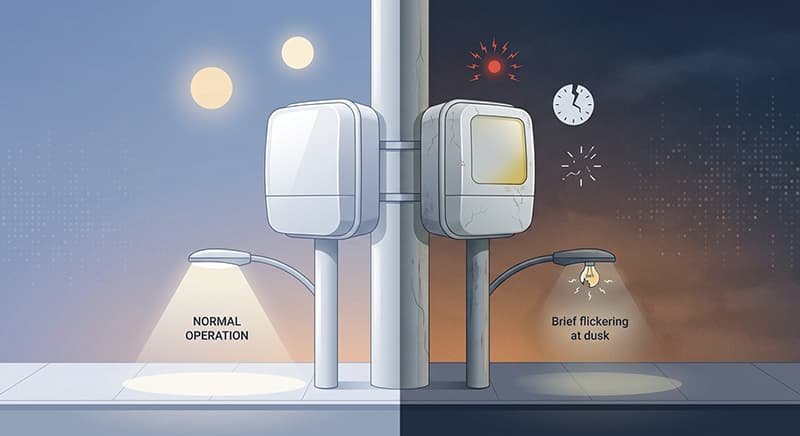
A photocell hardly fails overnight. There are usually signs before it stops working. The signs are usually there weeks or months before the unit stops working entirely. Signs could be lights coming on a little late, occasional daytime activation that seems to clear up on its own, and brief flickering at dusk.
These are easy to wave off, especially on a large network where individual fixture behaviour gets buried in the data. But each one means something specific. Catching them early costs a scheduled maintenance visit. Missing them costs an emergency callout, a dark road, and possibly a public safety incident.
The Five Warning Signs Worth Knowing
These five behavioural changes tell you a photocell is heading toward end of life. Each one points to a different underlying problem.
Frequent False Operations
The light toggles on and off when ambient conditions have not changed significantly. This usually means the photoelectric sensing element has aged to the point where its output is unstable. In CDS-based units, this is a classic aging symptom, but in Long-Join’s photodiode models, early onset of this symptom often points to moisture reaching the sensing circuit.
Decreased Sensitivity
The light switches on noticeably later than nearby fixtures at dusk, or stays on longer into the morning. The sensor’s light-to-electrical conversion efficiency has dropped. Gradual onset over months suggests normal component aging. Rapid onset suggests the photosensitive window has yellowed from UV degradation enough to reduce the light reaching the sensor.
Irregular Lamp Behaviour
The lamp is on during the day or off at night in patterns that have nothing to do with weather or ambient light. This is different from brief false triggering. It has sustained an incorrect state. A lamp that stays on during the day even when the photocell is covered may have a stuck relay. A lamp that stays off at night despite having power may have a faulty relay due to wear or oxidized contacts.
Unstable Relay Operation
Relay spring fatigue causes contact bouncing rather than clean snap action. This leads to either:
- Audible clicking or chattering from the fixture during switching
- Inconsistent switching timing
- Switching that takes multiple attempts.
The multiple contact events from each bounce create both the audible noise and accelerated contact wear from repeated arcing.
Complete Loss of Automatic Control
The photocell stops responding entirely, and the fixture needs manual override to work. On smart networks, this shows as a permanent fault state on the monitoring platform. This is a failure rather than a warning, but its appearance should prompt an audit of nearby fixtures of similar age installed in similar conditions.
What Causes These Signs?
Cause Type | Typical Manifestation and Impact |
Photoelectric Component Aging | Reduced conversion efficiency and sensing errors in photodiodes or photoresistors |
Electronic Circuit Damage | Humidity, vibration, or surge affecting circuit control and stability |
External Physical Damage | Thermal expansion or mechanical stress causing packaging or circuit breaks |
Mechanical Part Aging | Seal fatigue and relay spring wear reducing protection and switching reliability |
What Long-Join Does to Push These Signs Further Out
Long-Join photocell reaches the far end of its 10 to 15 year service life instead of showing warning signs at year three.
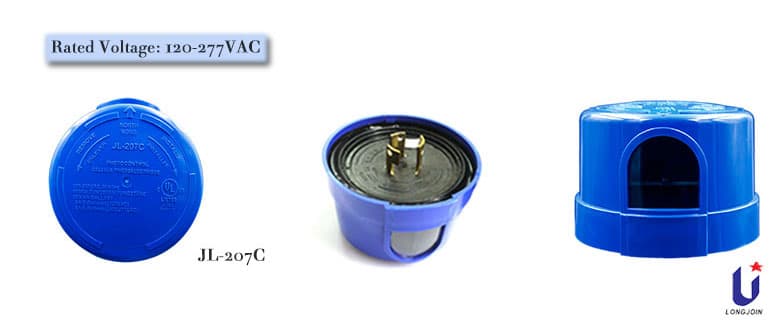
These four design decisions indicate how that is possible.
- الصمام الثنائي الضوئيsensing elements have inherently more stable long-term characteristics than CDS photoresistors. Their consistent conversion of light into electrical current over a wide range of temperatures helps minimize gradual changes in the switching threshold. Similarly, industrial-grade relays with silver-alloy contacts provide greater resistance to arc erosion than standard contacts, reducing contact surface deterioration over thousands of switching cycles.
- The photocell’s glass fibre-reinforced PBT (Polybutylene Terephthalate) housing with UV stabiliser keeps the photosensitive window from getting yellow after a prolonged exposure to sunlight. This enables the sensing element to get the light it needs to switch accurately.
- The EPDM (Ethylene Propylene Diene Monomer) also seals rings that maintain compression across thermal cycling to stop moisture from reaching the circuit in the first place. This prevents moisture ingress, which is one of the earliest failures in outdoor photocells.
- For maintenance teams, regular inspection is where the value of this design shows. A photocell that was switching in 5 seconds at installation and now takes 15 seconds is worth scheduling for replacement even if it has not technically failed yet.
Frequently Asked Questions on Photocell End-of-Life Signs
Frequent false switching without ambient light changes, delayed sensitivity at dusk and dawn, irregular on/off behaviour unrelated to weather, audible relay chattering, and eventually total loss of automatic control.
Normal false triggering may occur occasionally when ambient light levels are close to the photocell’s switching threshold, particularly during dawn, dusk, or changing weather conditions. However, frequent false triggering under stable lighting conditions, especially when it becomes progressively more common over several weeks, may indicate sensor deterioration or other faults and should be investigated.
High operating temperatures from luminaire heat, UV exposure on unstabilised housing material, moisture ingress from sealing degradation, surge events from grid instability, and excessive relay switching cycles from frequent false triggering.
Photodiode sensing, industrial-grade silver alloy relay contacts, GF+PBT housing with UV stabiliser, EPDM compression sealing, and integrated SPD surge protection. Each one targets a specific aging mechanism.
Annual for standard installations. Semi-annual for coastal, high-temperature, or high-vibration sites. For smart network installations with monitoring, flag any fixture showing switching pattern deviation from its baseline and inspect on the next scheduled visit.
خاتمة
Photocells give plenty of notice before they fail completely. The warning signs follow a progression from occasional false switching through sensitivity decline, irregular behaviour, relay chattering, and eventually total failure. That progression gives maintenance teams time to plan replacements before anything goes dark.
Long-Join’s design choices push the point where those warning signs appear toward the far end of the service life range. Regular inspection turns them into planned maintenance events rather than emergency callouts.
الروابط الخارجية
●https://en.wikipedia.org/wiki/Photoresistor
●https://en.wikipedia.org/wiki/Photodiode



 Arabic
 English
 Russian
 Spanish
 Portuguese
 Japanese
 Italian