
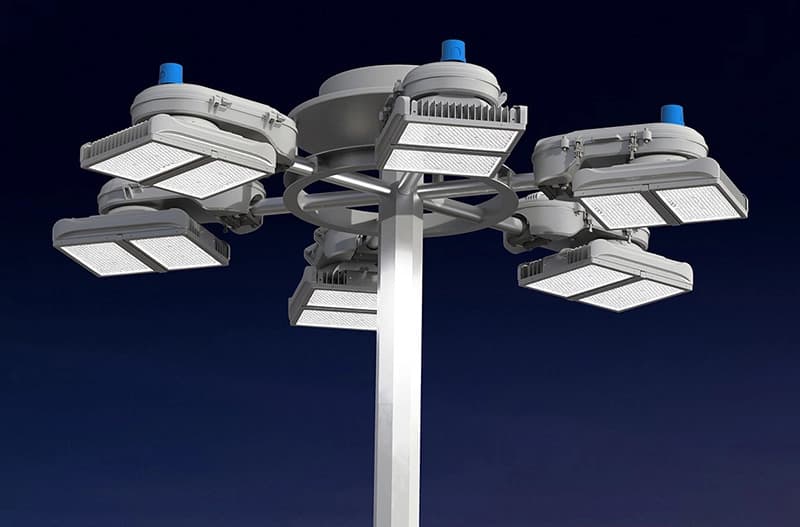
Are Composite Sensors Suitable for High Mast Lights?
يقدم
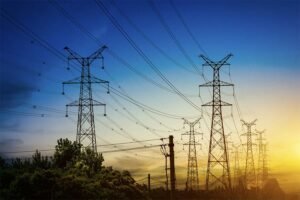
High mast lights sit at 8, 10, 12 meters and higher. They light roads, parking lots, large outdoor areas. They need to work reliably, and they need to work consistently.
In recent years, composite sensors started showing up for this work. Combine a مستشعر الضوء with a motion detector, add some logic, and you get something that sounds smart. In theory.
In practice, high-mast lighting breaks composite sensors. This article explains why, and it describes what actually works at that height.
Introduction to Composite Sensors
A photo control reads ambient light and switches based on that reading.
A composite sensor does two things. It reads light level (Lux), and it detects movement with an infrared PIR sensor. In theory, you get the best of both: the light comes on based on daylight level, and motion can influence the intensity or triggering.
Sounds smart. It is not.
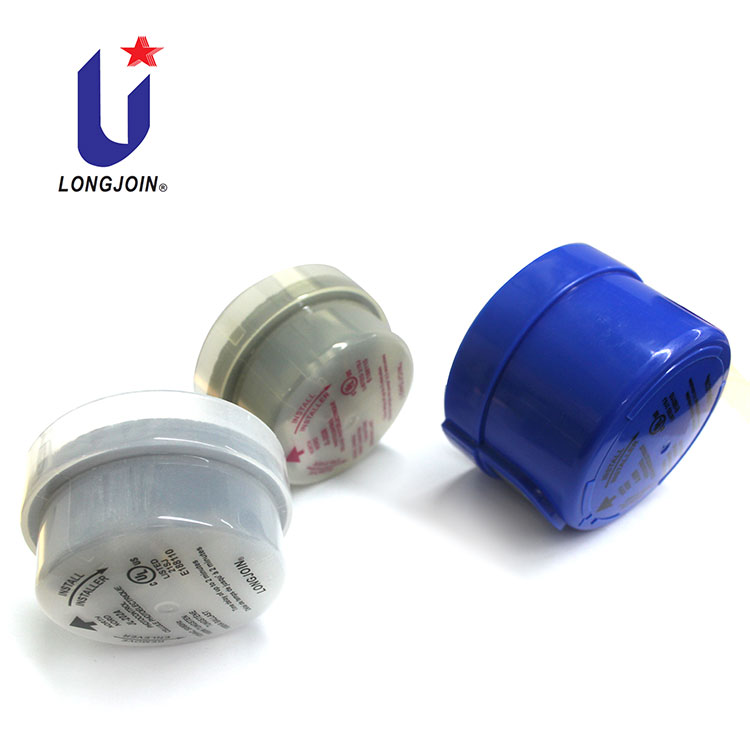
Ten Reasons Why Composite Sensors Are Not Suitable for High Mast Lights
Here is what actually happens when you put a composite sensor 8 to 12 meters up.
سبب | تفاصيل | تأثير |
PIR sensing distance insufficient at high mast heights | At 8–12 meters height, infrared signals from humans or vehicles are too weak; angles and distance limit effective sensing | Lights fail to turn on, delayed lighting, or cycling on/off |
Strong wind causes frequent false Motion triggers | Swaying branches, light pole shaking, air temperature fluctuations, and fog movement cause PIR false “motion” detection | Frequent flickering or continuous flashing |
Rain, snow, and fog alter infrared reflections | Raindrops, snowflakes, fog disrupt infrared reflections and cause false motion detection triggers | Flickering, unstable on/off cycling |
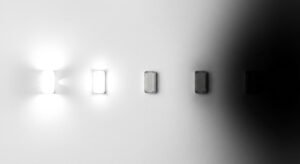
Complex lighting environment at high mast causes unstable Lux reading | LED reflection, ground reflection, vehicle lights, and building reflections combine to cause threshold drift | Delayed responses and frequent switching |
Complex sensor algorithms | Managing ambient light, PIR detection, delay, and sensitivity amid noise and environmental changes can cause incorrect judgments | Unstable control, increased misoperation rate |
High-power drivers vulnerable to frequent switching damage | Frequent on/off cycles cause large transient surges damaging LED drivers | Greatly reduced device lifespan |
Increased maintenance costs | Complex composite structure yields higher failure rates and maintenance frequency | Significant operational and economic burdens |
Continuous illumination requirement unsuitable for مستشعر الحركة | Dark periods without movement cause lights to switch off, with sudden brightening on motion creating safety hazards | Large safety risks for vehicles and pedestrians |
Difficult to properly calibrate sensitivity and delay | Challenging to set Lux threshold, PIR sensitivity, and delay properly given highly variable environments | Improper calibration often worsens problems |
Why Composite Sensors Fail At High Mast
The fundamental problem is height.
A PIR motion sensor is designed for human-scale distances, typically 5 to 7 meters maximum. Put it 12 meters up and the infrared signal dissipates. The detection range becomes unreliable or nonexistent.
Then there is wind. At 8 to 12 meters, wind is constant. Tree branches move. The pole flexes. Air temperature changes create movement in the sensor’s field of view. A sophisticated PIR sensor would filter this out. A composite sensor packed into a small fixture with limited processing power cannot. It false-triggers on wind.
Weather makes it worse. Rain scatters infrared. Snow reflects it. Fog disperses it. A motion sensor optimized for indoor use, where weather is controlled, falls apart outdoors. Add the Lux sensor reading all the complex reflections from ground, buildings, and vehicles, and the algorithm becomes confused.
The LED driver pays the price. Each on/off cycle creates an inrush current surge that stresses the power supply. You spend money replacing drivers, and nobody even tracks that the composite sensor is the root cause.
What Actually Works For High Mast
A photo control. Not a composite.
A fixed lux photo control reads daylight level and switches. That is the entire job. No motion detection. No complex algorithms. No PIR sensor hanging out at 12 meters trying to detect motion that is too far away.
Long-Join’s JL-207 series is built specifically for this. Phototransistor/IR-fitered-phototransistor, fixed threshold, simple relay. It reads the ambient light at whatever height the mast is. Dusk comes, the light turns on. Dawn arrives, the light turns off. Continuous, predictable, stable.
ميزة | وصف | فائدة |
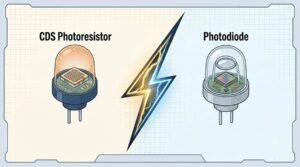
Fixed Lux Photo Control + Photodiode | Combines fixed threshold photo controls with highly sensitive photodiodes for stable ambient light sensing without frequent manual adjustment | Prevents false triggers due to weather; greatly reduces on/off cycling; protects driver lifespan; enhances road safety reliability |
التطبيق النموذجي | Generally used for 8–12 meter high mast lighting in city roads, plazas, and large parking lots requiring continuous illumination | Low maintenance cost and high deployment efficiency |
Why The Choice Matters
High mast lighting is not a place to experiment.
A light at 8 meters casts shadow across an entire intersection. When it flickers because a composite sensor is false-triggering on wind, drivers notice. When it goes dark because the motion detector does not work at that height, safety is compromised. When it cycles on and off, the LED driver wears out, and you are replacing fixtures ahead of schedule.
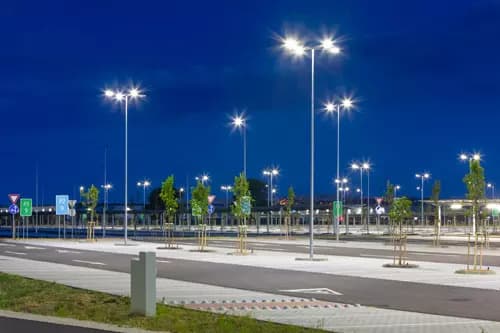
A composite sensor sounds like a step forward. In the field, at the heights where road lighting actually lives, it becomes a source of problems that take years to fully understand. By then, half the fixtures are failing, maintenance costs have doubled, and nobody remembers why the composite approach was chosen in the first place.
The answer for high mast is simple: use a photo control.
Why are fixed Lux photo controls more suitable for continuous illumination in mast lights above 8 meters?
خاتمة
Composite sensors sounded good when someone designed them for high mast lighting. They do not work.
The PIR motion sensor does not function reliably at 8 to 12 meters. The Lux sensor reads too much environmental noise. The algorithm cycles the light on and off trying to process all that conflicting data. The LED driver wears out faster. The system creates safety hazards instead of solving them.
الأسئلة الشائعة
PIR motion sensors do not work reliably at 8 to 12 meters. The infrared signal is too weak. Combined with wind, rain, and fog that scatter the signal, you get constant false triggers.
Because they do one thing: read light level. No motion detection that fails at height. No algorithm trying to balance competing inputs.
The light goes off during low-traffic periods because no motion is detected. A vehicle rounds a corner or enters the intersection and the light suddenly switches on at full brightness, potentially blinding the driver.
Frequent on/off switching damages the driver. Every cycle creates an inrush current surge that stresses the power supply.
The JL-207series is a simple phototrasistor control with a fixed Lux threshold. It reads actual ambient light at any height without complex algorithms or motion detection.
الروابط الخارجية
●https://en.wikipedia.org/wiki/Motion_detector
●https://en.wikipedia.org/wiki/Two-ray_ground-reflection_model
●https://en.wikipedia.org/wiki/High-mast_lighting
●https://en.wikipedia.org/wiki/Passive_infrared_sensor
 Arabic
  English
  Russian
  Spanish
  Portuguese
  Japanese
  Italian