

Why Can’t Photocells Use PC Bases?
導入
Polycarbonate (PC) is one of the most widely used engineering plastics in outdoor electronics. It is impact-resistant, optically transparent, and inexpensive to mould.
These properties make it attractive for photocell housing applications. However, they do not make it suitable for photocell bases.
The base of a photocell is the component under the most sustained thermal, UV, and mechanical stress in the assembly. PC’s material limitations in these conditions create reliability problems that disqualify it from this specific application.
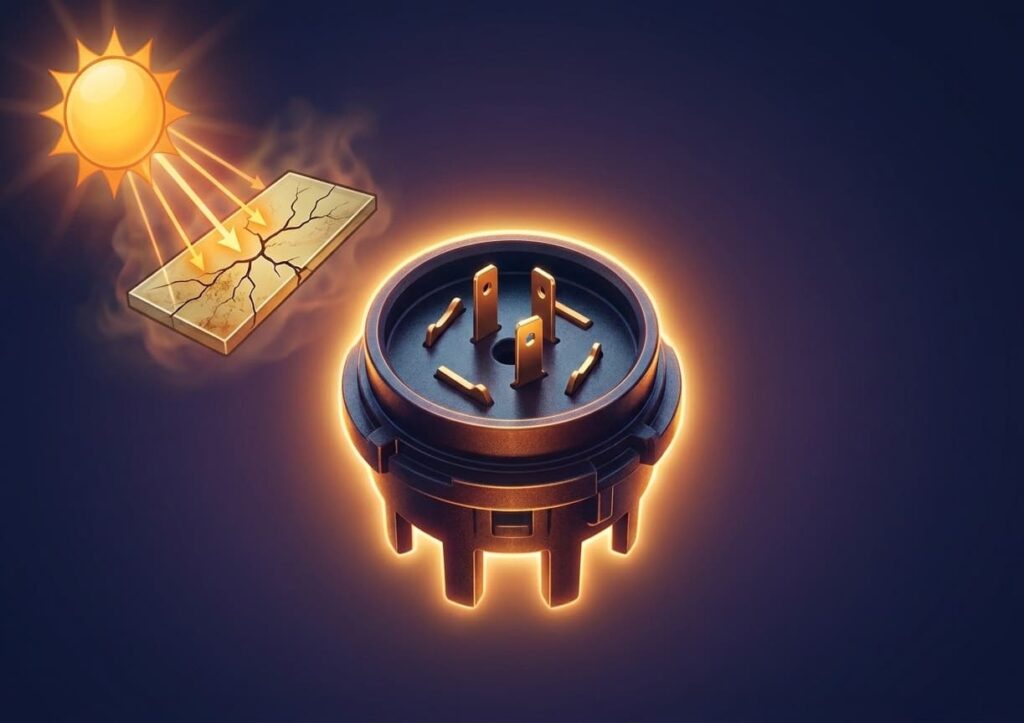
What Are the Material Properties and Problems of PC Bases?
ポリカーボネート (PC) bases face three fundamental material property limitations in outdoor photocell applications:
Material Property | 説明 |
Heat Softening Temperature | Approximately 110-125°C in lab conditions, but outdoor environments with 70-85°C approach or surpass stable limits |
環境適応性 | PC softens, deforms, and cracks under high temperature, damaging overall photocell structure and sealing integrity |
紫外線耐性 | PC has poor UV resistance; without UV stabiliser, rapid aging and yellowing occur, degrading photocell performance |
The heat softening temperature number is the most commonly misread specification in this context.
A lab heat deflection temperature of 110°C sounds adequate for an outdoor application where ambient temperatures rarely exceed 40 to 50°C. But the photocell base does not experience ambient temperature. It experiences the temperature of the luminaire surface it sits on, which accumulates solar radiation all day and heat from the LED driver below.
Sustained temperatures of 70 to 85°C at the base mounting surface are common in hot climates. At these temperatures, PC begins to lose dimensional stability before it reaches any temperature that would be described as “softening” in casual terms. The dimensional change is small but sufficient to reduce sealing ring compression.
What Challenges Do PC Bases Create in High-Temperature Outdoor Environments?

Three specific failure chains follow from PC’s material limitations in photocell base applications.
要素 | 影響の説明 |
Installation at Luminaire Top | Photocells are exposed to the highest temperatures and intense UV on luminaire surfaces, causing PC aging and cracking |
Decline in Sealing Performance | Thermal deformation leads to loosening of sealing rings; moisture ingress causes internal circuitry failure |
Functional Abnormalities | Unstable PC base and damaged parts cause photo sensing misjudgements, resulting in frequent switching and reliability loss |
The sealing performance decline is the most consequential failure chain. The base of a twist-lock photocell contains the sealing ring that creates a waterproof interface between the photocell and the receptacle. This ring must maintain consistent compression across the full thermal range the photocell experiences.
PC’s dimensional change with temperature is larger than Polybutylene Terephthalate‘s (PBT). As the base expands and contracts through this thermal range, the compression on the sealing ring changes. Over repeated cycles, the ring settles into a compressed state that reflects the average deformation rather than the designed-in compression. The result is a sealing gap that allows moisture ingress.
The functional abnormality chain follows from both the sealing failure and direct UV degradation. UV radiation attacks PC without UV stabiliser, causing progressive yellowing and embrittlement. Yellowing of the photosensitive window area reduces light transmittance, shifting the effective lux threshold. Embrittlement of the base causes micro-cracking that both compromises sealing and allows moisture to reach the PCB through paths too small to register as an IP test failure.
What Materials Does Long-Join Use Instead?
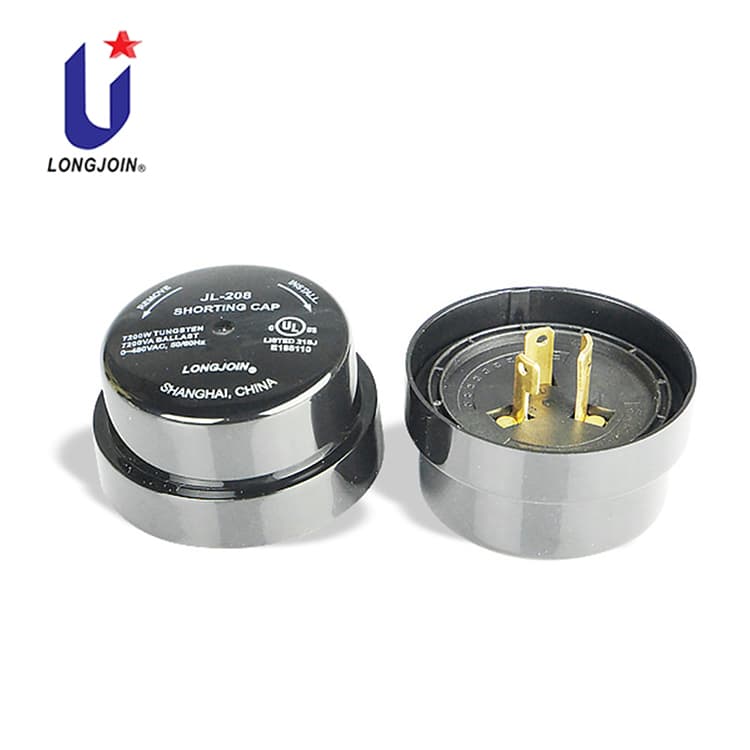
Long-Join’s photocell bases use glass-fibre reinforced PBT (GF+PBT) with enhanced UV stabiliser, addressing each of PC’s limitations directly.
Material Type | 特徴 | 利点 |
GF+PBT Glass Fibre Reinforced | High heat resistance, strong mechanical strength, stable durability | Effectively withstands luminaire environments of 70-90°C; resists physical and chemical corrosion |
Enhanced UV Stabiliser | Slows plastic aging, yellowing, and cracking caused by UV | Ensures stable housings long-term; maintains mechanical strength without affecting photosensitive element sensitivity |
PBT’s heat deflection temperature is higher than PC’s for equivalent thickness, and glass-fibre reinforcement raises it further.
The 30% glass-fibre loading that Long-Join uses in base material also significantly reduces the coefficient of thermal expansion, meaning the base changes dimensions less across the thermal range the photocell experiences. Less dimensional change means more consistent sealing ring compression. More consistent sealing ring compression means sustained waterproof performance across years of thermal cycling.
UV stabiliser additives in the PBT formulation slow the photodegradation process that causes yellowing and embrittlement. These additives absorb UV radiation and convert it to heat rather than allowing it to attack the polymer chains that determine the material’s mechanical properties.
The combination of GF+PBT with UV stabiliser is why Long-Join’s photocell bases maintain sealing integrity and dimensional stability across the operating life that outdoor applications demand, while PC bases in equivalent conditions begin to show dimensional change, sealing degradation, and surface embrittlement within the first two to three years of outdoor/
Frequently Asked Questions on PC Bases in Photocells
PC approaches its dimensional stability limit at 70 to 85°C in real outdoor installation conditions, causing small but sufficient deformation to reduce sealing ring compression and open paths for moisture ingress.
Sealing ring compression loss from thermal deformation leading to moisture ingress, UV-induced yellowing of the photosensitive window area shifting the switching threshold, and surface embrittlement causing micro-cracking that compromises both sealing and structural integrity.
Glass-fibre reinforced PBT (GF+PBT) with 30% glass-fibre loading and enhanced UV stabiliser additives. GF+PBT provides higher heat resistance, a lower thermal expansion coefficient, and better mechanical strength than PC, with the UV stabiliser preventing photodegradation across outdoor service life.
It absorbs UV radiation and converts it to heat rather than allowing it to attack the polymer chains that determine the material's mechanical properties, preventing the yellowing, embrittlement, and cracking that untreated outdoor plastics experience within two to three years of high-UV exposure.
UV yellowing of the base area near the photosensitive window reduces light transmittance and shifts the effective lux threshold. Sealing failure from thermal deformation allows moisture onto the PCB, causing corrosion that produces erratic relay behaviour. Both lead to false switching, cycling, or complete failure.
結論
PC bases fail in photocell applications because outdoor photocell installation conditions are sustained at high temperatures at the luminaire top, continuous UV radiation, thermal cycling, and moisture exposure, all of which push PC beyond its practical dimensional and UV stability limits.
The consequences are sealing degradation, moisture ingress, PCB corrosion, and switching threshold drift. Long-Join’s GF+PBT bases with enhanced UV stabiliser address all three of PC’s fundamental limitations, providing the dimensional consistency and sealing integrity that outdoor photocell service life demands.

 Japanese
  English
  Russian
  Spanish
  Portuguese
  Arabic
  Italian