
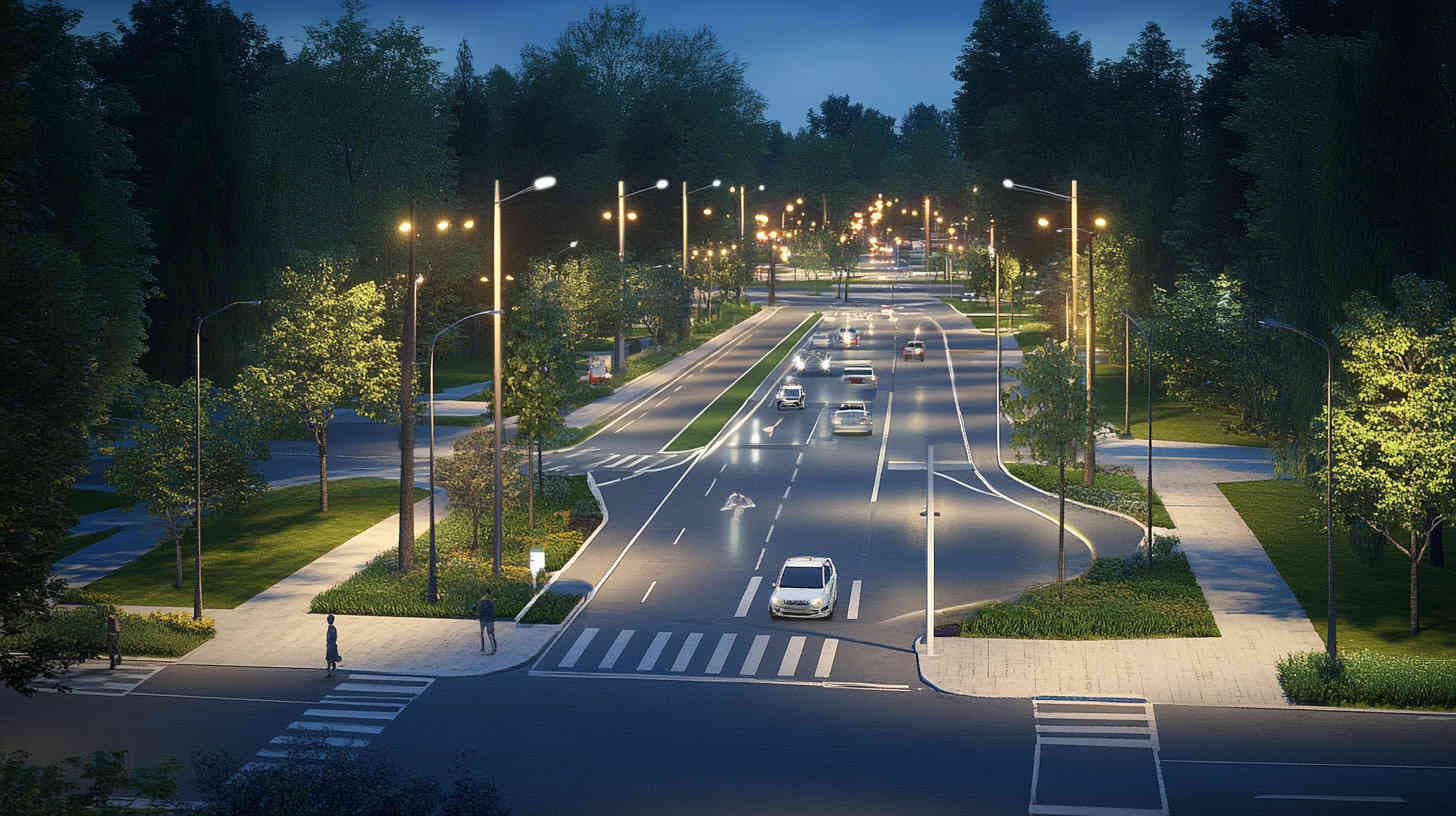
Is Photo Control More Suitable for Road Lighting than Motion Sensors?
導入
Photo controls run most road lighting worldwide.
This article compares photo controls and motion sensors for road lighting. It uses the JL-207C as a reference example, since Long-Join designed it for exactly this kind of work. The conclusion is straightforward: photo controls fit road lighting better. Motion sensors have a role, but not for the main grid.
Photo Control Types Suitable for Outdoor Road Lighting
Long-Join makes several versions.
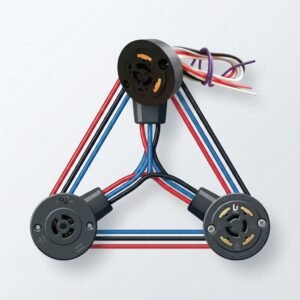
その NEMAソケット types come in different types. These include the 7-pin, 3-pin, and 5-pin versions. The JL-24x series covers most of those. These include the JL-207C and JL-205C models. For high mast lighting, the 7-pin JL-25X exists.
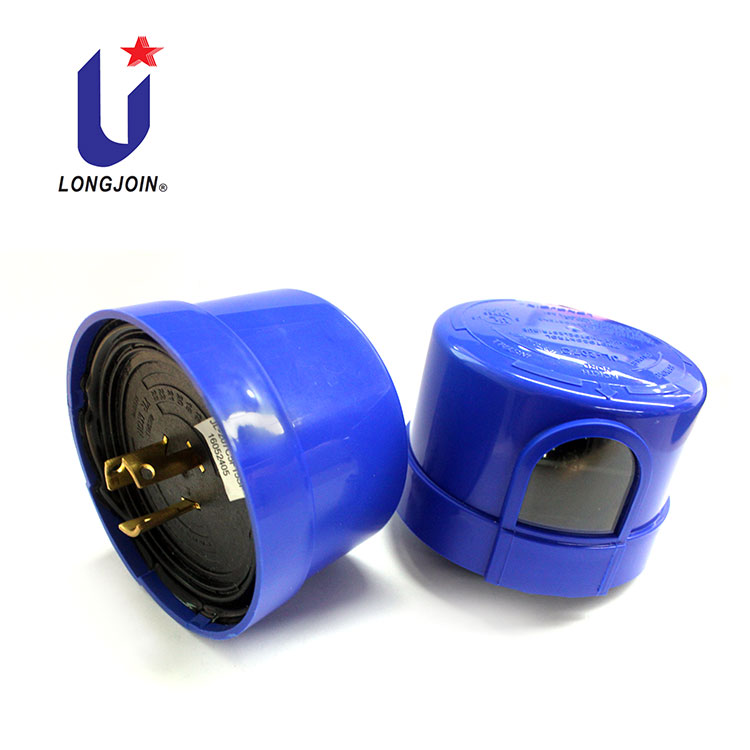
For projects that need timing, or a mix of light sensing and time, Long-Join offers composite controls. The JL-245CZ can handle different voltages and LED lamp types. There is also the JL723A1H, which combines PIR motion sensing with light sensing. That one matters if you need both.
The classic JL-207C series was built for harsh outdoor environments and for the high masts — 8, 10, 12 meters and higher — where road lighting lives.
Suitability Analysis of Photo Control vs Motion Sensor in Outdoor Road Lighting (Using JL-207C as Example)
Here is how they compare in actual practice.
Discussion Point | Photo Control | Motion Sensor | 説明 |
Is Continuous Lighting Required? | Yes. Laws and safety regulations require continuous lighting at night. | No. Lights turn on as needed, which can sometimes affect safety perceptions. | Road lighting prioritizes safety. |
Stability | High. Simple switch principle with strong interference resistance; LongJoin photo controls pass multiple safety certifications. | Lower. Prone to false triggers causing flickering and frequent switching. | Stability affects lifespan and energy savings directly. |
High Mast Suitability | Very suitable. Designed for continuous lighting at 8–12 meters or higher. | Insensitive. Motion sensing at 8–12 meters is often ineffective. | Frequent switches reduce driver lifetime. |
Harsh Weather Adaptability | Excellent. Waterproof, dustproof design effective against rain, snow, and temperature changes. | Easily affected by rain and snow, causing frequent false triggers. | Outdoors complex environment impacts success. |
LED Reflection Adaptability | Suitable. Specifically optimized for sensing LED reflective lighting. | Poor. Sensitive to reflection and obstruction. | LED reflection requires stable, sensitive light sensing elements. |
Compliance with Road Lighting Regulations | Complies with mandatory regulations in many countries and enables linear lighting solutions. | Regulations nationwide generally discourage switching entire street lights on demand. | Compliance enables long-term market access and policy support. |
Urban vs Rural Usage | Better for dense urban areas, neighborhoods, and commercial districts. | Better adapted for rural, low-traffic areas with dispersed vehicles and pedestrians. | Geography influences product suitability strategy. |
Suitability for High Humidity, Temperature, Salt Spray Environments | Excellent. Infrared and regular photo controls tested in humid, hot, and salty conditions. | Poor. Electronic components face corrosion and higher failure risk. | LongJoin technical test data confirms maturity. |
Ease of Large Scale City Maintenance | Good. Standardized modular design enables easy replacement and remote control. | Complex maintenance, frequent failures, significant manual intervention required. | Improves urban operation efficiency and reduces difficulty. |
Compatibility with Smart City Lighting | Easy integration with various smart control systems, including IoT and modular management. | Limited by independent sensor units; has limitations managing large-scale smart deployments. | LongJoin’s self-developed standardized devices support smart light management. |
The table speaks for itself.
Photo control wins on most counts. Motion sensor has a narrow niche: rural roads with low traffic, where you accept longer lag time and some safety trade-off to save a bit of power.
For everything else — cities, highways, commercial areas, anything with regulations — photo control is the answer.
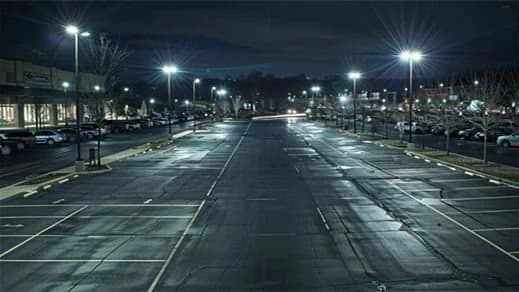
Photo Control as the Standard for Road Lighting
This is not tradition for tradition’s sake.
Photo control became standard because it works. Distributed, simple, stable, compliant with regulations. A city that runs on photo controls gets reliable night lighting with minimal callback maintenance.
Long-Join’s testing shows that photo controls perform well under the conditions that break other equipment. Salt spray, humidity, temperature swings, rain, dust. The JL-207C was tested in these environments and does not fail early.
よくある質問
The JL-207C is rated for high masts, 8 to 12 meters and beyond. It has surge protection and waterproof housing. It is designed for LED fixtures specifically. And it is simple — a light sensor, a relay, a switch. Not much to fail.
Laws in most countries require continuous night lighting. Motion sensors do not provide that. They also false-trigger in rain, snow, and wind. And they stress LED drivers by switching constantly. Photo control just reads daylight and switches once per day.
Long-Join's photo controls are tested in salt spray, high humidity, and wide temperature ranges. The housing is sealed, the circuit is potted, and the sensor is protected. Motion sensors have more complex electronics, which corrode faster in outdoor conditions.
They are standardized. NEMA sockets fit across different fixtures. A technician swaps a failed unit in five minutes. With motion sensors, each unit may need adjustment or replacement of a separate sensor. That adds up quickly across hundreds of fixtures.
Photo controls can communicate via wireless gateways. Long-Join's devices support modular smart control systems. Motion sensors are harder to integrate because each one operates independently, and managing them at scale becomes difficult. Photo control creates a standardized control layer.
結論
Photo control is the right choice for road lighting.
Motion sensors have a place in specific low-traffic rural areas. However, they are not the solution for cities or highways.
The JL-207C and other Long-Join photo controls are built for the actual demands of road lighting. Simple, proven, and effective.
外部リンク:
●https://en.wikipedia.org/wiki/Motion_detector
●https://www.openpr.com/news/3787631/enhancing-led-lighting-what-is-a-reflective-led-light
●https://en.wikipedia.org/wiki/Infrared
 Japanese
  English
  Russian
  Spanish
  Portuguese
  Arabic
  Italian