
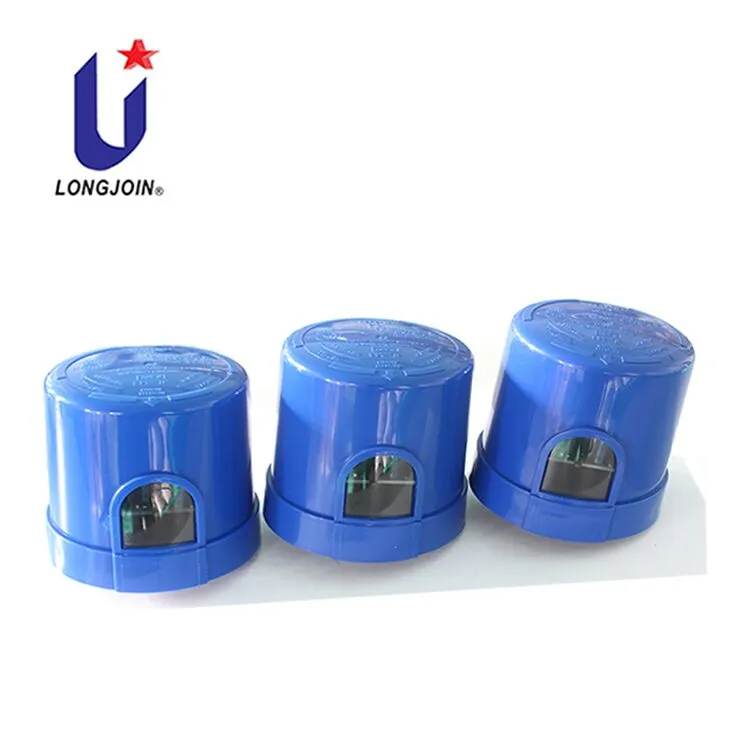
Are Long-Join Photocells Compatible With 0–10V Dimming?
導入
Yes. Several Long-Join photocontrol models work with 0–10V dimming systems.
Built for LED street lights, parking areas, roads, industrial sites — anywhere basic on/off control isn’t enough anymore.
Instead of blasting full brightness all night, a dimming photocell drops the light level during quiet hours. More control over energy use. Still lights up what needs lighting.
JL-241C, JL-242C, JL-243C — these combine automatic light sensing with dimming. Connect them through the right receptacle to a compatible LED driver, and the fixture switches on at night, adjusts brightness based on whatever program you set.

Which Models Actually Work With 0–10V?
Looking for a dimmable street light photocell? Start with JL-241C, JL-242C, JL-243C.
All three handle 0–10V dimming. Different control functions though, which makes picking one easier depending on what the project actually needs.
モデル | 関数 | 最適な用途 |
JL-241C | Basic 0–10V dimming | Simple dimmable lighting |
JL-242C | Dimming + midnight dimming | Late-night reduced output |
JL-243C | Multiple dimming + LED decay compensation | Advanced projects |
JL-240XB | Basic dimming socket | Simple 0–10V connection |
JL-240XA | 7-pin, extra low-voltage contacts | Smart lighting, flexible control |
JL-241C — automatic switching plus dimming, nothing fancier. JL-242C adds midnight dimming on top. JL-243C goes further with extra control and decay compensation for bigger, more complex projects.
How Does Midnight Dimming Actually Work?
Street lights at full brightness at 2 a.m. when nobody’s around? Most places don’t need that.
That’s the whole point of midnight dimming. Sensor drops output during quiet hours, brings it back up before morning.
Long-Join’s design pulls recent nighttime data — records lighting duration from the past eight nights — and uses that to figure out the dimming window.
Makes sense because sunset and sunrise shift constantly through the year. A fixed timer drifts out of accuracy as seasons change. Light-based sensing adjusts on its own.
Period | Brightness | 目的 |
After dusk | 100% | Evening activity, full visibility |
Late night | 50–70% | Quiet hours, reduced output |
Before dawn | 80–100% | Ramping up as activity picks back up |
Daytime | Off | No point wasting power |
Actual brightness levels depend on the project. Road type, location, safety requirements, whatever driver’s in there.

How Do Photocell, Socket, And Driver Actually Connect?
Does the photocell directly dim the LEDs itself? No. Not by itself.
Three parts working together — photocell, socket, driver.
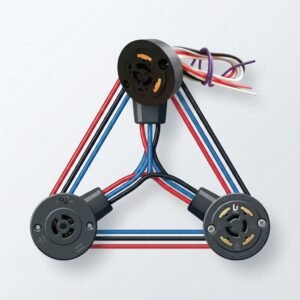
Photocell watches daylight, decides when to switch or dim. Receptacle carries the electrical and control signals into the fixture. Driver takes the 0–10V signal, adjusts power to the LEDs accordingly.
Simple sequence, really. Daylight drops low enough, photocell switches the fixture on. Programmed dimming period hits, control sends the low-voltage signal. Driver responds, lowers output.
Part | Job | Check This |
光電池 | Detects light, sends commands | Voltage and dimming compatibility |
JL-240XA/XB | Connects signals to fixture | Wiring, contact arrangement |
LED driver | Adjusts brightness | Must support 0–10V |
LED fixture | Produces light | Must match the driver |
JL-240XA gives extra low-voltage contacts for control connections. Not every fixture needs that, but some do.
JL-240XA vs JL-240XB — What's Actually Different?
Are both sockets interchangeable? Not really.
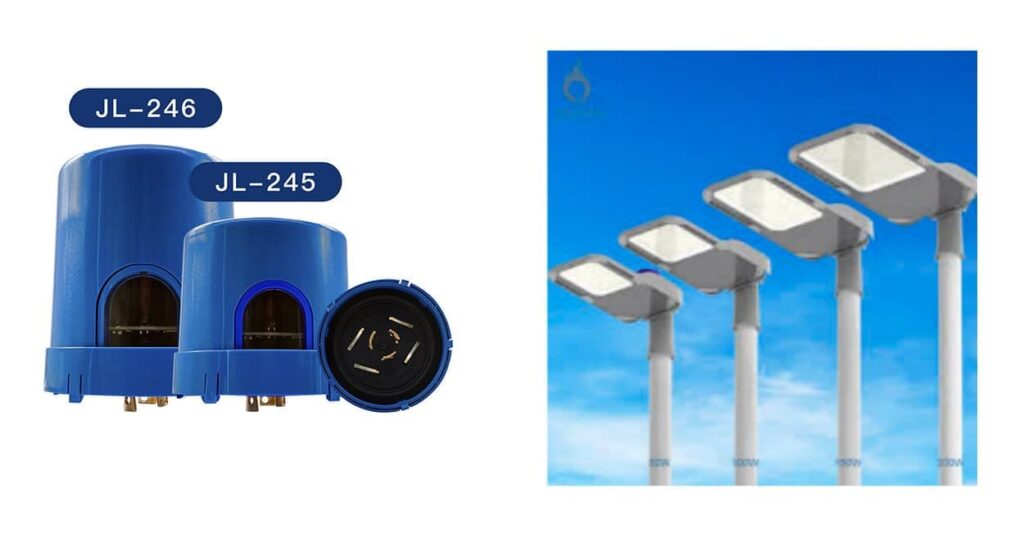
JL-240XA — 7-pin, four low-voltage contact pads. More connection options, works well for smart lighting and extra control functions.
JL-240XB — two low-voltage pads. Simpler, fits basic 0–10V connections just fine.
Basic street light, straightforward dimming needs? JL-240XB probably covers it. Need more control signals now or planning smart functions later? JL-240XA gives more room to grow.
Pick the socket alongside the photocell and driver, not separately. A great photocell means nothing if the rest of the fixture wasn’t built for the same signal type.
How Do You Check Driver Compatibility Before Installing?
Worried the photocell won’t play nice with the driver already in your fixture? Check the spec sheet first. Every time.
Driver needs to explicitly state 0–10V dimming support. Confirm the dimming wire polarity too — easy to mess up.
Most 0–10V drivers run separate low-voltage wires for the dimming signal. Don’t confuse those with the main AC power wires. Different job entirely.
And test one complete fixture before installing a batch. Does it turn on at dusk? Turn off with enough daylight? Dim correctly? Come back to normal after a power blip? Check all of it on one unit first.
Saves you from turning a small wiring mistake into a headache across three hundred street lights.
Why Bother With Dimming Instead Of Just On/Off?
If a basic photocell already switches lights off during the day, why complicate things with dimming?
Because nighttime needs change. A lot.
Busy road needs full brightness in the evening, less after midnight when traffic thins out. Factory parking lot needs high output while workers leave, way less once the site’s quiet.
Basic control gives you two options. On. Off. That’s it.
0–10V gives you a range. Multiple brightness levels instead of a binary switch.
Cuts unnecessary energy use without going completely dark. Also more flexible long-term — instead of swapping the whole fixture when requirements shift, adjust the photocell, driver, or program instead.
Long-Join’s dimming range covers several options depending on how much flexibility a project actually needs.
よくある質問
JL-241C does normal 0–10V dimming. JL-242C adds midnight dimming — automatic brightness drop during quiet hours.
Uses recent nighttime duration data to estimate night length, picks the dimming window based on that.
Both work with compatible 0–10V drivers. Contact arrangements differ though, so check wiring carefully.
No. Spec sheet has to explicitly state it. Don't assume.
Automatic dusk-to-dawn switching plus adjustable nighttime brightness, all in one control system.
結論
Yes — Long-Join 光電池 handle 0–10V dimming, as long as photocell, socket, and driver are matched correctly.
JL-241C for simple dimming needs. JL-242C and JL-243C for more advanced nighttime control.
Treat all three parts as one system, not separate purchases. Match the wiring, match the control signals, and the fixture gives reliable automatic lighting while cutting unnecessary nighttime output.
Get the matching wrong, and none of it works right.
外部リンク:
●https://www.upowertek.com/what-is-0-10v-dimming/
●https://www.etcconnect.com/workarea/DownloadAsset.aspx?id=10737502527
 Japanese
  English
  Russian
  Spanish
  Portuguese
  Arabic
  Italian