
Yellowed Lens or Dirty Lens? A 60-Second Test Before You Replace the Photocell
導入
The lens of a photocell is the “eyes” of the unit, which it uses to detect ambient light. When there is an issue, a blockage, or covering, the light unit will be switched on at the wrong time. However, not every situation requires a photocell replacement.
This article discusses yellowing and contamination of the photocell lens, 2 common reasons a photocell could misbehave in an outdoor lighting system. Read on to find out a one-minute test that helps decide if all that is needed is a wipe-down of the lens or a total replacement.
What Causes Lens Yellowing on a Photocell?
Yellowing of the lens is caused by oxidation and UV (Ultraviolet) sunlight exposure. It happens over time, taking years to develop, but once it does, the sensitivity of the photocell is compromised. The UV rays cause the lens/glass to fade and turn yellow over time, and oxidation speeds up this process.
The degree of sensitivity of the photocell’s sensing is reduced as the lens becomes yellow. A yellow tint generally absorbs some light, resulting in the sensor seeing a darker sky than the actual sky. This leads to early and late lighting.
This effect is why Long-Join lenses have UV-resistant material to delay the occurrence.
What Causes Lens Contamination?
Contamination, in this instance, refers to foreign material that can stick to or block the lens. This could be:
- Dust
- Rain residue
- Insect remains
They cling to the lens and block its ability to sense light rays and function properly. If the contaminant is stuck on the lens, the photocell will have metering errors, which will upset the switching times. Dirt is generally collected more quickly on roads that are close to busy roads, construction, or the coast.
The encouraging news is that the sensing performance could be restored quickly with regular cleaning.
How Do Yellowing and Contamination Factors Compare?
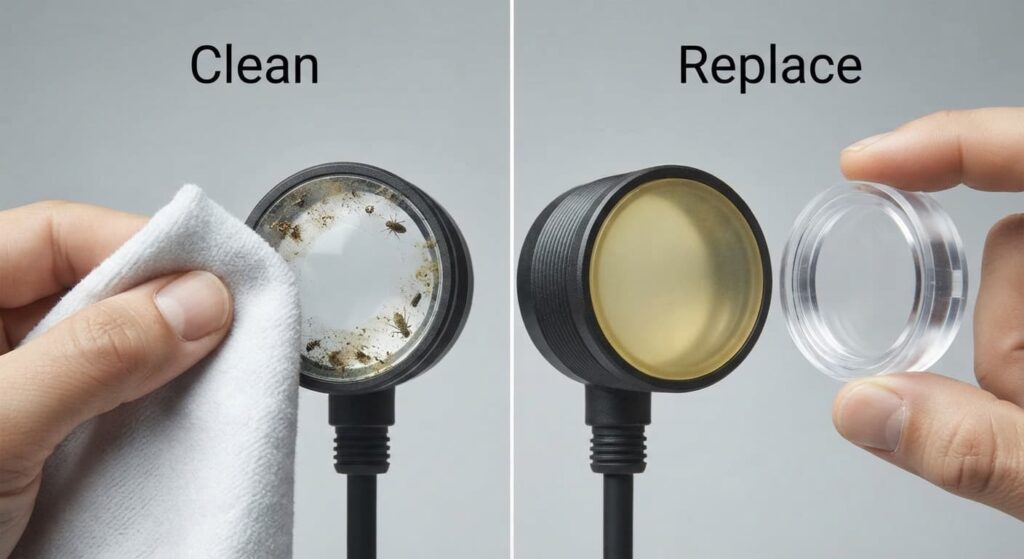
Three factors do most of the damage to a photocell lens, and each one has its own countermeasure.
要素 | Impact Characteristics | Countermeasures |
Long-term UV Exposure | Damage to material molecular structure, deepened color, reduced light transmittance | Use Long-Join UV-resistant materials to reduce replacement frequency |
Airborne Dust and Grime | Particles or organic matter covering lens surface, causing dirt blockage | Regularly clean with neutral detergent and soft cloth |
Other Environmental Corrosion | Salt spray, rain cause material surface fatigue and hazy damage | Use well-sealed, corrosion-resistant materials |
The most serious case is UV exposure, and this is because its effects are largely irreversible. It causes yellowing and decreases transmission. Using a UV-resistant material is therefore very important.
Likewise, environmental fatigue could eventually lead to serious damage, and the right product will help. Contaminants such as dirt are more controllable and will be removed with a neutral detergent and a soft cloth.
Should You Maintain or Replace a Yellowed or Contaminated Lens?
The answer is simple: Clean first, then decide based on how much of the light comes back. But the steps are even more important.
Maintenance or Replacement Judgment
This is the short version of 60 seconds:
- Clean the lens with a soft cloth and a neutral detergent
- Rinse and dry
- Repeat this process (cover and uncover the sensor)
- Observe if the lamp switches as expected.
If the surface contamination is apparent, gently clean the surface first and monitor the performance results. If dirt does come off and the lens becomes clear, you’ve saved the lens from replacement.
When it is not possible to get sufficient light transmittance after cleaning, or the coating is broken, replacement is required. Yellowing is a transformation that occurs inside the material and cannot be removed by wiping. A photometer or other special instrument can measure the transmittance, for which a more precise answer can be obtained.
Maintenance and Replacement Plans
プラン | Appropriate When | Operation Description |
Regular Cleaning & Maintenance | Slight surface dirt quickly recoverable | Use non-abrasive neutral cleaning tools to extend service life |
Partial or Full Photocell Replacement | Severe yellowing causes fundamental transmittance loss | Replace with Long-Join high-durability photocells to thoroughly restore performance |
Cleaning solutions will remove minor surface soil. Neutral Tools: neutral and non-abrasive tools help preserve the lens and its lifespan.
Replacement is only for severe yellowing (where transmittance has dropped for good). Then it’s a better unit, which is restored by a high-durability photocell and a UV-resistant lens.
What Maintenance Tips Help Individual Users?
Here are some best practices for photocell lens maintenance:
- Inspect and clean the lens at least once annually. In regions with more condensation, the cleaning interval should be shorter.
- Use a soft cloth and a gentle touch.
- Avoid contact of corrosive chemicals with the lens because it could compromise the glass.
- For light yellowing, professional UV care products or timely replacement are the usual advice. A protective product can help slow further damage, but it won’t undo yellowing that’s already in the plastic.
- Purchase photocells with high-durability lens material such as UV-resistance, corrosion-resistance, and strong anti-yellowing properties.
Frequently Asked Questions on Photocell Lens Yellowing and Contamination
Use a soft, damp cloth to clean the lens. Contaminants will be wiped away, while yellowing remains.
A soft cloth, clean water, and a small amount of neutral detergent. Use no abrasive pads or corrosive chemicals.
The UV-resistant material helps prevent yellowing and improves durability, but we should not quote a specific number for the model without data from the UV aging test.
Check and clean yearly, and replace if cleaning is not bringing the light transmittance back to the level of new material.
First, turn the power off and use the right equipment for pole-mounted units. Do not use hard objects or sharp chemicals to clean the lens.
結論
Not all lens issues require a new photocell. Dirt can be removed with a soft cloth and neutral detergent, but yellowing is damage that cannot be cleaned off the material. If transmittance cannot be restored, clean, then retest to see if the sensor functions properly again, and replace only then.
Choosing Long-Join photocells with UV-resistant lens materials cuts the chance of yellowing in the first place and keeps maintenance costs down.
外部リンク
●https://en.wikipedia.org/wiki/Ultraviolet
 Japanese
 English
 Russian
 Spanish
 Portuguese
 Arabic
 Italian