
What Are the Warning Signs Before a Photocell Reaches the End of Its Life?
導入
Photocells give signs before they stop working. It doesn’t just stop working overnight. These signs come in the form of minor glitches such as late switching, flickering lights, or lights on during the day.
When a photocell begins to fail, it begins to lose its energy-saving performance. Identifying these signs is the fastest way to prevent risky unexpected off-times and full damage, and one can make replacements in time.
In this article, we will go through the minor signs and how to check for them, as well as how Long-Join photocells are designed to slow down failure rates.
What Are the Typical Warning Signs Before a Photocell Wears Out?
Five signs usually show up before a photocell reaches the end of its life, and each one points to a different weak spot inside the unit.
Warning Sign | Possible Manifestation and Causes |
Frequent false triggers | Unstable response from the light sensor causing lights to switch on/off without reason |
Delayed or failed light response | Slow reaction or inability to control lights due to relay aging or poor contact |
Decreased light sensitivity | Photocell works only under stronger light, indicating sensor degradation |
Shell or interface abnormalities | Seal failure or loose connections leading to environmental corrosion or electrical faults |
Abnormal power consumption | Frequent faults causing extra stress on internal electronic components |

Frequent false triggers
This is very noticeable. It happens when the light begins to switch on and off unexpectedly. This is caused by an unstable sensor response. The sensor is wearing out if this continues during stable daylight or nighttime conditions.
A delayed or failed response
This often indicates that the relay is wearing out. When this happens, it may respond slowly or fail to connect properly. This leads to the lamp turning on late or not coming on at all. The clicking sound may also become weak and unstable.
Decreased sensitivity
This happens when a photocell only reacts under stronger light. It switches on later than expected at dusk. That’s a sign the sensing element is degrading, and it worsens gradually.
Shell and interface problems
This includes cracked casings, loose connections, or damaged seals that can allow moisture to enter. This eventually leads to corrosion. The presence of rust or green deposits on the terminals is a warning sign of possible electrical faults.
Abnormal power consumption
This is difficult to detect without proper monitoring. This is increased power consumption when faults happen repeatedly and the internal electronics experience extra strain. Smart lighting platforms pick up these changes early, sometimes before anyone notices anything wrong with the streetlight.
One sign alone is not enough to conclude that the unit is finished. Two or three signs together, or a sign that keeps getting worse over a few weeks, is the real signal.
How Does Long-Join Help Spot and Slow These Problems?
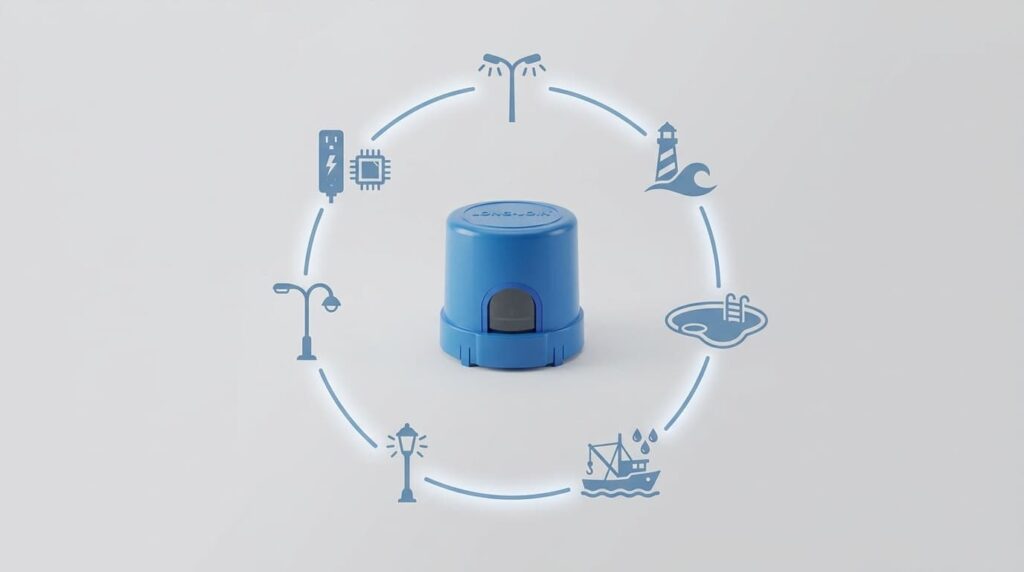
Four design features in ロングジョイント光電池 slow down wear and make it easier to tell when a unit needs replacing.
特徴 | Description and Benefits |
Highly sensitive, quality photodetector | Ensures stable light sensing and timely detection of false triggers |
Industrial-grade relay design | Extends switching life, easy to identify replacement when status deteriorates |
High-standard waterproof and dustproof housing | Effectively slows environmental corrosion and prevents seal-related faults |
Integration with smart monitoring systems | Suitable for intelligent platforms to monitor real-time operational status and predict anomalies |
The photodetector
The quality of the sensing element is the first thing. A good-quality sensor maintains stable performance for longer. This makes it easier to notice unusual responses or false activations when it eventually begins to fail.
Industrial-grade relays
They are designed to handle repeated switching over time. When it starts responding slowly or inconsistently, the change is easier to notice. This makes it possible to replace it before it fails.
The waterproof and dustproof housing
This prevents moisture from getting inside the photocell. This makes the photocell last longer by reducing corrosion and other faults. Since moisture is one of the common causes of premature photocell failure, proper protection makes a big difference.
Smart models
Smart models have the added ability to send operating updates directly to the maintenance team, making it easy to remotely monitor negative behaviours. The JL-245CN model delivers timely remote reporting to identify potential problems.
Frequently Asked Questions on Photocell End-of-Life Warning Signs
No. There could be other causes of false triggering, such as exposure to external lights or a dirty sensor window. If these lighting conditions are ruled out, then a photocell failure can be adequately identified.
Long-Join models have been designed to reduce the development of damage. This is done with the addition of industrial-grade sensors, relays, and sealed housings, protecting the photocell on all fronts.
The cover test, whereby you cover the sensor for a time and observe if it delivers the correct response of switching on, is the go-to for fast diagnosis. If it still shows the sign, replace it temporarily with a working unit to confirm it’s faulty.
Yes. Smart models like the JL-245CN remotely monitor and report status to a platform that detects abnormal switching before it becomes a failure.
The window should be cleaned every six months with a soft cloth for dust, and the photocell should be tested once a year.
結論
A photocell always gives signs before it finally fails. These warning signs come in the form of false triggers and slow response, and they point to potential damage to sensitivity, housings, or power draw. Noticing them early can prevent unexpected downtime. Long-Join’s photocell models are equipped with industrial-grade parts that slow wear and make the signs easier to read.

 Japanese
 English
 Russian
 Spanish
 Portuguese
 Arabic
 Italian