

NEMA Vs. Zhaga: Who Will Prevail In The Future?
導入
Walk past a streetlight and you’d never think about the bit stuck on top. Lighting people think about it a lot, because that socket decides what a city can plug in later. And right now it’s ネマ versus ジャガ.
Both can carry a photocell sensor or a smart controller. They just came from very different places.
NEMA is the old hand, the twist-lock socket most municipal crews could fit in the dark. Zhaga is newer and smaller, and it was drawn up with digital control in mind from day one. So which one has the better future? Zhaga is well set up for connected lighting. NEMA is dug deep into the street lighting that already exists. The honest answer is probably a bit of both.
What Actually Separates NEMA From Zhaga?
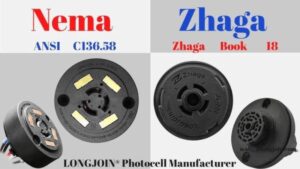
NEMA interfaces are everywhere in outdoor lighting control. The 3-pin version handles basic on/off switching. The ANSI C136.41 5-pin and 7-pin versions add low-voltage contacts for dimming and control signals. The socket is chunky, but that twist-lock design has been on poles for decades and it works. Long-Join carries 3-pin, 5-pin and 7-pin options in its NEMA Standard Connector range.
ザガ書 18 starts somewhere else entirely. Book 18 spells out a small interface between an outdoor luminaire and whatever sensing or comms module goes on top. The socket is meant for low-voltage control gear, so it suits newer LED heads where there’s barely room for it. Zhaga describes Book 18 as covering power, communication, mechanical fit and electrical contacts between the luminaire and the control node.
NEMA and Zhaga Once the Fixture Is Up
Both are sockets, sure. Spend a day with an install crew, though, and you’ll hear about wiring, fiddly swap-outs, which control options really work, and whether it can take a new module in five years.
NEMA wins on familiarity. Most lighting crews have a box of twist-lock photocells in the van and could change one half asleep. Long-Join’s JL-240XA 7-pin receptacle follows ANSI C136.41 and adds four low-voltage pads for signal connections, so that familiar socket can carry more than a simple on/off signal.
Zhaga goes the compact route. Book 18 pins down the fit, the contacts, the power and the comms between luminaire and node. Want a different sensor next year? Fit a new module. The fixture stays as it is.
ネマ | ジャガ | |
標準 | ANSI C136.10 / C136.41 | ザガ書 18 |
Socket size | 大きい | Much more compact |
力 | Mains at the receptacle, depending on design | Low-voltage interface |
Smart control | Good with 5-pin or 7-pin controllers | Built around sensing and comms modules |
Usual dimming | 0-10V and other controller setups | Often paired with DALI/D4i |
Best fit | Existing municipal and high-power lighting | New smart LED and compact designs |
Zhaga's Pull in Smart Projects
Ask a smart-city team what they want from a pole and switching on at dusk will be near the bottom of the list. Motion sensing on a quiet path. Energy figures. A dimming schedule for after midnight. Fault reports. Someone in an office able to change all of it without a ladder.
Sensing and communication modules on outdoor luminaires are the whole reason Book 18 exists. Put one on a slim LED head and you barely see it. Running at low voltage, it gets on fine with modern electronics too. And in a certified Zhaga-D4i system, compatible luminaires and nodes are meant to work together through one common interface.
Long-Join’s JL-700 Zhaga socket is built along these lines. Four contacts, support for DALI-based setups, a compact body for outdoor control work, all built around Zhaga Book 18.

Is NEMA on Its Way Out?
If Zhaga is growing, is NEMA finished? Very unlikely.
Think about a city with tens of thousands of poles, every one of them already fitted for NEMA controls. Ripping all that out just to follow a newer standard costs a fortune and doesn’t always buy much. The maintenance team has shelves of NEMA spares and years of habit too.
And NEMA isn’t stuck doing simple photocell switching anymore. A 7-pin receptacle brings extra contacts for dimming and smart control, so a street light controller can take on new jobs while the city keeps the NEMA format it already owns. Long-Join’s ANSI C136.41 receptacles, for instance, put low-voltage signal contacts right alongside the main power connection.
Where the Market Seems to Be Heading
Honestly, the kind of job matters more here than either standard. A brand-new smart-city build will usually go for the smaller modular socket. Older municipal systems tend to keep NEMA and upgrade whatever plugs into it.
傾向 | それが意味するもの |
More smart lighting | More call for sensors, dimming, monitoring and remote control |
NEMA holds on in existing networks | Cities upgrade controllers without swapping every receptacle |
Zhaga grows in new LED designs | Compact sockets suit modern connected luminaires |
More hybrid ranges | One lighting family can take different sockets |
Open interfaces matter more | Buyers want swappable controllers, not closed systems |
How Does Long-Join Handle Both?
Most buyers don’t lose sleep over which standard wins. They want to know if the supplier can make the socket that’s on their drawing.
Long-Join works across both families. On the NEMA side, that’s ANSI C136.10 and C136.41 receptacles. The Zhaga product range includes Book 18 sockets, bases, caps and controls. A buyer can pick by lamp design, voltage, control method and the market the fixture is going into.
Some products can be customised as well, for example wire length and connector arrangement. UL-related listings, ANSI receptacle testing and Zhaga Book 18 certification references are all published by Long-Join. Because it makes both, the same factory might ship photocells for a retrofit on Monday and Zhaga parts for a connected LED job by Friday.

Picking a Winner, If There Is One
For heavily connected new lighting, Zhaga has the wind behind it. Small size, low voltage and a design built around communication modules line up neatly with where smart lighting is going.
NEMA, though, is nowhere near obsolete. It’s rooted deep in municipal lighting, and the 7-pin format stretches far enough to cover a lot of advanced control work.
Best guess? Neither knocks the other out. Zhaga picks up ground in new smart LED projects, NEMA keeps its hold on traditional markets, retrofits and existing city infrastructure, and on any given job the winner is whichever socket suits that job.
よくある質問
NEMA, mostly where it already lives: municipal roads, highways, stadiums, existing outdoor lighting. Zhaga makes more sense on compact smart LED fixtures, in parks, on connected streets, anywhere there'll be a lot of sensors.
Zhaga has the edge in new systems built around plug-in sensors and digital communication. A 7-pin NEMA setup can still handle smart controls, though.
Yes. NEMA receptacles and Zhaga Book 18 products, so you match the socket to the fixture and the control system instead of the other way round.
Maybe one day. But NEMA and Zhaga both have whole industries built around them, so change would creep in over years, not overnight.
They let a manufacturer serve old and new lighting systems from one family and keep the upgrade options open.
結論
NEMA and Zhaga are heading for the same place from different directions: outdoor lighting that’s easier to manage and smarter to run. Zhaga will likely grow faster in compact connected systems. NEMA will stay important wherever proven infrastructure and retrofit compatibility count.
Don’t just grab the newest socket in the catalogue. Look at the lamp, the control plan, who’s maintaining it and what you might want to add later, and let that make the choice.
外部リンク:
●https://www.dali-alliance.org/zhaga-d4i/
●https://www.bjb.com/en/light-components/connectors-and-terminal-elements/receptacle-the-basis-for-outdoor-light-sensors/
●https://www.nema.org/membership/products/view/lighting-systems
●https://www.zhagastandard.org/


 Japanese
 English
 Russian
 Spanish
 Portuguese
 Arabic
 Italian