
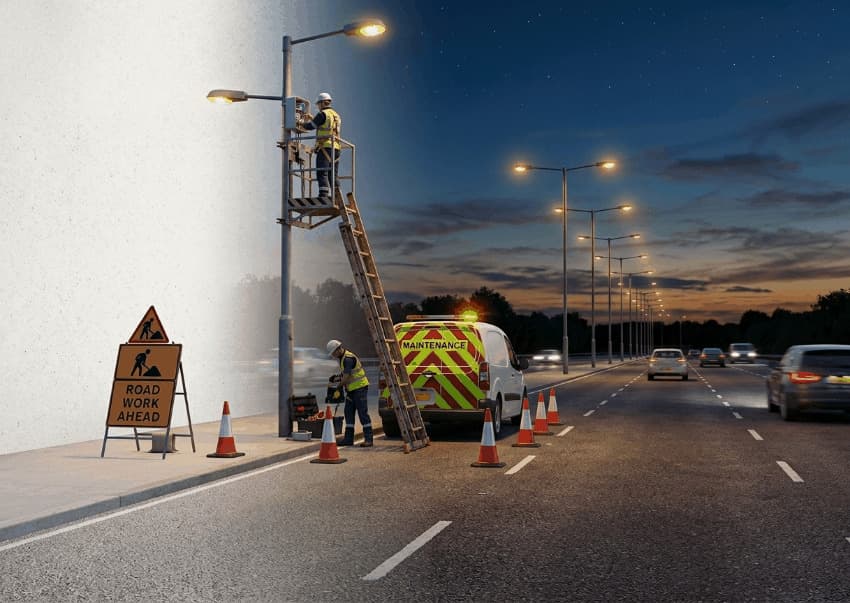
What Types of Photocell Failures Do Road Light Maintenance Workers Hate the Most?
導入
Sometimes, when setting up road lights and their photocells, it helps to know which ones are most problematic so you can avoid them. This is a very useful procurement trick.
The most important ones to watch for are photocell failures that are hard to find, expensive to fix, and somehow always seem to happen at the worst possible time.
This is not a small problem. A failing photocell can look identical to common faults such as a lamp, wiring, or driver fault. Tricky faults could lead to wasted maintenance visits, which translate to waste of time, energy, and money.
In this article, we will look into failure types that maintenance workers consistently find most frustrating, and why.
The Five Failure Types That Cause the Most Grief
Five categories of photocell failure account for the bulk of road light maintenance headaches, and each one creates problems that go well beyond just the fixture itself.
Failure Type | Main Symptoms | Maintenance Impact |
Frequent Misoperations | Road lights turn on early, late, or flicker | Increases equipment wear, wastes energy, affects traffic safety |
Failure to Trigger Switch | Lamps remain off or fail to turn off | Safety hazards at night, increases manual repair efforts |
Photo Sensor Aging | Reduced sensitivity or hypersensitivity | Incorrect light control response, uneven lighting distribution |
Relay Failures | Switch malfunctions or poor contact | Lamps stay powered, consuming energy unnecessarily |
Electromagnetic Interference | Misoperations caused by nearby electronics | Increases troubleshooting difficulty, disrupts normal operation |
The most common failure type is frequent misoperations. It is very obvious to the eyes and gets road users worried because it could cause an accident. The maintenance team gets the call, goes out, tests the lamp, tests the wiring, and eventually figures out it was the photocell all along. That sequence wastes hours per fixture and is entirely avoidable with a better product.
Relay failures are the most deceptive. A relay could get stuck in the closed position and keep the lights on all through, or in the open position and stay off. Troubleshooting becomes a hassle, as the maintenance team could replace perfectly good lamps or drivers before figuring it out. However, a simple cover test could diagnose this as a photocell problem.
Electromagnetic interference (EMI) is the trickiest failure mode to diagnose. Its presentation isn’t straightforward, and it can be affected by other factors such as location. Photocells without adequate EMI filtering are a huge maintenance issue because the fault cannot be reproduced and easily tested on-site.
What Makes These Failures Harder to Deal With Than They Should Be
Four maintenance challenges amplify the impact of photocell failures beyond just the fixture level.
Slow On-site Diagnosis
This is the biggest one. Photocell failure symptoms overlap significantly with lamp faults, driver faults, and cable faults. A crew that does not start with the photocell cover test as the first diagnostic step will often miss it entirely on the first visit.
Lack of a Standard Photocell Interface
Frequent and complex replacement compounds the problem on networks with non-standardised photocell interfaces. When different sections of the network use different photocell formats, spare parts logistics become complicated and replacement time goes up.
Insufficient Surge and Overvoltage Protection
If there is no protection for excess load, then failures are common, especially if the lighting system has been upgraded to LEDs. LED drivers produce EMI that traditional photocells can’t handle, and the more they are exposed to surge events, the more vulnerable they become.
Lack of Remote Monitoring
If the maintenance team aren’t able to monitor failures digitally, it means that every problem requires a site visit. This means it could take a longer time to discover problems, leading to an increased maintenance backlog
What Long-Join Builds In to Reduce These Problems
アドバンテージ | 説明 |
High-Quality Photosensitive Element | Stable light sensing response reduces false operations |
Industrial-Grade Relay Design | Supports low-load LED operation, prolonging product lifespan |
High Environmental Protection Level | Resistant to electromagnetic interference and variable environments |
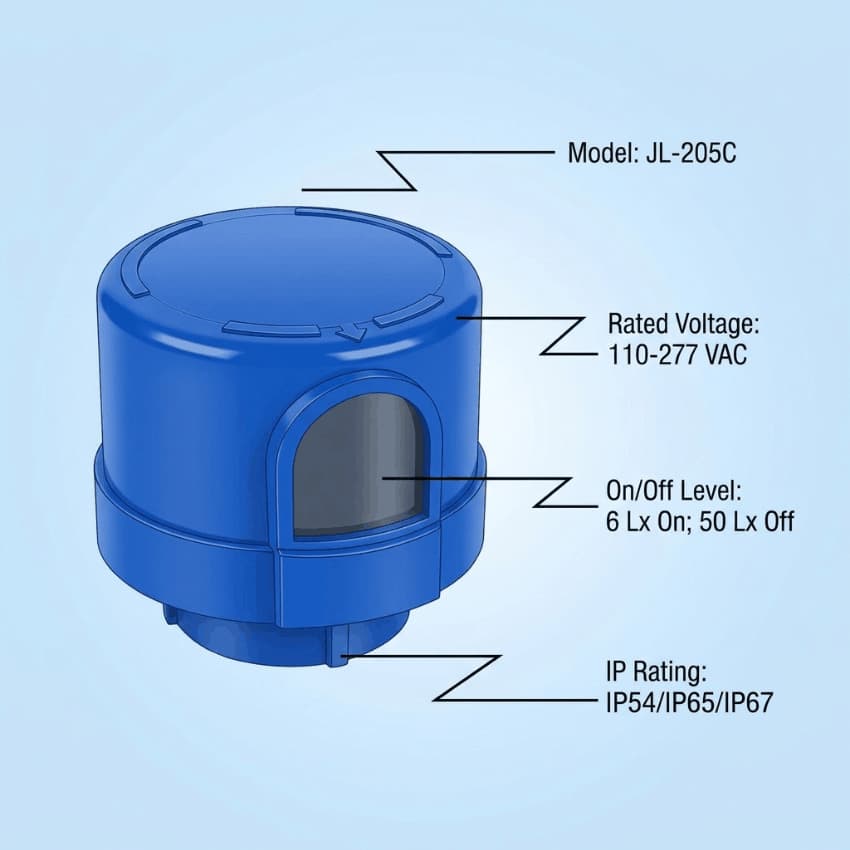
Standardised Interfaces | Facilitates quick maintenance and replacement, lowering technical barriers |
The standardised ネマ interface on Long-Join’s twist-lock range is specifically worth noting for maintenance efficiency. When every photocell on the network fits every receptacle, the crew carries one replacement model and can clear a fault in under a minute at the fixture. That is the difference between a 20-minute maintenance visit and a two-hour one.
Frequently Asked Questions on Road Light Photocell Failures
A relay sticking issue mimics typical failures. When the relay is stuck open, it resembles a lamp or driver fault, and when it’s stuck in a closed position, it mimics a timer issue. A cover test is a great way to isolate a photocell failure.
A comparison between fixtures of similar installation dates can help clear this up. A standout photocell switching failure indicates sensitivity decline in the sensing element.
Some common LED demands include resistance to leakage current and EMI, correct sizing for relay contacts, and the appropriate sensing elements for an LED-illuminated environment compared to an HPS amber-spectrum environment.
Long-Join models have essential features such as photodiode sensing, silver alloy relay contacts, SPD surge protection, EMI filtering, and Glass fiber housing.
Significantly. Smart network monitoring can detect switching anomalies and generate fault alerts before a crew is dispatched, turning reactive maintenance into planned maintenance. But it requires the photocell to be part of a smart node, which is why Long-Join recommends considering smart-ready receptacle infrastructure even in projects where full smart control is not yet deployed.
結論
Road light maintenance workers tackle several light failures, and some of the trickiest ones are those caused by photocell failures. This could lead to several misoperations, relay failures, sensor aging, EMI susceptibility, and non-standardised interfaces, each adding time, cost, and energy waste.
Long-Join’s photocell design addresses all the common failures through modifications that directly tackle the common issues.
外部リンク
1.https://en.wikipedia.org/wiki/Electromagnetic_interference
2.https://en.wikipedia.org/wiki/NEMA_connector


 Japanese
 English
 Russian
 Spanish
 Portuguese
 Arabic
 Italian