
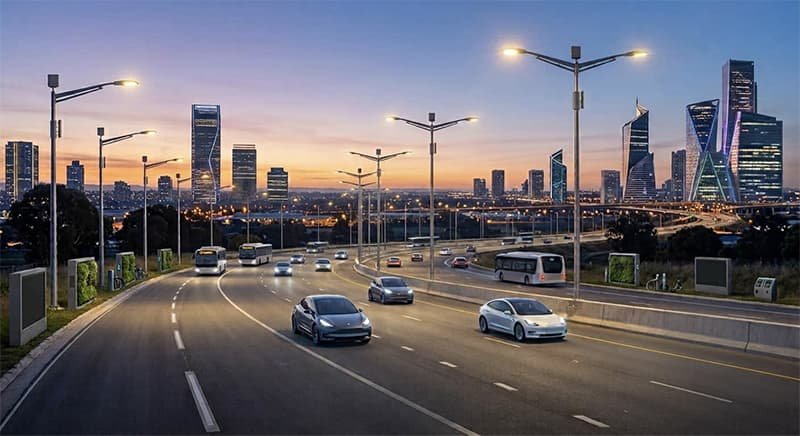
Why Do Many Smart Streetlight Projects Ultimately Add Photocells?
導入
Smart streetlight systems are the new popular route in outdoor lighting systems, especially in municipal lighting, and they come with so many features and upgrades.
Remote dimming, real-time fault alerts, energy consumption dashboards, and scheduled group control across thousands of fixtures from a single interface are all now possible with this modern lighting.
However, most procurement specification still includes a traditional photocell on every luminaire, and to someone looking at this from the outside, it seems redundant and an unnecessary cost.
The answer is not sentimental attachment to old technology. It is hard experience with what happens when the smart system component fails, and there is nothing underneath it.
What Does a Photocell Actually Provide for a Smart System Cannot?
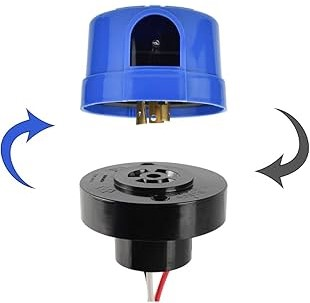
The photocell’s value in a smart streetlight network is not primary control, it is guaranteed local fallback that operates independently of every layer of infrastructure the smart system depends on.
A smart streetlight controller needs several things to function:
- A working SIM card
- An active network subscription
- A functioning gateway
- A reachable server
- A reliable signal.
Any one of these can fail. SIM cards could expire during budget disputes, gateways could briefly go offline during firmware updates, NB-IoT and LoRa signals have dead zones that only become apparent after installation, and server maintenance windows create control gaps. In a city running thousands of streetlights, these failures are common weekly.
When the smart system cannot reach a fixture, a photocell being available helps to keep things in order. It reads ambient light and acts on it.
Seven Reasons Smart Projects Keep Photocells
Seven distinct failure modes and operational realities drive the decision to retain photocells in smart streetlight projects.
Local Reliable Control Logic
The local autonomy provided by the photocells helps to achieve lamp switching when smart system communication is interrupted. This is why the photocells run continuously in parallel, ready to take over the moment the digital control layer has a problem.
Frequent Communication Failures
As mentioned earlier, failure could occur at any level of a smart system operation, be it the SIM card, the gateway, or blind spots after installation. These are routine operational realities in deployed smart lighting networks that a photocell eliminates the consequence of each one.
GPS Timing Inaccuracy
Some smart systems use GPS timing to plan the schedule of lamp switching. Heavy rain, dense overcast, and fog all interfere with GPS signal reliability, all of which could make ambient light most likely to drop below the dusk threshold early. A photocell responds to actual light conditions rather than a scheduled time, this makes the lights available when needed and not just at scheduled time.
Best Fault Safety Solution
Municipalities increasingly require locally prioritised photocell mechanisms in their tender specifications. The public safety implication of a dark road segment is significant enough that relying on a cloud-dependent control system without a local fallback is considered unacceptable in most serious infrastructure procurement.
Backup Control Strategy Integrity
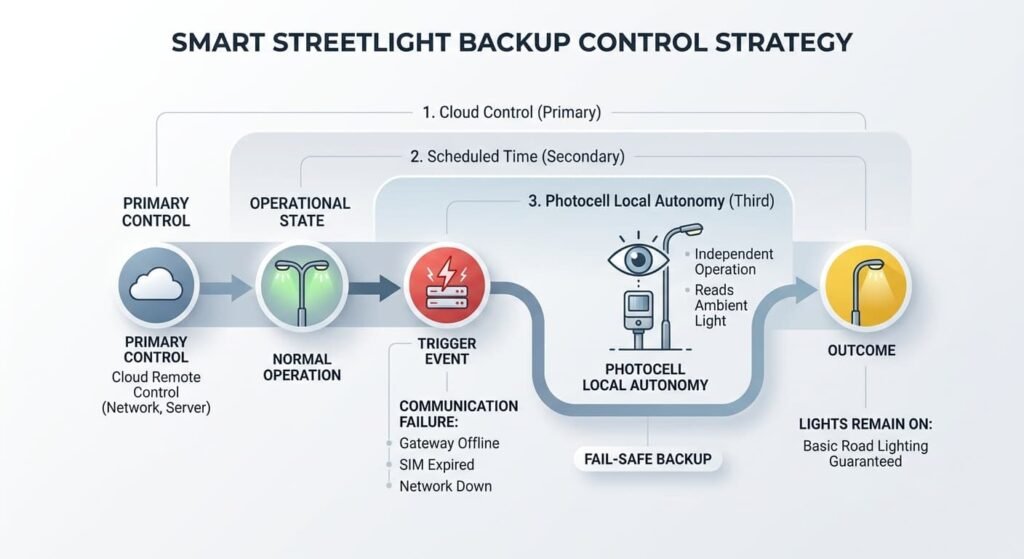
The three-layer control model that robust smart lighting projects use looks like this:
- Cloud remote control as the primary layer
- Scheduled timed control as the secondary layer
- Photocell local autonomy as the third layer.
Each layer operates independently and covers the failure modes of the layers above it. A project missing the third layer has two points of failure rather than three independent control paths.
Smart System Operation Cost
Platform maintenance, software licensing, network traffic costs, SIM subscriptions, and technical support all add ongoing operational expenditure to a smart lighting deployment. These costs accumulate across years. A photocell running in parallel reduces the consequences of cost-saving decisions that might temporarily reduce smart system coverage.
Basic Road Lighting Demands
Road lighting prioritises safety, stability, and predictability above intelligence. Municipalities need to know that roads will be lit at night, every night, regardless of what is happening with the management platform. Traditional photocells deliver exactly this guarantee. Smart systems add value on top of it, but they do not replace it.
Procurement Recommendations
Traditional photocells should be a necessity in Smart streetlight projects, especially when manufacturers are trying to ensure the highest level of efficiency.
Prioritise Long-Join photocell products with accurate light sensing and low false trigger rates to minimise the control layer conflicts that occur when the photocell and smart controller disagree about ambient conditions.
Frequently Asked Questions on Smart Streetlight Photocell Integration
A smart system depends on several online variables which still have the ability to fail. A photocell operates independently of all these, ensuring lights switch correctly regardless of what the digital control layer is doing.
They read ambient light directly and switch the relay without any network involvement. Communication loss has no effect on photocell operation.
GPS timing fails during weather conditions that darken the sky, as it doesn’t enable the light to come on at such odd hours, even though needed. Photocells respond to actual conditions rather than scheduled times.
The three-layer control strategy (Cloud remote control, timed scheduling, and photocell local autonomy) operates in such a way that each layer covers the failure modes of the layer above. Three independent control paths mean three separate things have to fail simultaneously before a fixture is left uncontrolled. That is highly unlikely.
Low false trigger rate, stable switching threshold, IP65 or higher protection, UL773 or UL1598 certification, and reliable relay cycle life. A photocell that false-triggers conflicts with the smart controller and generates unnecessary alerts on the management platform.
結論
Smart streetlight systems are impressive. They are also dependent on infrastructure that fails. The photocell’s role in these projects is to sit underneath both layers and ensure that when they fail, the road is still lit.
That function has no smart system equivalent, which is why experienced project teams keep specifying photocells regardless of how advanced the control platform above them becomes.
結論
●https://en.wikipedia.org/wiki/Narrowband_IoT



 Japanese
 English
 Russian
 Spanish
 Portuguese
 Arabic
 Italian